Tag: New York City Restaurants

  • Are Tasting Menus Worth It? What I’ve Learned Paying for My Own

    Are Tasting Menus Worth It? What I’ve Learned Paying for My Own

    “Are Tasting Menus Worth It?” banner with Richard Jarocki’s logo, four city skylines, plated dishes and a truffle box.

    I love tasting menus. That does not mean I think you should always order one.

    I have planned trips around restaurant reservations, tried things I never expected to eat, and spent amounts on dinner that would make plenty of people question my judgment. Fair enough. Sometimes I question it myself.

    Are tasting menus worth it? For me, yes—with conditions. The food has to be memorable, the hospitality has to make you comfortable, and the evening has to justify the money and time. That includes your money, your time, and the other things you could have done on that trip.

    An expensive dinner does not get a good review from me simply because I paid for it.

    How São Paulo Brought Me Back to Tasting Menus

    This interest started years before the trips I write about now. I used to frequent Harvest in Closter, New Jersey, and those tasting menus helped open my palate. I enjoyed letting the kitchen introduce me to things I might not have ordered myself.

    Then life happened. That part of my life slowed down.

    On my first trip to São Paulo, the omakase at Kazuo and the tasting menu at Evvai brought the urge back. I wanted to try more, learn more, and find out what another kitchen could show me.

    Since then, it has become part of how I live. I research restaurants, plan trips around meals, and come home thinking about the next experience.

    It is also part of what gets me to work every day. The next dollar, euro, real, or whatever currency I need for the next tasting menu or omakase has a purpose. I am working toward something I am excited to experience.

    Tasting Menu vs. À La Carte: What Am I Paying For?

    If I measured every meal by the amount of food on the table, I would make very different reservations.

    A tasting menu gives a kitchen the chance to introduce its cooking through a sequence of dishes. At its best, that means trying combinations I would never think to order, seeing ingredients used in unfamiliar ways, and enjoying a dinner that develops as it goes along.

    That is the appeal for me. I can order something familiar almost anywhere. When I commit to a tasting menu, I want the restaurant to give me a reason to hand over those decisions.

    But I still want dinner to taste good.

    An explanation can make a dish more interesting. It cannot make me enjoy a bite I do not want to eat again. Beautiful plates and elaborate presentations are welcome, but the food has to carry its part of the evening.

    Tasting Menus Changed What I Eat

    This is probably the strongest argument I can make for them: tasting menus have changed what I enjoy eating.

    Because of these meals, I have eaten guinea pig, pig’s face, pig’s brains, snails, and sea snails. I have eaten pigeon multiple times. I started eating eel and discovered that I actually enjoy it. At Metzi and D.O.M., I ate insects, too.

    I found my love of uni. Truffles and caviar have become very close friends of mine. Expensive friends, admittedly.

    And then there are beans. I do not like beans. Yet Evvai’s take on feijoada was amazing.

    That is what makes handing over some control worthwhile. Left to my own decisions, I might have read an ingredient, decided it was not for me, and ordered something familiar. A tasting menu puts a different preparation in front of me and gives me a reason to reconsider.

    I am not going to pretend I loved every unfamiliar thing I have ever eaten. But I would have missed foods I now enjoy if I had only ordered what I already knew I liked.

    Sometimes the value of a dinner follows you into the next restaurant. You see eel or uni on another menu, and this time you are excited to order it.

    It also works with food I already know. Disfrutar served me familiar flavors in forms I barely recognized—unexpected shapes, textures, and presentations that made me look twice before taking a bite. Evvai and Mont Bar have done that, too.

    I enjoy the moment when what I am looking at and what I am tasting do not quite match my expectations. When it works, I get to rediscover something familiar. The unusual form gets my attention; the flavor is what makes me want another bite.

    Sometimes Dinner Teaches You About the Place

    Tasting menus have also helped me understand where I am traveling.

    D.O.M. and Tuju taught me about Brazil’s ecosystems through their food. Those meals gave me more to think about than whether I liked an individual course. They made me curious about the places and environments behind the ingredients.

    At Tuju, I had the Chuva, or Rain, menu, and at D.O.M. I had Quando a Onça Bebe Água—“When the Jaguar Drinks Water.” Both used the meal to tell me something about Brazil beyond what was on the plate. That is what I remember most. I wasn’t just eating dinner; I was learning something about the place I was visiting.

    At Dos Pebrots in Barcelona, dinner became an introduction to Catalan gastronomic history. I was learning about the food of a place while actually tasting it.

    Maido did that for me in Peru. So did Astrid y Gastón, although that meal was à la carte. It was my first day in Peru, and yes, I overordered. Apparently, arriving in a new country makes me want to start tasting as much of it as possible immediately.

    That is an important distinction: a tasting menu is one way to learn about a place through food. My à la carte meal at Astrid y Gastón gave me that kind of introduction, too. What matters is the cooking, the people explaining it, and my willingness to try something unfamiliar.

    And the experience does not have to stop at food. At Carnaval, a cocktail tasting menu also introduced me to Peru through what was in the glass. They made me custom cocktails with Don Julio 1942, too, and seemed just as happy to crack open that bottle as I was to see what they would make with it.

    The custom drinks were another part of the evening—the kind of personal interaction that makes a bar stay with me long after the last sip.

    That matters to me because food is a big part of why I travel. I want to come home with more than photographs of attractive plates. I want to understand something I did not understand before I sat down.

    An explanation still has to connect to food I enjoy eating. But when a restaurant gets both right, I leave with a memory of the meal and a better understanding of the destination. That adds something to the value of the evening that counting courses never will.

    Mont Bar: When the Whole Evening Comes Together

    Mont Bar in Barcelona is one of my clearest examples of a tasting menu earning its place in a trip.

    I loved the smoked tuna belly with pine nut emulsion and the warm mochi with sobrasada and Mahón cheese. The mushroom course with mushroom ice cream and white miso gave me something unfamiliar that I actually wanted to eat.

    The wine pairing added discoveries, and the room felt lively and welcoming. After dinner, the team made me a complimentary custom cocktail to enjoy outside.

    I paid for my meal; that final drink was a gesture from the restaurant. It stayed with me because it felt personal.

    Mont Bar remains one of my five best meals. The reason is the combination: food, wine, people, and how comfortable I felt spending the evening there.

    Oiji Mi: The Dessert I Thought I Was Getting

    At Oiji Mi in New York, the first course was amazing. The Oiji Bowl gave me some of the best uni I have eaten, and the beef tartare and scallop were other favorites.

    But one of the most memorable moments came at dessert.

    My dining partner told me I would have to finish hers. That sounded like an arrangement I could work with.

    Then I looked up to get another piece, and her plate was empty. She had finished it herself.

    Apparently, I was no longer needed.

    We had arrived after a long day without much appetite, yet the food kept giving us reasons to carry on. I can describe ingredients and presentation, but someone going from “you’ll have to finish mine” to leaving nothing for me says quite a lot about that dessert.

    Those are the details that make a meal stay with me. The first bite, a standout dish, and the moment across the table that still makes me laugh afterward.

    You Do Not Need the Most Expensive Version

    At Viaggio’s chef’s counter, the pasta and the interaction with Chef Rabbit gave the experience its value. The ravioli, oxtail tortellini, and spaghetti were central to what I enjoyed.

    That is a useful reminder when planning a food-focused trip: a memorable meal does not have to be the most famous reservation available.

    Look at what interests you. It might be pasta, a particular chef’s approach, a regional cuisine, or the chance to sit at a counter and watch the kitchen work.

    Start there. The price should be something you evaluate after finding a reason to go.

    Check Whether You Actually Have a Choice

    Before you decide between a tasting menu and à la carte, check whether the restaurant offers both. Some restaurants only serve a tasting menu. You cannot assume you can sit down, skip the full experience, and order the two dishes you saw online.

    Research that before you book. Read the restaurant’s current menu and reservation terms, check whether different dining rooms or counters offer different formats, and ask if anything is unclear. Confirm dietary restrictions and substitutions ahead of time, too.

    If it is tasting-menu-only, the decision is whether you want that experience at all. There is nothing wrong with choosing another restaurant if you do not.

    That is especially important when booking for other people. Everyone should know what kind of meal they are agreeing to, how long it is likely to take, and what it is likely to cost.

    Before you reserve: confirm the menu format for your exact seating, the expected duration, any dietary accommodations, and the cancellation or no-show policy. If a deposit is required, check whether it comes off the final bill. Photographs and dishes below are from my visits; they are not a promise of what a restaurant serves today.

    I Overorder. The Rest of the Table Knows It.

    Even when à la carte is available, I am not exactly the person who orders two sensible dishes and hands back the menu.

    There can be just two of us, and I still want to try far more food than we need. I see another dish that sounds interesting, then another, and suddenly a normal dinner has become a much bigger project.

    I enjoy that. I want to taste things, compare them, and find out whether the dish I almost skipped ends up being the best thing on the table.

    But I have also seen the faces.

    Friends, family, friends of friends. I start ordering, and there is a look that says, “Wait. Are we splitting this equally?” Followed pretty closely by, “What the hell is an oyster with pearls?”

    That is my interpretation of the look, but the concern is fair. I may be thinking about what I want to try. Someone else may be calculating their share of a dinner that just got a lot more expensive without anyone asking them.

    My enthusiasm is not an agreement from everyone else to fund it.

    Before ordering half the menu, the table needs to agree on what we are sharing, roughly what we want to spend, and how we are splitting the bill. If I want something extra that nobody else wants, I need to make clear that it is my extra—not quietly add it to everybody’s equal share.

    A tasting menu can make the base food cost clearer because everyone knows the price ahead of time. Pairings, drinks, and supplements still need a conversation. One person’s enthusiasm for an upgrade does not make it a group decision.

    Does Everyone Need the Biggest Dinner Possible?

    No. Not even when I am tempted to order it.

    If à la carte is available and the dishes you are most excited about can be ordered that way, choose those dishes. Share something else if everyone wants to. Leave room for dessert—or another stop later.

    A long tasting menu works much better when everyone actually wants to be there. If one person wants an evening built around dinner and another wants to eat and explore the city, settle that before booking.

    I would rather have a table full of people enjoying the meal than a table full of people wondering how expensive my next sentence is going to be.

    Is the Wine Pairing Worth It? I Usually Skip It.

    I love a tasting menu, but I usually skip the wine pairing and order a few drinks instead. I like being able to drink at my own pace.

    Sometimes I want to stay with a cocktail I am enjoying. Sometimes I want a glass of wine without another selection arriving with the next course. I do not always want my drinking to follow the kitchen’s schedule.

    There is also how I feel afterward. In the United States and South America, wine pairings have usually left me with a hangover and sometimes what feels like acid reflux. With the pairings I have had in Europe, that has not been my experience.

    That is an observation about my own meals, not proof that European wine prevents either problem. I cannot tell you whether the difference was the wines, quantities, pacing, food, or something else.

    Mont Bar helped change how open I was to pairings. That experience encouraged me to order them at Disfrutar and Dos Pebrots, too. It also introduced me to Spanish wines I would now order independently from a wine list.

    That is value I can take into another meal. I am learning what I enjoy, instead of needing someone to choose for me every time.

    On my European trips, particularly in Spain, I have also noticed a different rhythm around drinking: wine with the meal, and cocktails often before or afterward. It felt different from the way I tend to drink when dining in the United States. That is how those particular evenings unfolded for me, rather than a rule for everyone in Europe.

    I still usually prefer choosing a few drinks and enjoying them at my own pace. But after Mont Bar, I am more willing to consider what a thoughtful pairing might add.

    You can commit to the food experience without committing to every drink offered alongside it.

    Supplements: If They Make Sense, Go for It

    If a supplement sounds interesting and the extra cost seems reasonable for what it adds, I am usually inclined to go for it.

    I am already there because I want to experience the cooking. If there is a dish I am particularly curious about, I do not want to skip it automatically just because it costs extra.

    The question is what the upgrade actually gives me.

    Is it a different dish or an ingredient that makes the preparation more appealing? Or is it mostly an excuse to sell me caviar or shave truffles over something?

    I love both. We have established that. But even close friends do not need to show up at every course.

    Give me a reason to want the supplement beyond the name of an expensive ingredient, and a price that makes sense to me, and I will happily consider it.

    Judge the Full Bill Before You Book

    The advertised menu price is where I start. I also check drinks, supplements, any booking charges, and how tax and service are handled at that restaurant.

    Then I ask a more useful question: would I still choose this dinner at the total I am realistically going to spend?

    That number matters much more than the lowest price shown on the menu.

    For a useful comparison, put the complete tasting-menu evening next to the à la carte meal you would realistically order. Include drinks in both. Check whether a supplement replaces a course or adds another one, and whether its price is per person. An optional upgrade should be a deliberate choice, not something you discover on the bill.

    So does the time involved. On a short trip, one long dinner occupies an evening you could spend somewhere else. Sometimes that reservation is exactly why I traveled. Other times, a shorter meal leaves room for more of the city.

    I am also not going to pretend I only book experiences when the money is comfortably sitting there. Sometimes, after doing the research, I decide a meal or experience is worth going into debt for. That is a personal decision about what matters to me, not a rule I expect anyone else to follow.

    The question is whether I want that experience enough to accept the full cost—including the interest if I carry a balance. I want to make that decision before I book, with a clear understanding of what I am committing to.

    Service Is Part of What I Am Buying

    When I book a tasting menu, I want to know about every dish I am served. Tell me what the ingredients are, where they come from, and why they belong together. Tell me the backstory: what inspired the dish, what it means to the chef, and how it connects to the place I am visiting.

    I want that conversation. I ask questions because I am interested, and those answers can become as memorable as the food itself.

    If I am eating something unfamiliar, I want to understand it. If a familiar ingredient arrives in a form I barely recognize, I want to know how the kitchen got there. And if a dish draws on a tradition or a childhood memory, I want to hear that story while I am tasting it.

    That is part of what I am paying for. The explanation gives me something to think about, and the conversation makes the experience personal.

    I also want something to take home. Give me the menu, the dish cards, the little pieces of the experience I can look through afterward. I photograph plenty, but I love having something that helps me remember what I ate and the stories that came with it.

    Evvai’s pop-art cards are exactly the kind of detail I mean. They gave me an explanation and description of the dishes, along with a sense of what inspired their creation. I could connect what I was tasting to the idea behind it, then take that reminder home.

    The artwork added to the fun. The cards made the explanations something I wanted to keep, and they gave me another way to revisit the meal afterward. MICHELIN notes that the accompanying illustrations are drawn by chef Luiz Filipe Souza himself, which makes them feel even more connected to the person creating the food.

    Thank you, Luiz Filipe.

    Those details matter when I get home and try to explain why a meal stayed with me. A card can bring back a dish, its inspiration, and the conversation around it in a way that a photograph of the plate alone might not.

    At D.O.M., I even bought one of their napkins to take home. Alex Atala’s punk-rock background connected with me because I was once a punk rocker, too.

    So yes, I went out for a tasting menu and bought a napkin. Completely unnecessary? Probably. But that little connection turned it into a souvenir I wanted to keep.

    The same goes for the drinks. Evvai and Disfrutar have both made me custom cocktails. Those moments made me feel special because someone took the time to make a drink for me.

    At The Modern, I loved the drink I was having so much that I never asked for a custom one. Sometimes finding something you want to order again is enough.

    For me, great service means sharing that enthusiasm. I want to feel comfortable asking questions, hear the stories behind the cooking, and leave knowing more than I did when I arrived. That is a big part of whether I want to return.

    Pacing matters as much as the number of courses

    A long meal needs room for conversation and time to enjoy what is already in front of you. When booking, ask how long the experience usually takes rather than guessing from the course count. If you have theater tickets, a flight, or another fixed commitment afterward, tell the restaurant before committing to the reservation.

    The right format also depends on the people at your table. Someone who enjoys hearing about every preparation may love an evening like this. Someone who wants a relaxed dinner without frequent explanations may prefer another setting. Both are reasonable ways to enjoy a meal.

    Why Travel for Food When I Live in New York?

    People ask me this, and I understand the question.

    I live in New York. I love the food scene here. Within reach of home, I can find an extraordinary range of cuisines, prices, and acclaimed restaurants. I do not have to board a plane to eat well.

    But when I travel for a meal, I am also traveling for the people, the place, and the culture around it.

    Learning about Brazil at a table in São Paulo, exploring Catalan food history in Barcelona, or arriving in Peru and immediately ordering too much at Astrid y Gastón gives the food a different context. The conversations, the surroundings, and everything I experience before and after dinner become part of the memory.

    I can love New York’s restaurants and still want to experience those things where they happen. That is why the journey is worth it to me.

    Would I Pay for It Again?

    That is the question I trust most after dinner.

    So, are tasting menus worth it? I judge that by whether I would pay for the experience again—not by how famous the restaurant is.

    Would I choose this restaurant again, knowing the full cost? Would I recommend it to someone who had saved for one special meal? Can I explain what made it worth doing beyond its reputation?

    Sometimes a tasting menu introduces me to food, wine, and people I will remember for years. Sometimes ordering a few dishes is exactly enough. And sometimes I order far too many. We have covered that.

    Harvest helped open my palate. Kazuo and Evvai brought that curiosity back. The meals since then have kept giving me reasons to follow it.

    This has become part of my lifestyle and something that gives me drive. There is another table I want to sit at, another place I want to understand, and another experience worth working toward.

    That is why I keep going to work, earning the money, doing the research, and making the reservation.

    Completely unnecessary. Absolutely worth it. When the restaurant earns it.

    What is the most you have spent on dinner—and, knowing what you know now, would you pay for it again? Tell me in the comments.
  • Blue Box Café NYC Review: Is the $68 Breakfast at Tiffany’s Worth It?

    Blue Box Café NYC Review: Is the $68 Breakfast at Tiffany’s Worth It?

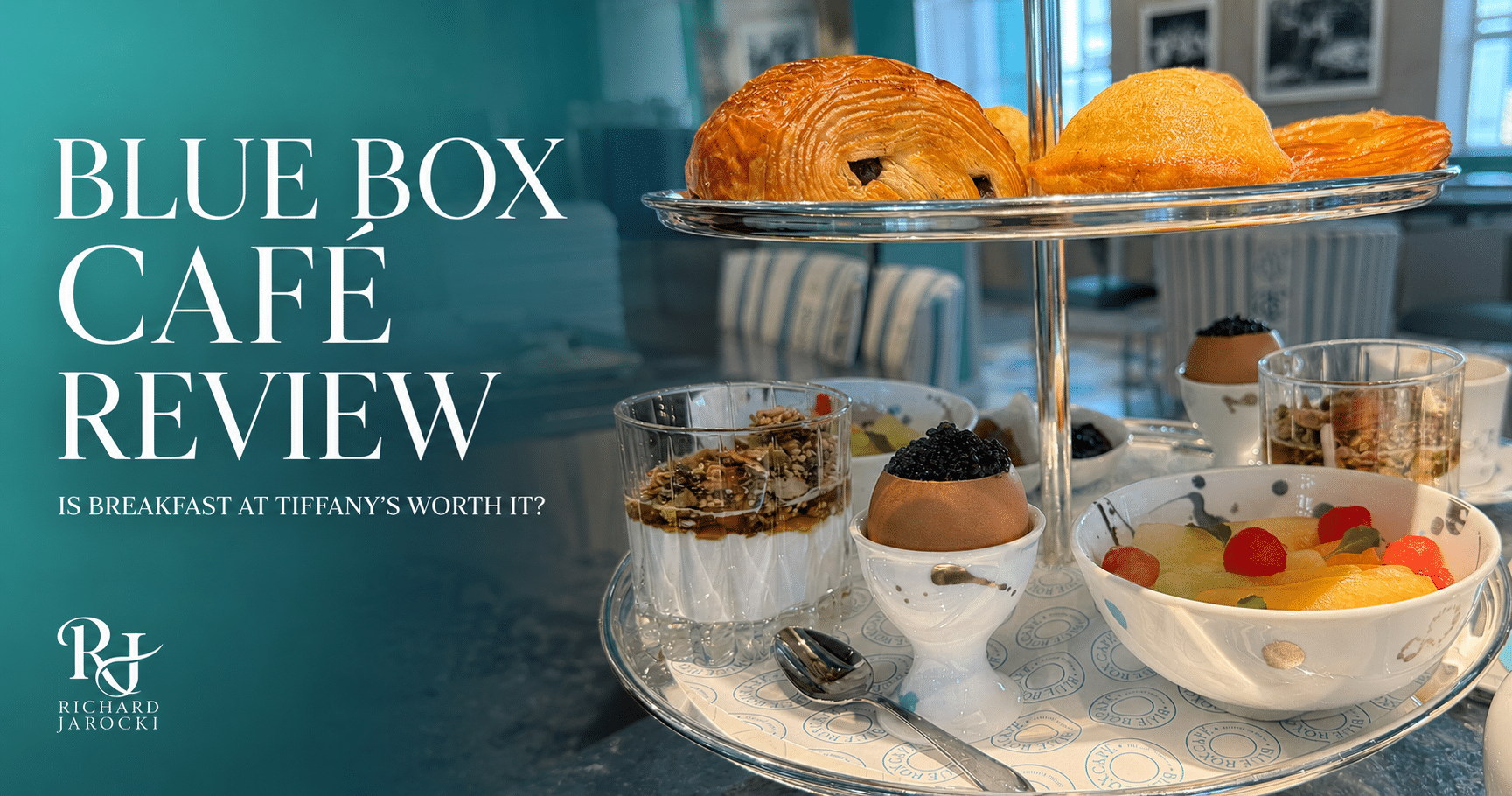
    Blue Box Café Review – Breakfast at Tiffany’s NYC Blue Box Café review featured image showing Breakfast at Tiffany’s with pastries, caviar eggs, maple parfait and fruit in NYC

    Blue Box Café review: Breakfast at Tiffany’s could have survived entirely on its name. The room gave us the photographs, but the lobster salad and cocktails are why I would return.

    I visited on July 4, 2026, while showing a first-time visitor around New York. The $68 breakfast was good, the setting was memorable and the drinks delivered. My main criticism was the service: frequent check-ins interrupted the meal, followed by a longer-than-expected wait for additional cocktails.

    Blue Box Café at a Glance

    • Location: Sixth floor of Tiffany & Co.’s Landmark, 727 Fifth Avenue, New York City.
    • My visit: July 4, 2026, for a 10 a.m. Saturday reservation.
    • Breakfast price: $68 per person during my visit and still listed at $68 on the official menu checked October 27, 2026. Seasonal components have changed.
    • What I ordered: Breakfast at Tiffany’s, the then-available $38 lobster salad, and cocktails including the Halftime and Blue Cosmo.
    • Reservations: Book through Resy. The official FAQ currently says reservations open at midnight, 30 calendar days ahead. Walk-ins depend on space.
    • Best for: A distinctly New York occasion, Tiffany fans and visitors who value the room as well as the meal. This is not my pick for a budget breakfast.
    • My verdict: Good breakfast, excellent lobster salad and cocktails, with service that needed a little more restraint.

    Practical information checked October 27, 2026. Read the current menu and booking terms before reserving.

    Current Menu, Prices and Reservations

    The official Breakfast at Tiffany’s menu still lists $68 per person as of October 27, 2026. That is the breakfast price, not a promise about your final bill. Additional dishes and drinks can increase what you spend.

    The menu changes with the season. My July breakfast included pain au chocolat, melon carpaccio and maple parfait. The current menu instead lists pain suisse, poached pear and grapes, and a PB&J parfait. The dish descriptions below are what I ate, not a claim that every component is available today.

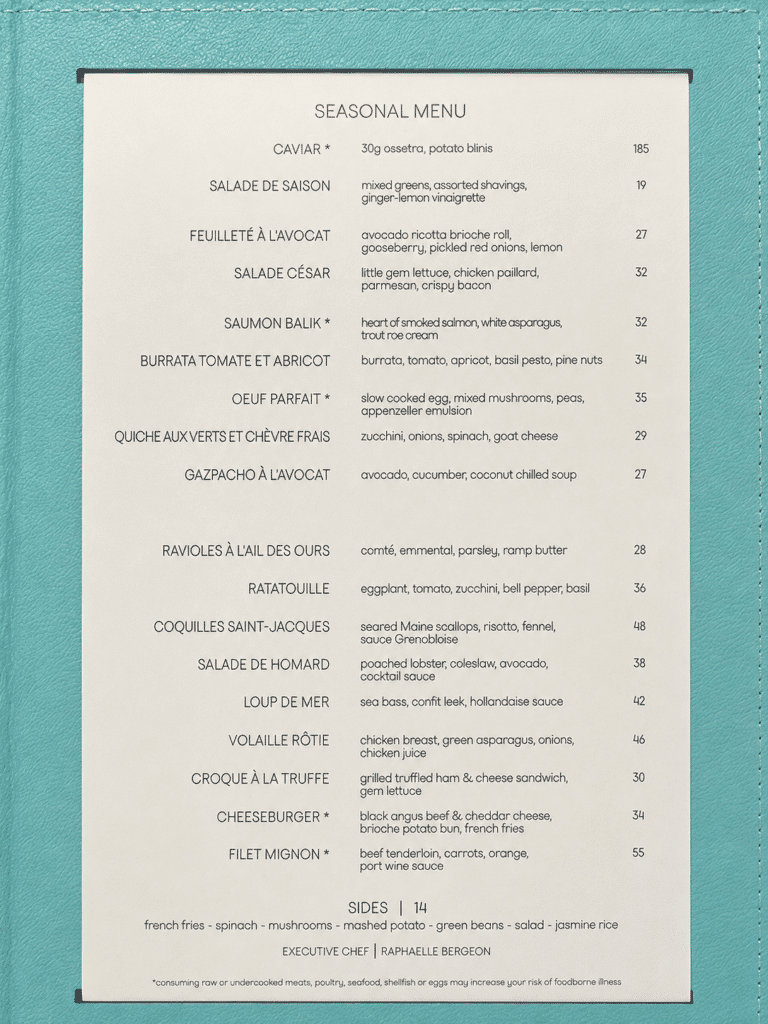
    The same distinction matters for the lobster. My $38 Salade de Homard was a highlight of the visit, but it is not listed on the current seasonal menu. That menu now lists Homard & Chorizo at $48, a different dish I have not tried. Tea at Tiffany’s is currently listed at $98, with Champagne offered separately. I did not have afternoon tea on this visit.

    Reservations are handled exclusively through Resy. The official FAQ currently says new reservations open daily at midnight for dates 30 calendar days ahead. Check the listing for your actual date and read its cancellation terms before confirming.

    The current FAQ says all menus are available throughout the day, so Breakfast at Tiffany’s does not have to mean a morning reservation. It lists opening hours of 10 a.m. to 8 p.m. Monday through Saturday and 11 a.m. to 7 p.m. Sunday, with last reservations earlier than closing. Recheck hours for your date.

    The café welcomes walk-ins when space permits, including seven first-come bar seats. I would still reserve if this is an important part of your New York plans. A walk-in policy is an option, not a guaranteed table.

    Set a Resy notification if your preferred time is unavailable, be flexible about timing and check again as your visit approaches. Search for your actual party size rather than booking a table that will not accommodate everyone.

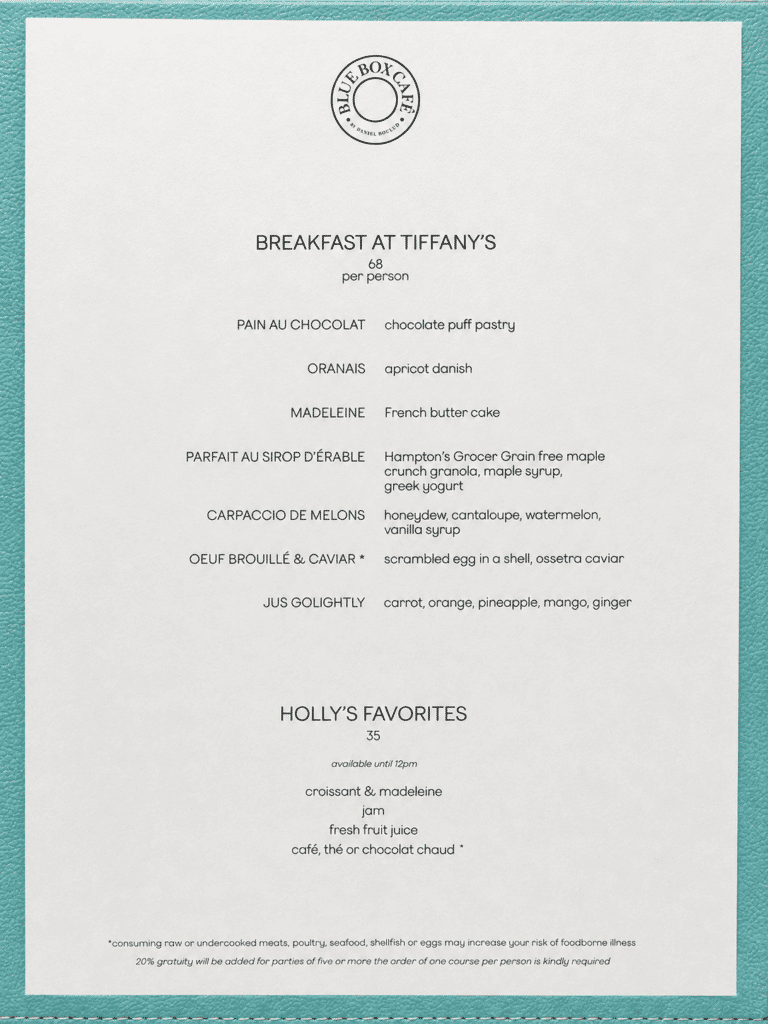
    Breakfast at Tiffany’s menu priced at $68 per person at the Blue Box Café in New York City
    The $68 Breakfast at Tiffany’s menu, including pastries, maple parfait, fresh melon, scrambled egg with Ossetra caviar and Jus Golightly. Photographed during my July 4, 2026 visit; these are historical menu details, not the current menu.
    Blue Box Café seasonal menu listing the $38 Salade de Homard with poached lobster, coleslaw, avocado and cocktail sauce
    The seasonal menu featuring the $38 Salade de Homard: poached lobster, coleslaw, avocado and cocktail sauce. Photographed during my July 4, 2026 visit; these are historical menu details, not the current menu.

    More Than a Photograph Inside Tiffany

    Put a restaurant inside Tiffany & Co.’s Fifth Avenue flagship. Make everything Tiffany Blue. Serve breakfast on custom china beneath an installation made from hundreds of suspended blue boxes. Add a connection to one of the most recognizable movies and luxury brands in the world.

    The reservations will fill themselves.

    The food would not necessarily have to be good.

    Fortunately, it was.

    I visited The Blue Box Café by Daniel Boulud while showing a first-time visitor around New York City. If you are building that kind of itinerary, it is difficult to find an experience more unmistakably New York than having Breakfast at Tiffany’s inside the Tiffany & Co. Landmark on Fifth Avenue.

    But I was still skeptical.

    Was this a legitimate restaurant or an expensive photo opportunity with pastries?

    After the $68 Breakfast at Tiffany’s experience, a spot-on lobster salad and several excellent drinks, I had my answer.

    The room delivers the fantasy, but Daniel Boulud’s kitchen keeps it from becoming a gimmick.

    Finding the Café Inside The Landmark

    The Blue Box Café is located on the sixth floor of Tiffany & Co.’s Fifth Avenue flagship, known as The Landmark, at 727 Fifth Avenue in Manhattan.

    This is not a themed café loosely associated with Tiffany. You enter the flagship store and travel upstairs into a dining room fully integrated into the Tiffany experience.

    Daniel Boulud is behind the restaurant, executive chef Raphaelle Bergeon leads the kitchen, and Peter Marino designed the renovated space. Check the official café website for current hours before planning around the store opening.

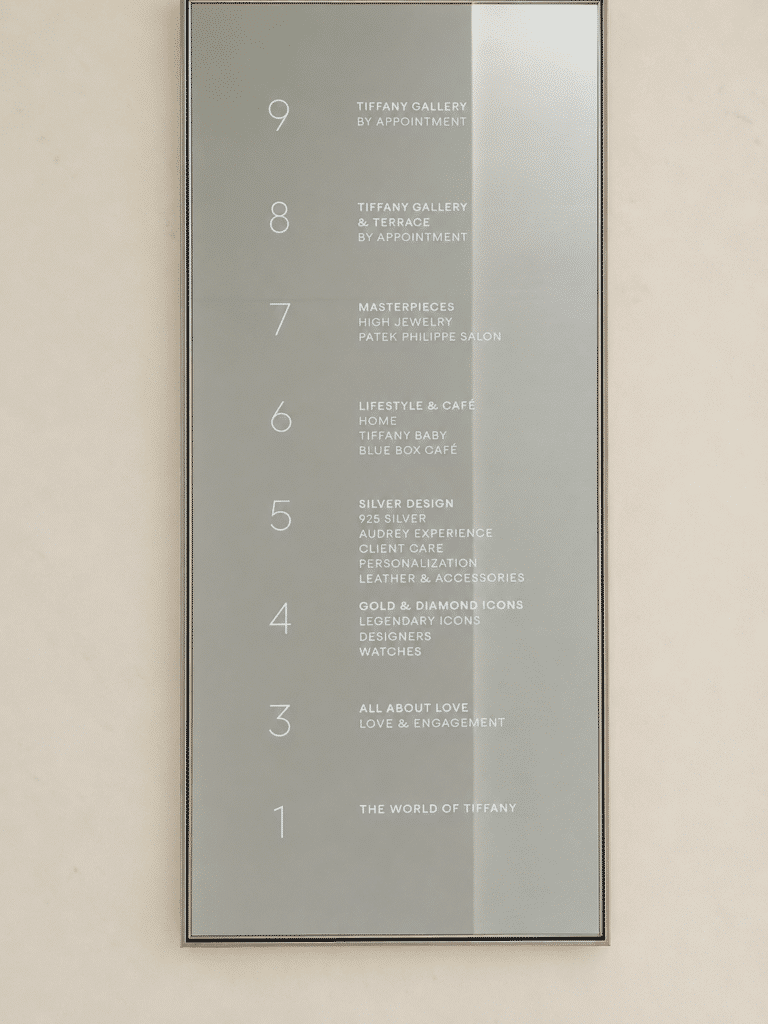
    Tiffany Landmark directory showing floors one through nine with the Blue Box Café located on the sixth floor
    The Landmark’s directory places the Blue Box Café on the sixth floor alongside Tiffany Baby, Home and Lifestyle
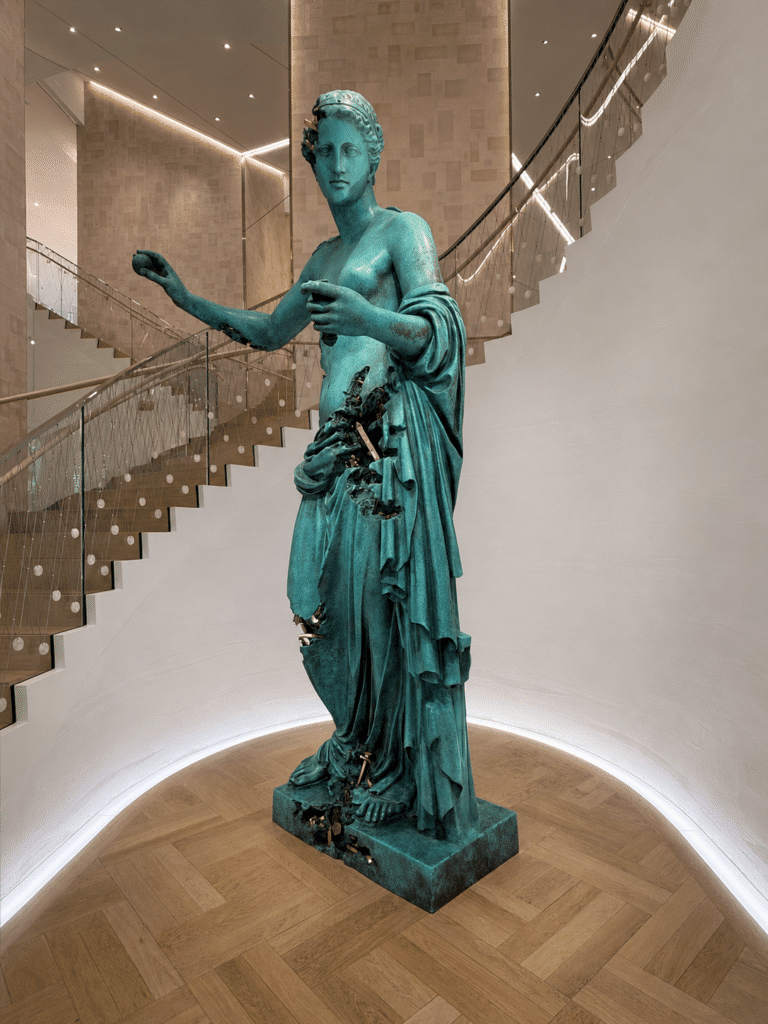
    Patinated bronze sculpture framed by a curved staircase inside Tiffany & Co.’s Fifth Avenue flagship in New York City
    Art and architecture meet inside The Landmark, where a patinated bronze sculpture stands beneath the sweeping staircase.

    The Room Is Unmistakably Tiffany

    There is no subtle interpretation of the brand here.

    The room is Tiffany Blue. The menus arrive in blue leather folders. The chairs, flowers, coasters and table details reinforce the color palette. Even the plates and coffee cups are custom Tiffany & Co. pieces decorated with blue, black and metallic brushstrokes.

    Then you look up.

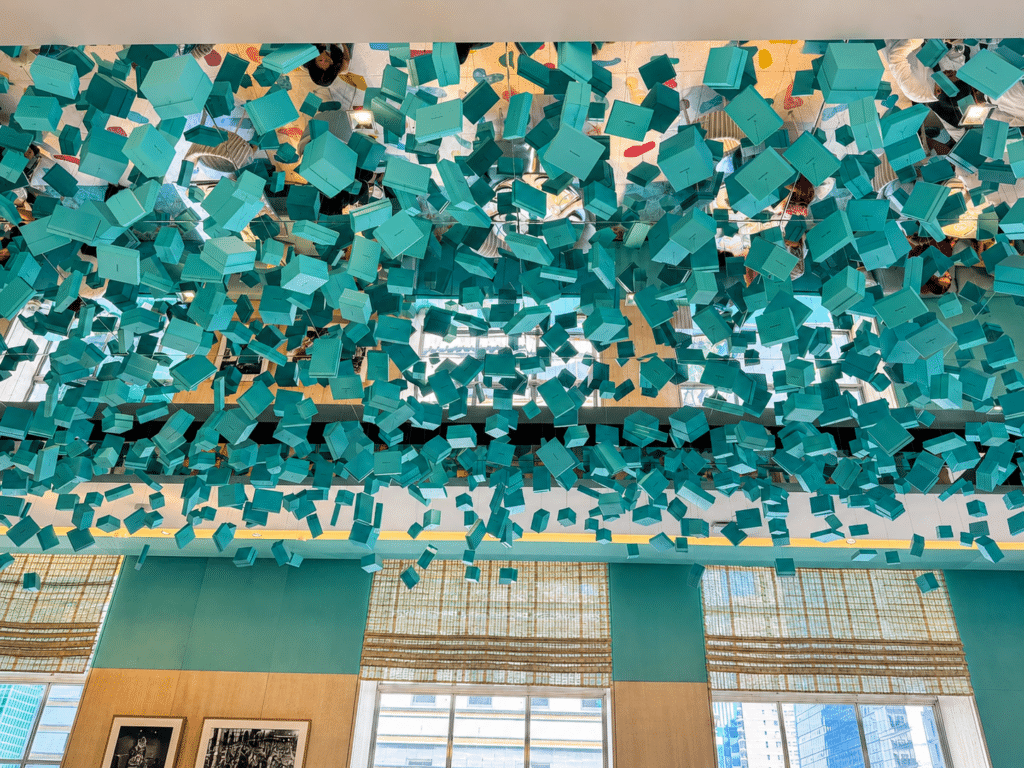
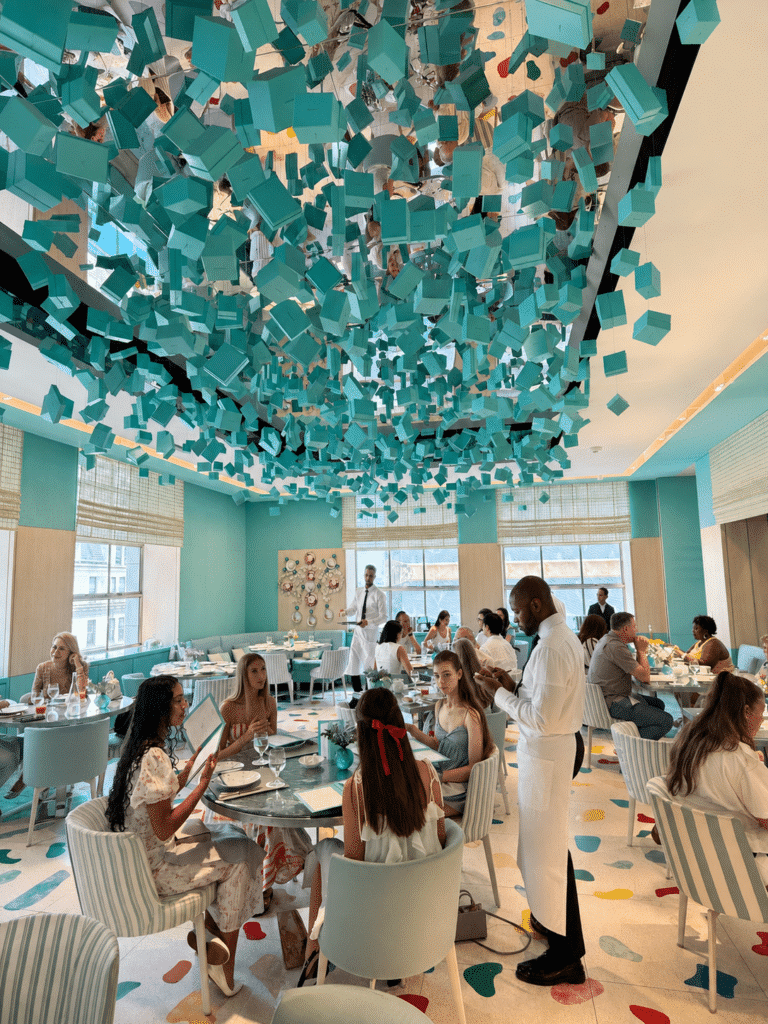
    Hundreds of Tiffany Blue boxes appear to float across a mirrored ceiling. Their reflections multiply the installation until it seems to continue far beyond the dining room.

    It could have felt excessive or like a temporary branded pop-up. Instead, the room feels polished, playful and expensive without becoming cartoonish.

    The mirrored ceiling, windows, light-colored wood and flashes of color on the floor keep the restaurant from becoming one solid block of blue. Black-and-white imagery associated with Audrey Hepburn and Breakfast at Tiffany’s adds another layer of history without turning the café into a movie museum.

    The design gives people what they came to photograph, but it also creates a dining room that remains distinctive after everyone puts away their phones.

    This is a restaurant that understands why people booked it.

    Hundreds of suspended Tiffany-blue boxes reflected across the mirrored ceiling inside the Blue Box Café in New York City
    The Blue Box Café’s most dramatic design feature: hundreds of Tiffany-blue boxes suspended beneath a mirrored ceiling.
    Busy Saturday breakfast service beneath the suspended Tiffany Blue Box installation at the Blue Box Café in New York City
    Saturday breakfast service beneath the Blue Box Café’s dramatic suspended Tiffany-box installation.

    How Much Does Breakfast at Tiffany’s Cost?

    During our visit, the signature Breakfast at Tiffany’s experience cost $68 per person.

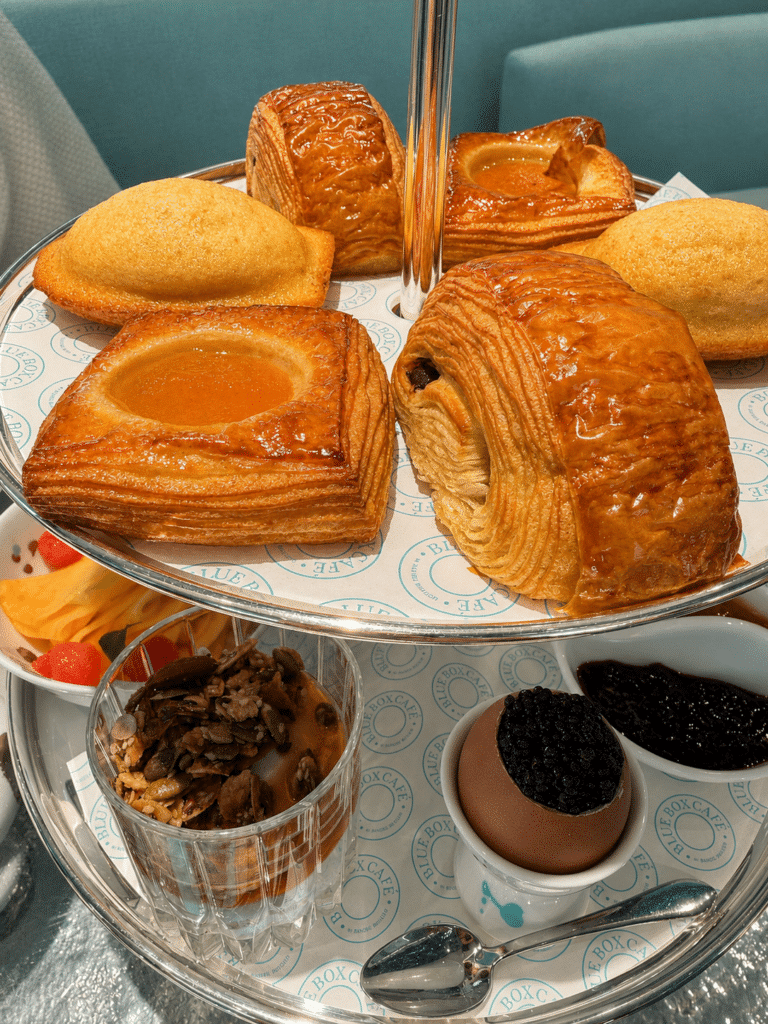
    The tiered presentation included:

    • Pain au chocolat
    • Oranais, an apricot Danish
    • Madeleine
    • Oeuf Brouillé & Caviar: scrambled egg served in its shell with Ossetra caviar
    • Carpaccio de Melons with honeydew, cantaloupe, watermelon and vanilla syrup
    • Parfait au Sirop d’Érable with grain-free maple granola, Greek yogurt and maple syrup
    • Jus Golightly with carrot, orange, pineapple, mango and ginger

    It is a substantial breakfast presented in a way that makes the table immediately look like an occasion.

    The pastries occupy the upper tier, while the egg and caviar, fruit and parfait sit below. The custom china, Tiffany-branded paper and polished stand make even familiar breakfast components feel ceremonial.

    Does breakfast need to arrive on a two-level tower inside a jewelry store?

    Absolutely not.

    But nobody comes to Breakfast at Tiffany’s looking for necessary.

    Blue Box Café Review: Breakfast Pastries at the Blue Box Café NYC
    French pastries served on the Breakfast at Tiffany’s tower inside the Blue Box Café.

    Were the Pastries Any Good?

    The pain au chocolat, apricot Danish and madeleine looked the part, with deeply golden pastry and clean, glossy finishes.

    The pain au chocolat had visible layers and enough chocolate to register without overwhelming the pastry. The apricot Danish added fruit and acidity, while the madeleine gave the tower a softer, buttery counterpoint.

    Were these the greatest pastries I have ever eaten?

    No.

    But they were well-made and good enough to support the experience. Nothing tasted like an afterthought placed on the tower because the restaurant needed more height for the photographs.

    That distinction matters.

    At a restaurant built around such a powerful visual identity, the food could easily become a prop. Here, the pastries still did their job as food.

    Scrambled Egg and Ossetra Caviar

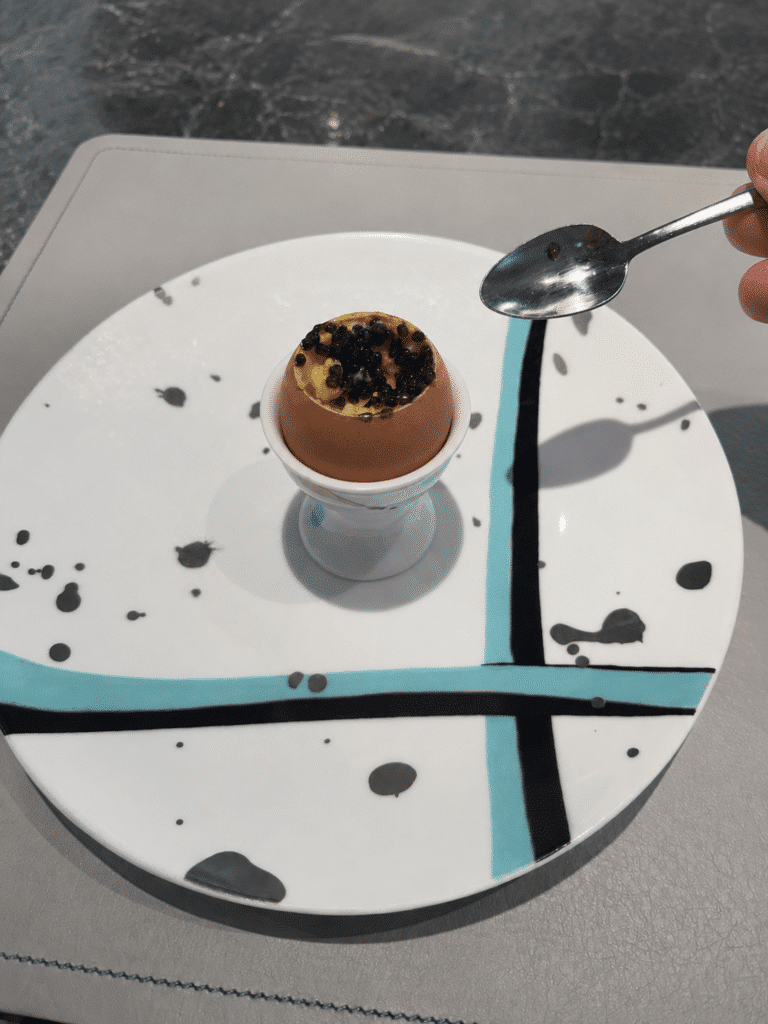
    The best-known savory component of Breakfast at Tiffany’s is the scrambled egg served inside its shell and topped with Ossetra caviar.

    It is small, luxurious and completely on brand.

    The egg was soft and rich, while the caviar contributed salinity and texture. Serving it in the shell turned a few bites of scrambled egg into the centerpiece of the breakfast tower.

    This is exactly the kind of detail the experience needs. Anyone can place pastries on a stand and surround them with Tiffany Blue. The egg and caviar demonstrate that the kitchen understands the difference between decoration and refinement.

    It also gives the breakfast a savory anchor. Without it, the experience could lean too heavily toward pastries, fruit and sweetness.

    Scrambled egg topped with Ossetra caviar served in an eggshell at the Blue Box Café in New York City
    Scrambled egg and Ossetra caviar served inside an eggshell during Breakfast at Tiffany’s.

    Melon Carpaccio and Maple Parfait

    The melon carpaccio included thin slices of honeydew and cantaloupe with watermelon spheres, vanilla syrup and small green leaves.

    It was refreshing, light and visually clean. After the pastries and rich egg, the fruit reset the palate without feeling like the obligatory bowl of melon served at an average hotel breakfast.

    The maple parfait was actually very good.

    Greek yogurt, maple syrup and crunchy grain-free granola provided a satisfying balance of creaminess, sweetness and texture. It was a familiar combination, but the quality and presentation kept it from feeling generic.

    It became one of the quiet surprises of breakfast.

    Neither dish existed to shock anyone. They made the meal feel complete and balanced.

    The Jus Golightly

    The Jus Golightly blended carrot, orange, pineapple, mango and ginger.

    Its color was vivid, and the ginger prevented the drink from becoming flat or excessively sweet. It worked particularly well alongside the pastries and fruit.

    The name is an obvious reference to Holly Golightly, but the drink was more than a movie reference in a glass. It tasted fresh and thoughtfully composed.

    Jus Golightly carrot, orange, pineapple, mango and ginger juice at the Blue Box Café in New York City
    The Jus Golightly: a fresh blend of carrot, orange, pineapple, mango and ginger: served with Breakfast at Tiffany’s.

    I Also Ordered the Lobster Salad

    Of course, I did not stop with the set breakfast.

    The Breakfast at Tiffany’s tower already offered more than enough food for a reasonable person.

    I ordered the lobster salad anyway.

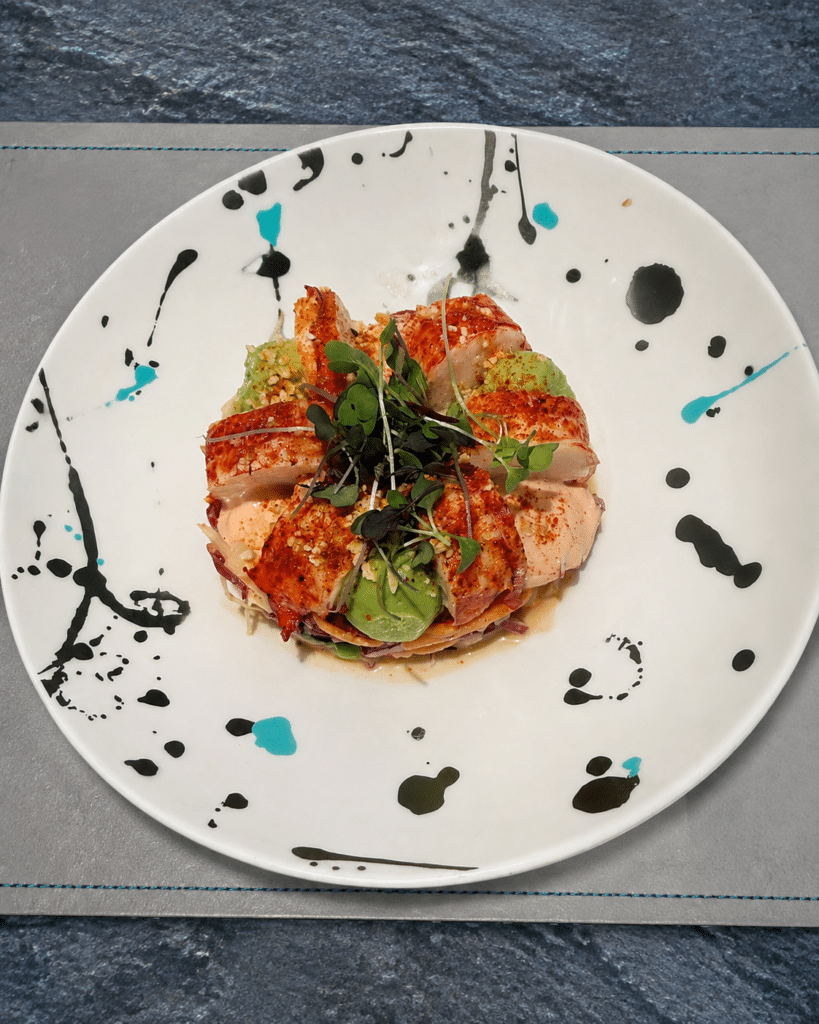
    During our visit, the Salade de Homard featured poached lobster, coleslaw, avocado and cocktail sauce. The presentation placed large pieces of lobster over a layered base of vegetables, with avocado and sauce adding richness.

    The dish was spot-on.

    The lobster was the focus, not a few small pieces buried beneath lettuce. It was sweet, properly cooked and substantial enough to justify ordering it separately. The avocado and creamy-spicy sauce gave it weight, while the slaw added crunch and acidity.

    This was the dish that confirmed Blue Box Café was not surviving on the Tiffany name alone.

    The breakfast tower was part meal and part experience. The lobster salad stood on its own as restaurant food.

    It was exactly what I would expect from Daniel Boulud’s team: polished, controlled and more serious than the setting technically required.

    Poached lobster salad with avocado, coleslaw, cocktail sauce and microgreens at the Blue Box Café in NYC
    The Salade de Homard: poached lobster, avocado, coleslaw and cocktail sauce: at the Blue Box Café.

    The Cocktails Were Excellent

    The drinks also met the standard.

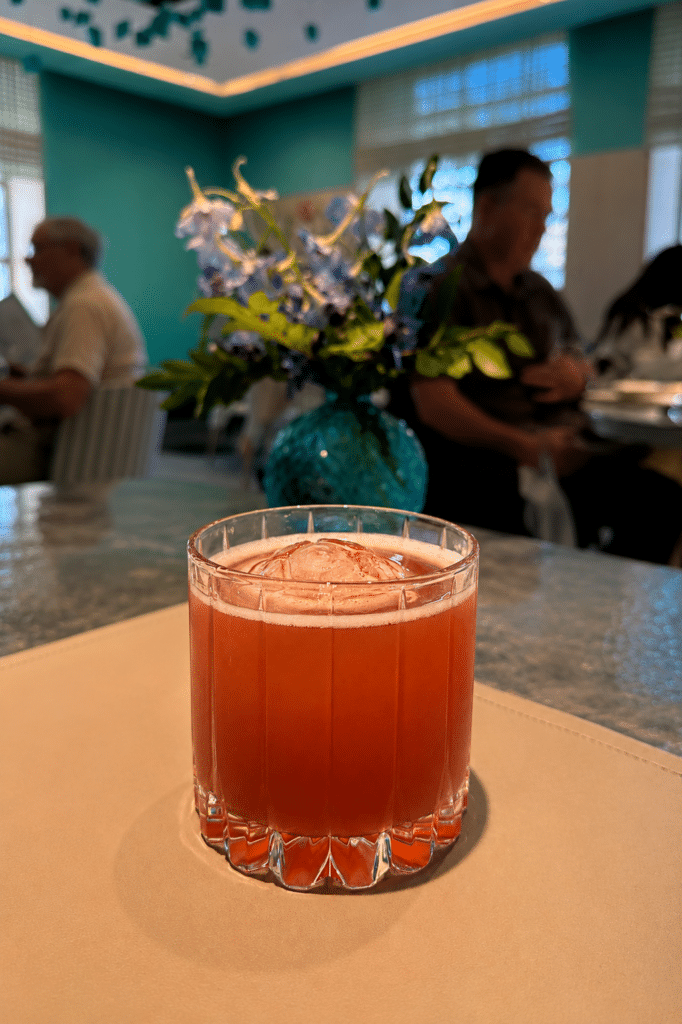
    During our visit, the signature cocktail list included the Halftime, made with bourbon, reposado tequila, lime, maple and tart cherry juice.

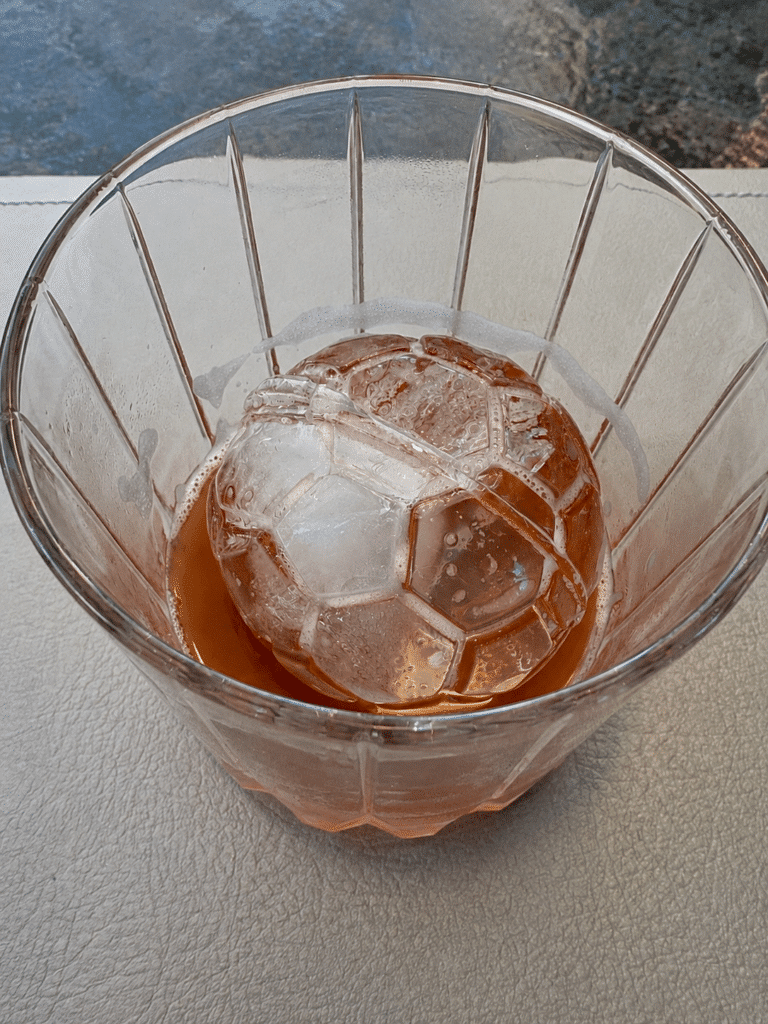
    It arrived over a large soccer-ball-shaped ice cube, which could not have been more appropriate.

    We visited over World Cup weekend, so the soccer-ball ice was a particularly memorable detail.

    The cocktail could have been another visual trick. Instead, the bourbon and reposado gave it structure, the maple added body and the tart cherry and lime kept it from becoming too sweet.

    We also ordered the Blue Cosmo.

    Both cocktails were well made. The Halftime was playful without sacrificing balance, while the Blue Cosmo delivered the polished, unmistakably Tiffany presentation you would expect inside the flagship store.

    The menu also offered an espresso martini, Landmark Negroni, Vieux Carré and several nonalcoholic drinks.

    Every drink we tried was properly made.

    Again, I would expect nothing less from a restaurant carrying Daniel Boulud’s name. Tiffany provides the fantasy, but Boulud’s involvement gives the kitchen and bar credibility.

    Close-up of soccer-ball-shaped ice inside the Halftime cocktail at the Blue Box Café in NYC
    The soccer-ball-shaped ice inside the Halftime cocktail was perfectly timed for a World Cup weekend in New York.
    Halftime cocktail with soccer-ball-shaped ice at the Blue Box Café in New York City
    The Halftime cocktail and its soccer-ball-shaped ice: a fitting detail during World Cup weekend.

    The Service Tried Too Hard to Feel High-End

    The service was attentive, arguably too attentive.

    There were a lot of people checking on the table. One person would ask how everything was, and then someone else would arrive shortly afterward to ask essentially the same question.

    Nobody was rude. Nobody ignored us. There was no shortage of effort.

    Oddly, once breakfast was finished and we ordered a few more drinks, the pace changed. After all the frequent check-ins during the meal, the cocktails took longer than expected to arrive.

    They were spot-on when they finally reached the table, but the delay did not match the level of service the restaurant was trying to deliver.

    The restaurant seemed so determined to provide high-end hospitality that the service occasionally felt orchestrated rather than natural. Too many touchpoints interrupted the rhythm of the meal.

    True luxury service should feel almost invisible. Your glass stays filled, the table remains organized and problems are handled before you need to ask, but you should not feel as though you are constantly answering a satisfaction survey.

    Blue Box Café had the resources and staffing. It could have trusted the room, food and team a little more.

    This did not ruin the meal. It was simply the only part that felt like it was trying to prove something.

    The food did not need that much help.

    Is Blue Box Café Just for Instagram?

    No. The restaurant is highly photogenic, but the meal gave me more to talk about than the photographs.

    Almost every surface has been designed to be photographed. The blue-box ceiling, custom china, pastry tower, caviar egg, cocktails and color-coordinated room create endless content opportunities.

    There is nothing wrong with that.

    The problem with many highly photographed restaurants is that the visual promise is stronger than the meal. Once the picture is taken, there is nothing left to discuss.

    Blue Box Café avoided that trap.

    The breakfast was good. The lobster salad was spot-on. The drinks were properly made. The room was memorable, and the connection to Tiffany felt genuine because we were actually inside The Landmark.

    The photographs are part of the value, but they are not the only value.

    Is Blue Box Café All Tourists?

    At our 10 a.m. Saturday reservation, the line appeared to be made up mostly of tourists.

    That was noticeable, but it does not mean Blue Box Café is exclusively a tourist restaurant.

    The café sits inside Tiffany’s Fifth Avenue flagship at 57th Street, just a few blocks south of Central Park. This is one of New York’s most heavily visited luxury-shopping corridors, and the chance to have Breakfast at Tiffany’s is an obvious bucket-list experience.

    A tourist-heavy reservation line should not surprise anyone.

    Timing also matters.

    We visited over Fourth of July weekend. That single holiday-morning line is not enough to establish the café’s normal mix of locals and visitors.

    My honest assessment: Blue Box Café is tourist-forward, but not tourist-only.

    My impression was of a destination restaurant rather than an everyday neighborhood breakfast spot. The setting makes sense for visitors, shoppers and celebrations, but I would not claim to know where everyone in the room lives.

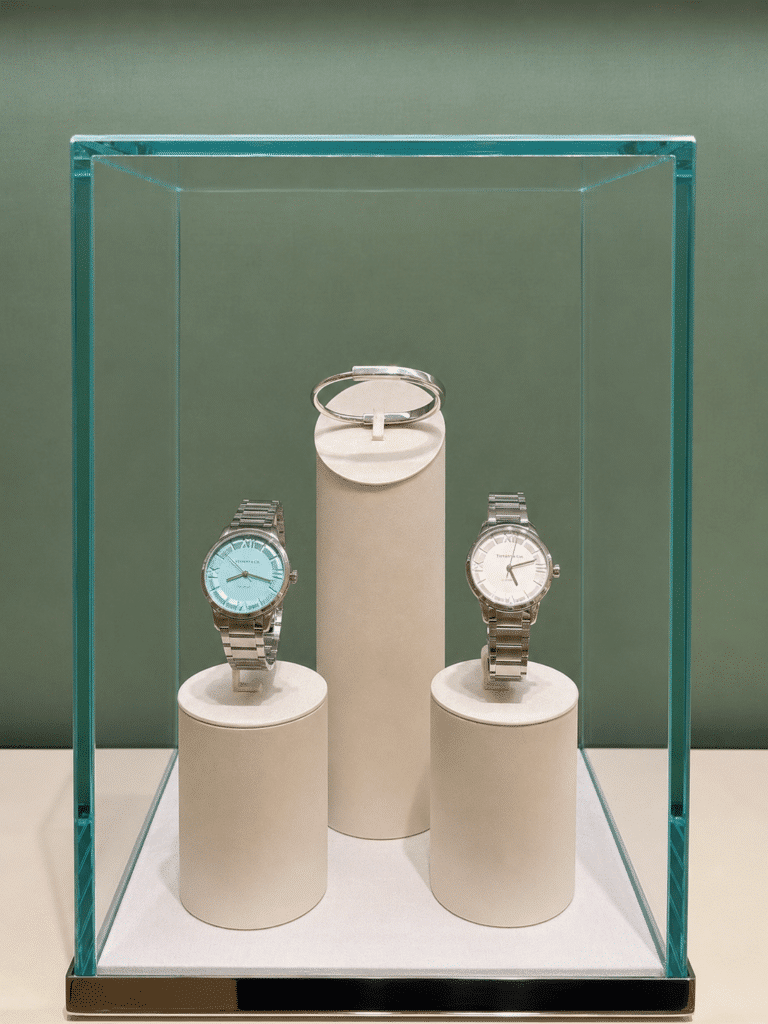
    Two stainless-steel Tiffany watches with Tiffany-blue and white dials displayed beneath a silver bracelet inside a glass case
    Tiffany watches and a silver bracelet presented inside The Landmark’s glass jewelry display.
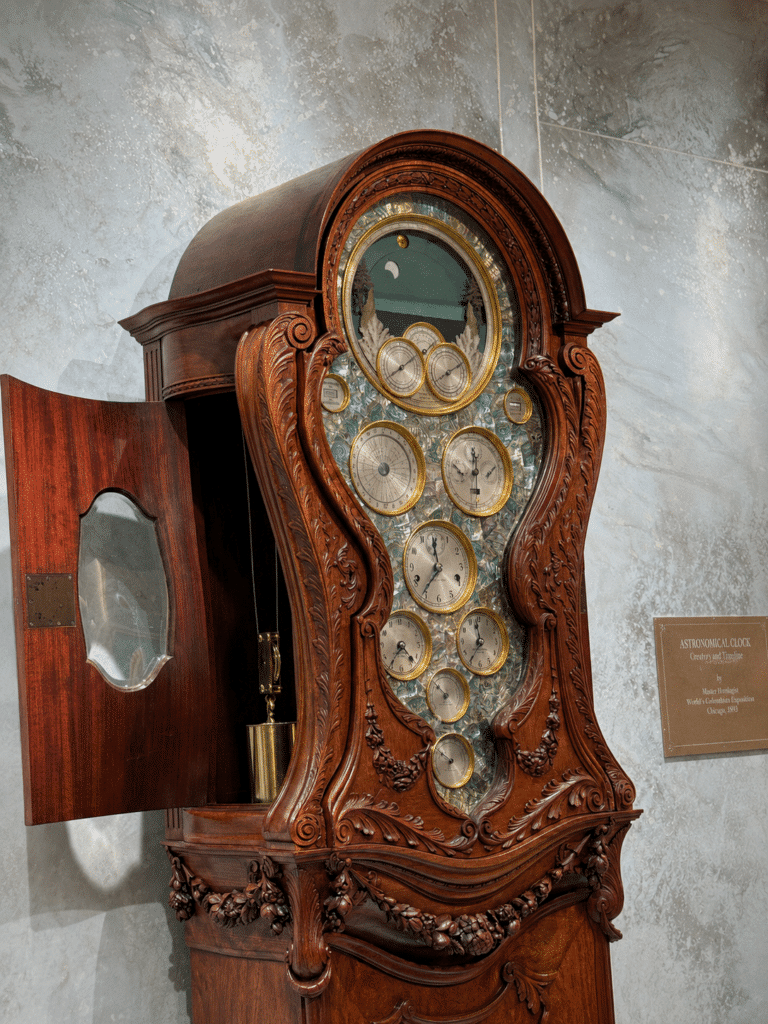
    Ornately carved Tiffany astronomical grandfather clock with multiple dials, a moon display and exposed pendulum mechanism
    The historic astronomical clock displayed inside Tiffany & Co.’s Fifth Avenue flagship.
    Tiffany jewelry rings displayed on waffle ice-cream cones against a Tiffany-blue background inside the Fifth Avenue flagship
    A playful Tiffany & Co. jewelry display pairing gemstone rings with rows of waffle ice-cream cones.

    Who Is This Experience For?

    Blue Box Café makes the most sense for:

    • Someone visiting New York for the first time
    • Anyone who loves Tiffany & Co.
    • Fans of Breakfast at Tiffany’s and classic New York imagery
    • Birthdays, engagements and celebrations
    • Visitors building a Fifth Avenue, Central Park or Midtown itinerary
    • Anyone who considers atmosphere an important part of a meal

    This is not where I would send someone searching for New York’s best-value breakfast.

    It is also not the place for a quiet, anonymous meal. The room is busy, people are taking pictures and the entire experience is designed to feel like an event.

    But that is the point.

    For a complete New York day, Blue Box Café works naturally with Fifth Avenue and Central Park before heading downtown or west.

    If Hudson Yards is also on your itinerary, my Peak restaurant and Edge NYC guide explains the dining-and-observation-deck option and what to check before booking.

    What Should You Order?

    For a first visit, order the signature Breakfast at Tiffany’s experience.

    It gives you the signature presentation. Check the current seasonal inclusions rather than expecting every item from my July meal.

    If you want something more substantial and savory, consider a seasonal dish. The lobster salad was the strongest individual plate we tried and the item I would most enthusiastically order again if it returns to the menu.

    And order a drink.

    Whether you choose a cocktail, Champagne, coffee or Bellocq tea, the beverage service helps complete the experience. The Halftime cocktail was both playful and genuinely good.

    Is the $68 Breakfast at Tiffany’s Worth It?

    If you evaluate it only as breakfast, $68 is expensive.

    You can find excellent eggs, pastries, yogurt and fruit elsewhere in New York for less money.

    But Blue Box Café is not selling only breakfast.

    You are paying for the sixth-floor setting inside Tiffany’s flagship, the Daniel Boulud connection, the custom tableware, the blue-box ceiling, the service, the movie association and the opportunity to give someone a distinctly New York memory.

    The food still needs to be good, and it was.

    That is the line Blue Box Café had to cross. If the breakfast had been average, the entire experience would have felt like a branded cash grab.

    Instead, the kitchen justified the setting.

    The final bill can climb quickly once you add cocktails and another dish. This is not a budget travel tip. But for the right person and the right occasion, the experience delivers what it promises.

    Frequently Asked Questions

    Where is the Blue Box Café in New York?

    It is on the sixth floor of Tiffany & Co.’s Landmark at 727 Fifth Avenue in Manhattan, at 57th Street.

    How much is Breakfast at Tiffany’s?

    The official menu checked October 27, 2026 lists $68 per person. That matches what the signature breakfast cost during my July visit. Additional orders increase the bill, and seasonal inclusions can change.

    Do you need a reservation?

    I strongly recommend one. Resy is the café’s official reservation channel. Walk-ins and the seven first-come bar seats depend on availability; I would not plan an entire day around getting lucky.

    Is there a dress code?

    Smart-casual clothing fits the room, in my opinion. That is my suggestion, not a quoted dress-code policy. Check the café or your booking confirmation if you need specific guidance.

    Can you have afternoon tea?

    Yes. The current Tea at Tiffany’s menu is listed at $98, with a selection of sandwiches, scones and sweets plus tea. It is a separate experience from the breakfast I reviewed.

    Is it worth visiting if you do not care about Tiffany?

    The food and drinks were good enough to stand on their own, but much of the value comes from the room and the Tiffany connection. If those mean nothing to you, another Daniel Boulud restaurant may be a better match for a more food-centered outing.

    The Verdict: Is Blue Box Café Worth It?

    Would I return to Blue Box Café?

    Yes.

    I went in expecting the room to do most of the work. Instead, the food impressed me.

    The Breakfast at Tiffany’s tower was more than a photograph. The pastries were properly made, the scrambled egg and caviar gave the breakfast a legitimate luxury centerpiece, and the melon, parfait and juice kept everything balanced.

    The maple parfait was a genuine surprise. The lobster salad was spot-on and the strongest individual dish we ordered. Both the Halftime and Blue Cosmo were excellent.

    The service was the only part that needed restraint. Everyone was trying so hard to create a high-end experience that too many people checked on us. Then, once breakfast was over, the additional drinks took longer than expected to arrive.

    The attention was well-intentioned, but luxury does not need to announce itself every few minutes, and when a guest orders something, the timing still needs to be sharp.

    That criticism aside, Blue Box Café delivered exactly what I expected from Daniel Boulud and more than I expected from a restaurant built inside a luxury jewelry store.

    It would have been easy for Tiffany to offer a beautiful room and an average breakfast.

    They did not.

    The room got us through the door. The lobster salad and cocktails are why I would return.

    Completely unnecessary?

    Of course.

    But Breakfast at Tiffany’s, done properly, was absolutely worth it.

    More NYC Dining Experiences

    Planning another meal in New York City? Explore more of my firsthand restaurant reviews:

    Visit the official Blue Box Café website · Read more food and travel stories

  • Oiji Mi Review NYC: Tasting Menu & My Verdict

    Oiji Mi Review NYC: Tasting Menu & My Verdict

    Oiji Mi tasting menu dishes featuring the Oiji Bowl, sea bass, galbi and Korean appetizers in New York City.


    Oiji Mi’s five-course Korean tasting menu made dinner worth keeping, even after a day of eating and drinking at two rooftop parties. During my visit to the restaurant in Manhattan’s Flatiron District, the menu was $150 per person before optional supplements. The beef tartare and scallop were highlights, but the Oiji Bowl was my favorite; and the dish I would order again. This Oiji Mi review covers what we ate, the atmosphere, and whether the experience was worth it. Menus and prices may have changed since my visit.

    I had been eating and drinking throughout the day. Canceling dinner briefly crossed my mind, but I had been looking forward to this reservation and did not want to miss it. My dining partner and I sat down wondering how we would possibly finish a five-course tasting menu.

    Somehow, we ate everything.

    That may be the strongest endorsement I can give Oiji Mi. We arrived without much appetite, yet the kitchen kept placing food in front of us that we genuinely wanted to finish.

    Oiji Mi at a Glance

    • Location: 17 West 19th Street, Manhattan’s Flatiron District.
    • What I came for: A five-course contemporary Korean dinner. The Oiji Bowl was my favorite, with the beef tartare and scallop close behind.
    • My visit price: $150 per person before supplements, drinks, tax and gratuity. My Oiji Bowl supplement was $35.
    • Current menu check: The official menu lists $155 per person and a $35 Oiji Bowl supplement as of October 27, 2026. Check your selected date before booking.
    • Where to sit: The main dining room serves the prix-fixe menu. À la carte is offered in the bar and lounge.
    • Reservations: Released 30 days ahead according to the restaurant. Bar walk-ins are first come, first served.
    • My verdict: I would return, and I would order the Oiji Bowl again without hesitation.

    Planning details checked against the official menu and restaurant FAQ. The meal and photographs below describe my visit, not a promise of today’s dishes.

    Oiji Mi Menu, Prices and Reservations

    If you are deciding whether to book, start with the kind of evening you want. The main dining room is for the five-course prix-fixe experience. The bar and lounge offer à la carte, which is a different way to approach the restaurant if you do not want to commit to the full dinner.

    The current Oiji Mi menu, checked October 27, 2026, lists the dining-room menu at $155 per person. The Oiji Bowl remains a $35 supplement. Those two items would total $190 per person before anything else you order, tax or gratuity. That is a planning calculation, not the price of my earlier meal.

    I paid $150 for the menu during my visit, with optional supplements. The restaurant’s FAQ still uses “starting at $150,” while the dedicated menu page says $155. I would use the menu page to plan and confirm the amount shown for the reservation you actually select. Special-date menus can differ.

    The restaurant’s FAQ says reservations open 30 days in advance for the dining room and lounge. Bar seating welcomes walk-ins on a first-come basis. If the full tasting menu is the reason for your visit, book the dining room rather than assuming an available bar seat will give you the same evening.

    At the time of this check, the stated cancellation charge was $50 per guest for cancellations within 24 hours. Read the terms attached to your booking, and discuss dietary needs directly before committing; the restaurant warns that some restrictions significantly limit its options.

    The photographs below are the menus from my visit. They help explain what I ordered, but seasonal preparations and drinks can change. Follow the official menu link for the current selection.

    Oiji Mi five-course prix fixe menu with modern Korean dishes, supplements and beverage pairings.
    The $150 five-course menu photographed during my visit. This is a historical menu, not the current price.
    Oiji Mi cocktail menu listing effervescent, shaken, stirred and reserve drinks.
    The cocktail menu from my visit. Names, ingredients and prices may change.

    Oiji Mi Tasting Menu: Prices and the Flatiron Setting

    Located at 17 West 19th Street in Manhattan’s Flatiron District, Oiji Mi describes itself as a contemporary Korean restaurant created specifically for New York City.

    Owner and Executive Chef Brian Kim takes recognizable Korean ingredients and preparations and presents them through the structure and precision of a modern tasting menu. The cooking is polished and ambitious, but its Korean identity remains clear.

    For a different Korean dining experience in Manhattan, read my COQODAQ brunch review.

    The restaurant itself feels refined without becoming cold. Warm wood, softly illuminated lanterns, pink banquettes and carefully selected tableware give the dining room a sense of occasion. It is sophisticated enough for a celebration but comfortable enough to let the evening unfold naturally.

    Metal plate, Korean-style spoons, chopsticks and clear glassware arranged on a wooden table at Oiji Mi.
    Oiji Mi’s understated modern table setting.
    Oiji Mi dining room with sculptural lanterns, red banquette seating and a view into the open kitchen.
    Sculptural lighting and a clear view into Oiji Mi’s open kitchen.

    A Meal That Began with Caviar

    We added the caviar donuts before the tasting officially began.

    These were small fried pastries topped with crème fraîche, caviar and chives. The contrast worked immediately: a warm, crisp exterior, a soft center, cool cream and the clean salinity of the roe.

    They were playful, luxurious and easy to eat. More importantly, they established the tone for the rest of the evening. Oiji Mi uses premium ingredients, but the kitchen does not treat them as museum pieces. The food is meant to be enjoyed.

    Two savory donuts topped with crème fraîche, caviar and chopped chives at Oiji Mi.
    Oiji Mi’s two-piece caviar donut supplement.

    Oiji Mi Review: Three Introductions to the Kitchen

    Three opening bites from Oiji Mi’s modern Korean tasting menu served in brass bowls.
    Oiji Mi’s beautifully presented trio of opening bites.

    The first course arrived as a trio: spotted prawn, beef tartare and gyeran jjim.

    Spotted Prawn

    The spotted prawn was served in a shell with a gochujang panna cotta, pearl rice and a bright accompanying sauce. The presentation was delicate, but the flavors had enough acidity and spice to keep the dish from becoming overly sweet.

    It was a light beginning and a smart way to wake up an appetite I was not sure I still had.

    Beef Tartare

    The beef tartare was one of my favorite dishes of the entire dinner.

    The beef delivered the expected richness, but pickled radish and caviar gave the dish contrast. The acidity of the radish cut through the meat, while the caviar brought salinity without dominating the plate.

    This was technically polished food that still tasted satisfying. It did not disappear under unnecessary decoration or technique. The kitchen understood that excellent beef should remain the focus.

    Gyeran Jjim

    Gyeran jjim is traditionally a comforting Korean steamed-egg dish. Oiji Mi’s version elevated that familiarity with king crab, anchovy and roe.

    It was soft, warm and deeply savory, with the seafood adding layers of sweetness and salinity. Of the three opening preparations, this was the most comforting; a refined interpretation of something that still felt rooted in home cooking.

    Together, the three dishes introduced Oiji Mi’s point of view: recognizable Korean flavors presented with fine-dining precision.

    Scallop and Spicy BBQ Squid

    Seared scallop with its accompaniments on a textured glass plate at Oiji Mi.
    The seared scallop, one of my favorite dishes of the evening.
    Spicy BBQ squid with green strawberry, tomatillo, dubu and fresh greens on a textured glass plate at Oiji Mi.
    Oiji Mi’s Spicy BBQ Squid with green strawberry, tomatillo and dubu.

    For the second course, we chose two different preparations so we could try both sides of the kitchen’s approach.

    Scallop

    The scallop was another highlight of the night.

    It arrived beautifully seared, with a deeply caramelized exterior protecting a tender center. The scallop’s natural sweetness remained intact, while the sauce and accompanying vegetables added richness and an earthy edge.

    A restaurant can surround a scallop with expensive ingredients and complicated technique, but none of that matters if the scallop itself is overcooked. This one was handled properly.

    Along with the beef tartare, it was one of the best dishes before the meal reached its undeniable high point.

    Spicy BBQ Squid

    The spicy barbecue squid offered a more assertive counterpoint. It arrived beneath a generous layer of greens, with heat and sweetness working underneath.

    The dish showed another side of the kitchen. Where the scallop was controlled and delicate, the squid leaned into char, spice and stronger seasoning. Ordering both allowed us to see how comfortably Oiji Mi moves between restraint and intensity.

    The Oiji Bowl: My Favorite Dish of the Night

    Oiji Bowl with uni, spotted prawn, ikura and spicy cucumber at Oiji Mi in New York City.
    The signature Oiji Bowl with uni, spotted prawn, ikura and spicy cucumber.

    The Oiji Bowl was my favorite course of the evening. It combined uni, spotted prawn, eel, ikura, cucumber, pickled elements, and seasoned rice. The uni was exceptionally sweet and creamy, while the other ingredients brought richness, salinity, and freshness without competing with it.

    At a $35 supplement during my visit, it was an extra expense; but also the dish I would order again without hesitation. Even after a full day of eating and drinking, I finished every bite.

    Sea Bass and Galbi

    Crispy-skinned fish with mushrooms, puffed rice and savory sauce at Oiji Mi in New York City.
    The sea bass course from my dinner at Oiji Mi.
    Sliced medium-rare galbi with seaweed, vegetables and savory sauce at Oiji Mi.
    Oiji Mi’s tender medium-rare galbi with seaweed and seasonal accompaniments.

    The fourth course moved the tasting into heavier territory with sea bass and galbi.

    Sea Bass

    The sea bass arrived with octopus, crispy rice and a truffle-scented seafood broth.

    The fish had a crisp, properly rendered skin and a moist interior. Crispy rice added texture, while the broth gave the dish depth. The octopus made it feel substantial enough to serve as a main course rather than another delicate seafood tasting.

    Truffle and seafood can compete if the kitchen is not careful. Here, the broth connected the components and allowed the fish to remain central.

    Galbi

    The galbi was sliced to reveal a beautifully pink center and served with a smooth pommes purée, dark vegetables and jus.

    This was the richer of the two main courses. The beef was cooked with precision, and the sauce provided the savory finish the course needed after several seafood-forward plates.

    By this point in the evening, I had no logical reason to still be eating. Neither did my dining partner.

    We finished it anyway.

    Chamoe Bingsu and Oksusu

    Chamoe bingsu with Korean melon, honey-oat crumble and cashew served in a brass bowl at Oiji Mi.
    Chamoe bingsu with Korean melon, honey-oat crumble and cashew.
    Oiji Mi Review: Oksusu dessert with grilled corn, dulce de leche, and sesame at Oiji Mi in New York City.
    Oksusu; Oiji Mi’s grilled-corn dessert with dulce de leche and sesame.

    Dessert continued the restaurant’s practice of using familiar Korean ingredients in polished, contemporary ways.

    Chamoe Bingsu

    The chamoe bingsu was built around Korean melon, honey-oat crumble and cashew.

    After the richness of the Oiji Bowl and galbi, the cool shaved ice and fresh melon were welcome. The crumble was served separately, allowing us to add texture without losing the lightness that made the dessert work.

    It was refreshing without feeling like an obligatory palate cleanser.

    Oksusu

    The oksusu dessert explored grilled corn with dulce de leche and sesame.

    Corn’s natural sweetness made it an easy fit for dessert, while the toasted flavors gave the plate more depth than a conventional sweet ending. The presentation separated the components, encouraging us to combine the creamy, crisp, sweet and savory elements in each bite.

    The two desserts approached the finish from opposite directions: one cool and refreshing, the other richer and more roasted.

    Cocktails and the Dining Room

    Oiji Mi’s beverage program follows the same creative approach as the food. The cocktail list incorporates ingredients such as makgeolli, soju, bokbunja, omija, yuja and shiso alongside spirits and techniques associated with contemporary cocktail bars.

    The drinks look playful, but the menu is clearly serious about structure and balance. Oiji Mi also offers wine pairings and nonalcoholic options for the tasting menu.

    Visually, the dining room occupies an appealing middle ground between a formal tasting-menu restaurant and an energetic Manhattan night out. The lantern-like lighting and warm color palette make the room feel elegant, while the open layout keeps it from becoming stiff or overly ceremonial.

    Oiji Mi Review: Pink foamy Ode to CDMX cocktail beside blue Saratoga bottles in the Oiji Mi dining room.
    Ode to CDMX combines mezcal, pineapple tepache, cranberry, genepy and chili tincture.
    Amber Arsonist cocktail with foam, green leaf and charred pineapple garnish at Oiji Mi.
    The Arsonist pairs añejo tequila with charred pineapple, Cappelletti and clairin Milot.
    Alternate view of the cloudy Melon Eight Milk 2.0 cocktail with orange melon garnishes at Oiji Mi.
    An alternate view of Oiji Mi’s Melon Eight Milk 2.0.
    Cloudy Melon Eight Milk 2.0 cocktail served in a ceramic bowl with orange melon garnishes at Oiji Mi.
    Melon Eight Milk 2.0 combines makgeolli, melon, soju, Yakult and Chilsung Cider.
    Oiji Mi dining room with sculptural pendant lights, red banquettes, marble tables and warm wood details.
    Oiji Mi’s dining room blends dramatic lighting with warm wood and red leather seating.
    Oiji Mi dining room with wooden tables and a view of chefs working in the open kitchen.
    The open kitchen brings energy into Oiji Mi’s intimate dining room.
    Oiji Mi bar displaying Michelin figures, a 2025 Michelin plaque, Krug bottles and glassware.
    Michelin recognition displayed behind the bar during my visit.

    Service

    The service was excellent from beginning to end. The staff was polished, attentive and knowledgeable without making the experience feel stiff. Courses were paced well, each dish was clearly explained, and the team made the tasting menu feel welcoming rather than overly formal.

    Oiji Mi Review: The Verdict

    We arrived at Oiji Mi after a Formula 1 party, a World Cup party and an entire day of eating and drinking. Neither of us was hungry when the first course reached the table, yet we both finished everything.

    That does not happen because a restaurant is fashionable, expensive or beautifully designed. It happens because the kitchen understands pacing and knows how to keep each course distinct enough to renew your interest in the meal.

    The beef tartare was rich, balanced and precise. The scallop was beautifully cooked. The sea bass and galbi gave the tasting enough substance to feel complete, while the two desserts ended the evening from entirely different directions.

    But the Oiji Bowl was the reason this meal became memorable.

    The combination of sea urchin, spotted prawn, eel, ikura and seasoned rice could easily have become excessive. Instead, it was focused, balanced and genuinely delicious. The uni alone ranked among the best I have ever tasted.

    Oiji Mi presents Korean food through the language of a modern New York tasting menu, but the cooking does not lose its identity in the process. Technique supports the ingredients rather than replacing them.

    Would I order the Oiji Bowl again? Without hesitation.

    Would I return to Oiji Mi? The fact that I am still thinking about that uni answers the question.

    Planning Your Own Oiji Mi Dinner

    My strongest recommendation is to arrive with more appetite than I did. The kitchen held my attention even after two rooftop parties, but I would rather give a dinner like this room in the day than ask it to compete with everything I had already eaten.

    Choose the dining format before choosing individual dishes. My review is of the five-course experience, with the pacing, choices and supplements that were available that night. It is not a separate review of an à la carte evening at the bar.

    The Oiji Bowl is the dish I keep coming back to in my memory. If it is available when you visit, it is the supplement I would personally prioritize. The beef tartare and scallop also deserve the praise they received here. I would check the current preparations rather than expect every accompaniment in my photographs to be reproduced exactly.

    For the latest menu and booking route, visit Oiji Mi’s official website. The restaurant is at 17 West 19th Street, New York, NY 10011; its published phone number is 212-256-1259.

    More NYC Dining Experiences

    For a different side of Korean dining, read my COQODAQ brunch review. You can also compare this dinner with my Blue Box Café experience or explore the wider collection of food and drink stories.