Category: Travel Insights

  • Formula 1 Beyond the Circuit

    Formula 1 Beyond the Circuit

    Follow my Instagram

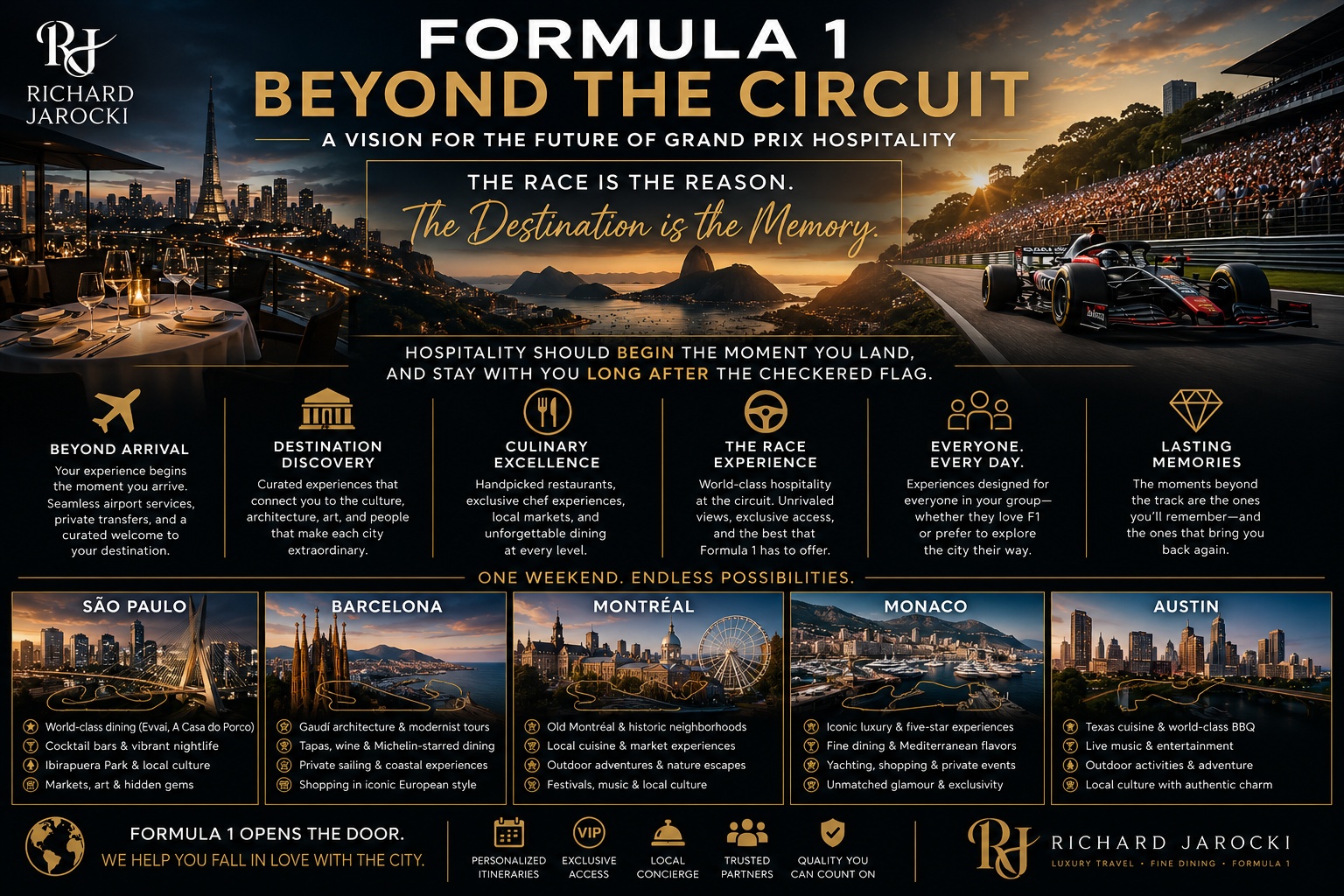
    Infographic illustrating a vision for the future of Formula 1 hospitality, featuring Grand Prix destinations, luxury travel, fine dining, and experiences beyond the race circuit by Richard Jarocki.

    A Vision for the Future of Grand Prix Hospitality

    The Opportunity

    Over the past several years, I’ve traveled to Formula 1 destinations around the world—not simply to attend races, but to experience the cities that host them.

    Long before I purchase a race ticket, I’m researching restaurants, cocktail bars, hotels, neighborhoods, architecture, museums, and local culture. Sometimes I know where I’ll have dinner months before I know where I’ll be sitting on race day.

    Along the way, I realized something.

    Formula 1 has become one of the world’s greatest reasons to travel.

    But we’re still treating the destination as a backdrop rather than part of the experience.

    Every Grand Prix introduces hundreds of thousands of people to cities they may never have otherwise visited. The racing is extraordinary, yet the opportunity to connect guests with the destination often begins and ends at the circuit gates.

    I believe there’s an opportunity to expand what Formula 1 hospitality means—not by replacing what’s already exceptional, but by extending it beyond the track.


    Formula 1 Isn’t Selling Three Days

    This is where I think the article becomes more interesting.

    People often describe Formula 1 as a weekend event.

    I don’t think that’s true anymore.

    When someone travels from New York to São Paulo, London to Singapore, or Sydney to Montréal, they’re not buying a three-day sporting event.

    They’re planning an international vacation.

    The race may be the reason they booked the flight, but it’s rarely the only reason they’re traveling.

    For many guests, the Grand Prix is one chapter in a much larger story.

    Hospitality should reflect that.


    Hospitality Should Begin Before the First Practice Session

    Today’s hospitality programs are exceptional once guests arrive at the circuit.

    But what happens before Friday morning?

    Imagine arriving in Barcelona.

    Instead of simply receiving your race credentials, you receive a curated itinerary tailored to your interests.

    Perhaps you’re passionate about architecture. Your first afternoon explores Gaudí’s masterpieces before dinner at one of Barcelona’s most celebrated restaurants.

    Maybe food is your passion. Your itinerary introduces you to neighborhood tapas bars, a market tour, and one of the city’s Michelin-starred tasting menus.

    Or perhaps you’re visiting with your family. While you’re at the circuit, your spouse and children spend the day on experiences designed specifically for them, all curated under the same standard of excellence associated with Formula 1.

    Now hospitality isn’t confined to the paddock.

    It’s woven into the entire journey.


    One Trip. Different Experiences.

    This, in my opinion, is where Formula 1 has its biggest opportunity.

    Not everyone who travels to a Grand Prix is a Formula 1 fan.

    Some are spouses.

    Some are children.

    Some are parents.

    Some are corporate guests.

    Some are clients invited by sponsors.

    Some simply want to experience a new city.

    Yet too often they’re treated as an afterthought.

    Imagine asking one simple question during booking:

    “Who is traveling with you?”

    That single question changes everything.

    One guest spends the afternoon inside the Paddock Club.

    Their partner spends the afternoon exploring São Paulo’s art museums with a private guide before enjoying cocktails at one of Latin America’s best bars.

    Their children participate in an FIA-inspired STEM program where they learn how aerodynamics, engineering, and sustainability shape modern motorsport through hands-on activities.

    Everyone reconvenes for dinner.

    Everyone has stories to tell.

    Nobody spent the day waiting for someone else.


    Every Grand Prix Should Feel Like Its Host City

    One of Formula 1’s greatest strengths is its global calendar.

    No two cities are alike.

    So why should hospitality feel the same?

    The experience in Japan should celebrate Japanese craftsmanship, precision, and cuisine.

    Montréal should showcase Québec’s culinary scene, history, and neighborhoods.

    São Paulo should introduce guests to one of the world’s most exciting food cities.

    Melbourne should embrace its coffee culture, laneways, and coastal lifestyle.

    Monaco should feel unmistakably Monaco.

    The destination itself should shape the experience.

    Because guests don’t simply remember where they watched the race.

    They remember where they had the best meal of their lives.

    They remember the bartender who introduced them to a local spirit.

    They remember wandering neighborhoods they would never have discovered on their own.

    Those memories become inseparable from the Grand Prix itself.


    A New Standard: FIA-Endorsed Destination Experiences

    This doesn’t require Formula 1 to become a tour operator.

    Instead, it could become a trusted curator.

    Working alongside tourism boards, Michelin Guide restaurants, museums, luxury hotels, local guides, and cultural institutions, every Grand Prix could offer an official collection of experiences carrying the same quality standards associated with the championship.

    Guests would know these aren’t generic excursions.

    They’re experiences chosen because they represent the very best of that city.

    That distinction matters.


    Technology Makes This Possible

    Imagine the official Formula 1 app evolving beyond schedules and timing.

    After purchasing your ticket, guests complete a short profile.

    • Are you traveling alone?
    • With family?
    • With children?
    • Are you interested in food?
    • Architecture?
    • Shopping?
    • Wine?
    • Photography?
    • Wellness?
    • Adventure?

    Artificial intelligence could build a personalized itinerary around the race weekend, integrating official experiences, restaurant reservations, transportation, and local recommendations into one seamless journey.

    Every guest leaves with an experience unique to them.


    Why This Makes Business Sense

    This isn’t simply about improving hospitality.

    It’s about increasing value for everyone involved.

    When visitors extend their stay from three nights to six, everyone benefits.

    Hotels see higher occupancy.

    Restaurants welcome more guests.

    Museums and attractions gain additional visitors.

    Local businesses generate more revenue.

    Sponsors gain more opportunities to engage with guests beyond the circuit.

    Host cities strengthen the economic case for investing in Formula 1.

    Formula 1 itself becomes associated with world-class travel, not just world-class racing.

    Hospitality becomes an economic engine rather than simply an event offering.


    A Framework for Destination Hospitality

    If I were designing hospitality for a Grand Prix, I’d build it around five principles.

    1. Arrival

    The guest experience begins at the airport—not at the circuit.

    2. Discovery

    Introduce visitors to the city’s neighborhoods, culture, history, and people.

    3. Culinary

    Use restaurants, markets, cafés, and bars to tell the story of the destination.

    4. Circuit

    Deliver the exceptional race-day experience Formula 1 already excels at.

    5. Legacy

    Leave guests wanting to return to the city, even when there isn’t a race.

    When these five elements work together, a Grand Prix becomes more than a sporting event.

    It becomes one of the world’s great travel experiences.


    Beyond Hospitality

    Ultimately, this isn’t just about hospitality.

    It’s about strengthening the relationship between Formula 1 and the cities that welcome it.

    The championship already inspires millions of people to travel.

    The next evolution is ensuring they fall in love not only with the race, but with the destination itself.

    Because the most memorable Grand Prix weekends don’t end when the checkered flag falls.

    They continue every time someone remembers the café where they had breakfast, the neighborhood they wandered through, the restaurant they’ll spend years recommending to friends, or the city they can’t wait to return to.

    Formula 1 has already become a global lifestyle brand.

    I believe its next chapter is becoming the world’s greatest gateway to travel.
  • Machu Picchu Without the Hike

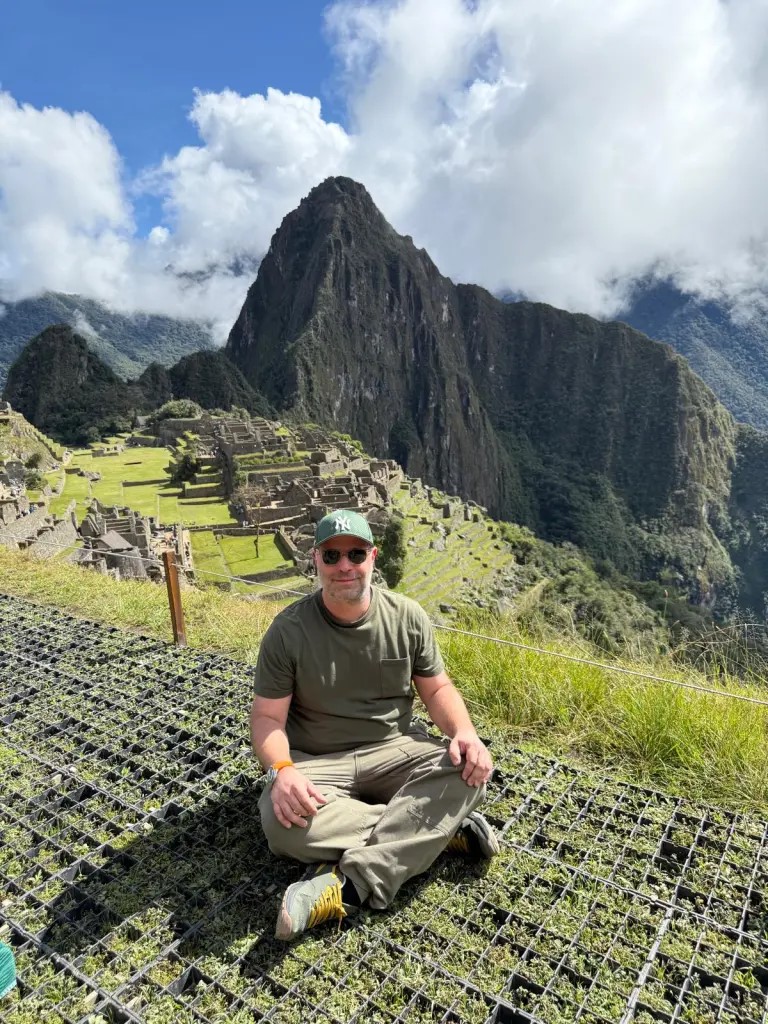
    Richard Jarocki at Machu Picchu after reaching the ruins without hiking the Inca Trail
    You don’t have to hike the Inca Trail to experience Machu Picchu—train and bus transportation make the site accessible to non-hikers.

    A Luxury Traveler’s Guide to Machu Picchu by Richard Jarocki

    For most people, Machu Picchu conjures up images of strenuous hikes, early mornings, and dusty boots. But what if you could witness the same breathtaking wonder without breaking a sweat—and do it all in luxury? As someone who blends high-end travel with real, on-the-ground experience, I set out to explore Machu Picchu in style—and this is your guide to doing the same.

    This isn’t a backpacker’s trip. This is Machu Picchu, elevated.


    Getting There in Style

    You don’t need to hike the Inca Trail to reach this iconic site. There are two scenic train options that offer a luxurious way to get there:

    Belmond Hiram Bingham Train – The gold standard of train travel in Peru. Think polished wood interiors, white tablecloth dining, live music, and panoramic windows. A full brunch, cocktails, and a private guide at Machu Picchu are included. Conde Nast Traveler ranked it among the most luxurious train rides in the world. Read more

    Vistadome or Sacred Valley Train – Still upscale, with large viewing windows and comfortable seating. Ideal for travelers who want luxury without the full Belmond price tag.

    Pro tip: Spend a night or two in the Sacred Valley to acclimate before the train ride. It’s the perfect prelude to the trip.


    Where to Stay: Luxury Hotels Near Machu Picchu (and Cusco)

    You have several top-tier lodging options that offer incredible service, views, and proximity to the ruins:

    1. Belmond Sanctuary Lodge

    Why it stands out: It’s the only hotel located right at the entrance to Machu Picchu. That means exclusive early access before the crowds.

    Ideal for: Those who want privacy, priority access, and round-the-clock service.

    2. Inkaterra Machu Picchu Pueblo Hotel

    Vibe: Eco-luxury meets Andean jungle. Private casitas, organic gardens, and on-site nature trails.

    Highlight: Their on-site spa and focus on sustainability make it a perfect retreat.

    3. Sumaq Machu Picchu Hotel

    Perks: Exceptional Peruvian cuisine, cooking classes, and spiritual offerings like Andean rituals.

    Location: Aguas Calientes, the town just below the ruins.

    4. Tambo del Inka, a Luxury Collection Resort & Spa

    Location: Sacred Valley (Urubamba)

    Highlight: Private train station on site. Ideal for a soft landing and full-service spa immersion.

    5. Alpaca Lodge & Explorations

    Location: Sacred Valley

    Vibe: This eco-conscious retreat provides private chalets with hot tubs and sweeping Andean views. The standout feature? Guests can pet and feed friendly alpacas on-site. With a focus on sustainability and serene design, it’s a perfect blend of luxury and authenticity for travelers seeking an unforgettable, immersive experience.

    Book: View Alpaca Lodge & Explorations on Airbnb

    6. Palacio del Inka, a Luxury Collection Hotel

    Location: Cusco city center

    Vibe: Housed in a historic colonial mansion with original Incan stonework, this hotel is both luxurious and culturally rich. Guests enjoy elegant rooms, a full-service spa, and one of the best breakfast spreads in Peru—served as early as 4–5 a.m. for early risers.

    7. Belmond Hotel Monasterio

    Location: Cusco, near the Plaza de Armas

    Vibe: A 16th-century monastery turned luxury hotel, combining historical charm with Belmond’s signature service. Known for its oxygen-enriched rooms and refined on-site dining, it’s an ideal base for unwinding after your Sacred Valley or Machu Picchu adventure.


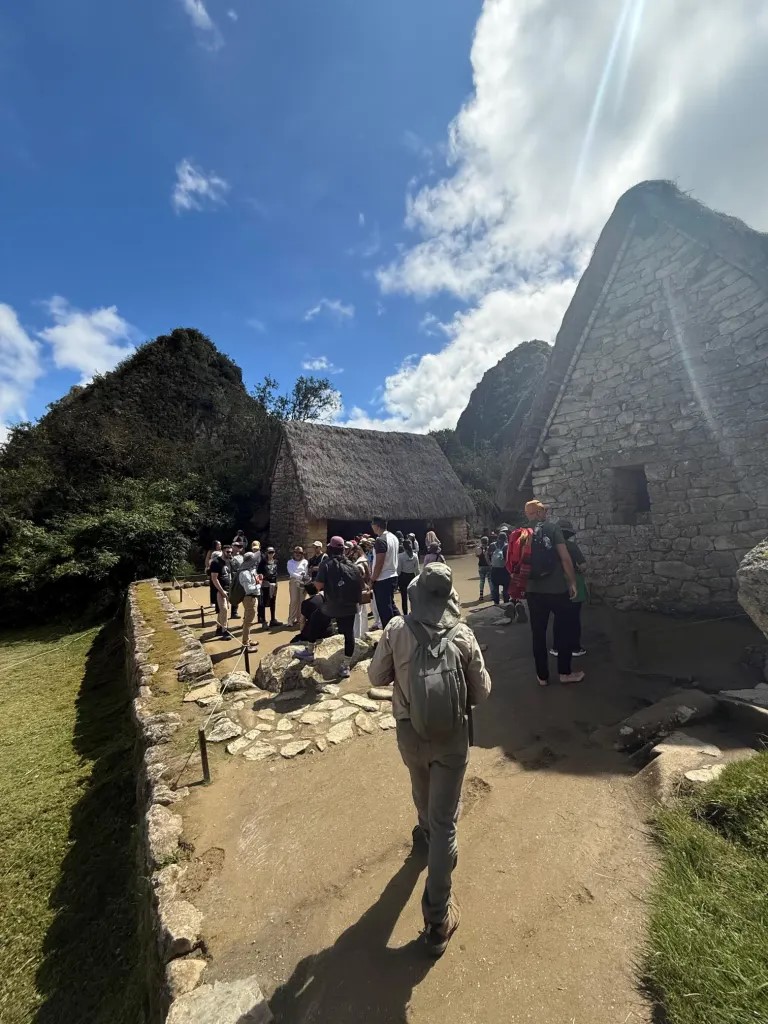
    Visitors walking through the historic stone ruins at Machu Picchu in Peru
    Reaching Machu Picchu without the Inca Trail still involves walking through the archaeological site, including stone paths, steps and uneven terrain.

    Visiting the Citadel in Comfort

    The final leg of your journey begins with a 20-minute shuttle up a winding mountain road. While many arrive breathless and tired from the trek, you’ll step off refreshed and ready to immerse yourself.

    Private Guided Tours

    Flexible pacing tailored to your interests

    In-depth knowledge of Incan history, architecture, and astronomy

    Opportunities for quiet moments of reflection away from the crowds

    Pro Tips for a Seamless Visit

    Go early: First entry at 6 a.m. means cooler temps and golden light for photos.

    Skip the stampede: Afternoon entries (2–4 p.m.) can be calmer once large tour groups have left.

    Choose Circuit 2: This route offers panoramic views and includes key sites like the Temple of the Sun and the Sacred Plaza.

    Dining and Recharging

    After the citadel, indulge in a gourmet lunch at your hotel or opt for one of Aguas Calientes’ finer restaurants like Indio Feliz or Tree House Restaurant, known for their creative takes on Andean cuisine.

    Then unwind with:

    A massage using native botanicals

    A private soaking tub overlooking the river

    Afternoon tea and a glass of Chilean wine


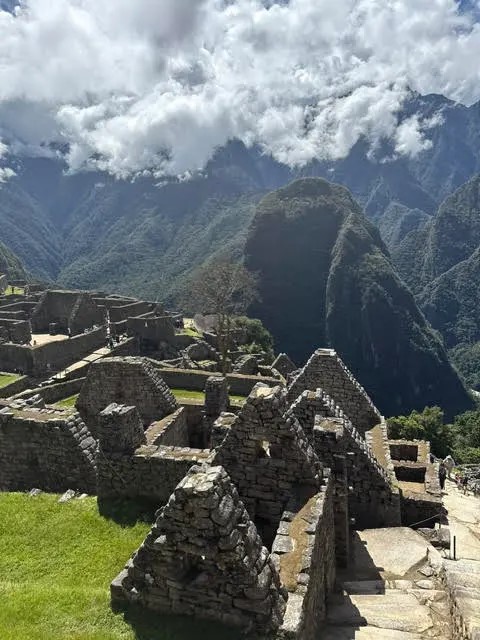
    Stone ruins of Machu Picchu surrounded by cloud-covered mountains in Peru
    Machu Picchu’s preserved stone buildings sit high in the Andes, surrounded by steep mountains and shifting clouds.

    The Return: Reflect and Rejuvenate

    Early Riser Perks at Palacio del Inka
    If you’re staying at Palacio del Inka before or after your Machu Picchu visit, take advantage of their thoughtful early-morning amenities. The hotel begins serving breakfast as early as 4–5 a.m. to accommodate travelers heading out for sunrise tours. It’s a small luxury that makes a big difference when your day starts before dawn.

    The train ride back is a chance to reflect on the scale of what you’ve just seen. Luxury trains often include dinner service, live music, or a glass of champagne as you cross back into the Sacred Valley.

    Once in Cusco, extend your journey with another few nights at Palacio del Inka or Belmond Hotel Monasterio. Add on curated experiences like:

    A private pisco tasting

    Artisanal market tours

    Day trips to nearby natural and cultural wonders such as Rainbow Mountain, Humantay Lake, the Maras Salt Mines, or the agricultural terraces of Moray


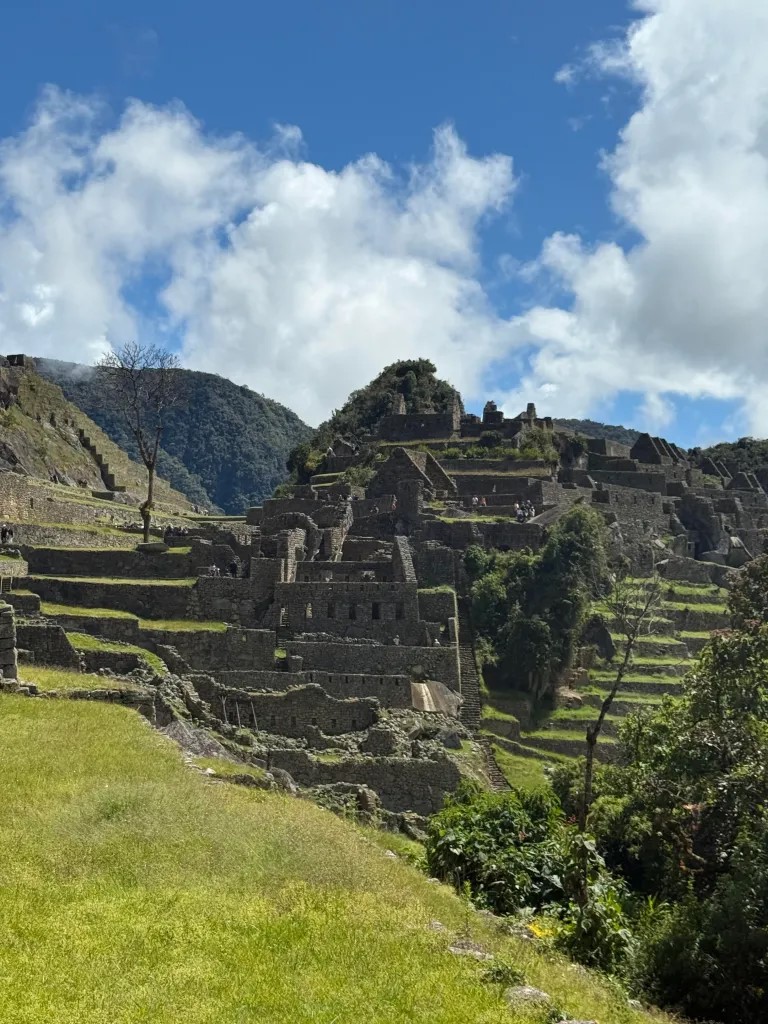
    Agricultural terraces and stone ruins at Machu Picchu beneath a blue sky
    Machu Picchu’s stone structures and agricultural terraces reveal how the Inca built an entire city into the steep Andean landscape.

    Final Thoughts

    Machu Picchu doesn’t have to be a grueling expedition to be meaningful. With the right approach, it becomes something far richer—a seamless blend of adventure, culture, and luxury. Whether you’re sipping champagne on the return train or waking up in a centuries-old monastery, this journey offers moments of awe, reflection, and refinement.

    If you’re ready to experience Machu Picchu in comfort and style, this is your invitation to travel differently—and intentionally.

    Plan your curated luxury experience at Travel with Richard

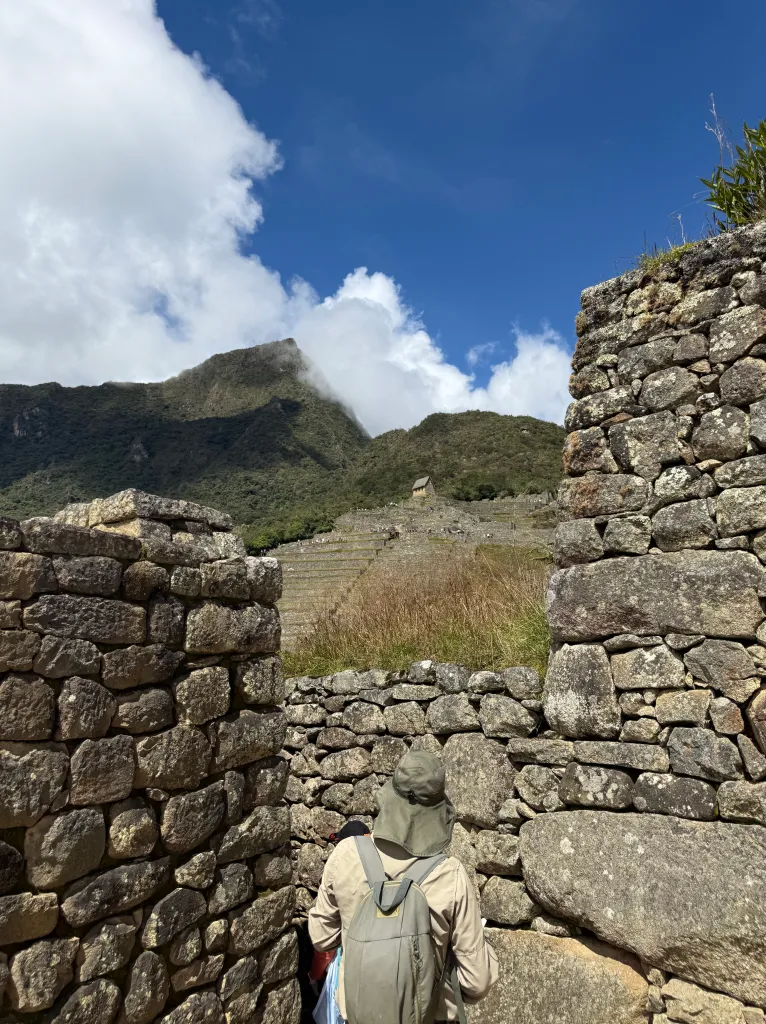
    Visitor walking through a narrow stone passageway at Machu Picchu in Peru
    Even without hiking the Inca Trail, exploring Machu Picchu requires navigating narrow passages, uneven stone paths and steps.

    Follow My IG

  • From Supercars to Suitcases: Why I’m Leaving the Auto Industry to Curate Luxury Travel Experiences

    For years, my world was powered by horsepower. I’ve had the honor of working with some of the most iconic names in the automotive world—Ferrari, BMW, Infiniti, and Ford. I’ve sat behind the wheel of dreams, sold machines that stir the soul, and helped clients discover the kind of joy only a perfect car can bring.

    But even passion can wear thin when it becomes routine.

    Loving cars and selling them are two very different things. Somewhere along the way, the showroom started to feel less like a playground and more like a grind. What once gave me energy began to feel transactional. The machines I once revered became commodities—VINs on a spreadsheet, monthly quotas, and deal sheets.

    That’s when I knew something had to change.


    Reigniting the Spark

    To be clear, I never stopped loving cars. In fact, Ferrari and BMW helped bring the spark back. Their craftsmanship, history, and relentless pursuit of excellence reminded me of why I fell in love with the automotive world in the first place.

    But now, I’m making a conscious choice to step away—not because the passion is gone, but because I don’t want to lose it again.

    I want to preserve what cars mean to me. I want to experience them in their purest form—not through inventory management systems, but through emotion, travel, and storytelling. I want to drive a Ferrari F8 through the streets of Modena, the hometown of Enzo Ferrari himself. I want to take a McLaren Senna through the winding roads of Brazil in honor of one of the greatest drivers in history. I want to unleash a BMW M-series or Mercedes-AMG on the Nürburgring and feel what engineering perfection really means—without the weight of a sales contract in my back pocket.

    This isn’t the end of my love for cars. It’s a rebirth.


    A New Direction: From Sales to Curated Experiences

    Over time, I started curating luxury events for exotic car lovers—private dinners, spirited drives, behind-the-scenes experiences. I realized I was no longer selling vehicles—I was selling a feeling. I was crafting unforgettable moments.

    And that gave me an idea: What if I could take my eye for luxury, my obsession with details, and my ability to craft meaningful experiences—and apply that to travel?

    Because when you think about it, luxury travel and exotic cars are two sides of the same coin: they’re about freedom, performance, aesthetic, and memory-making. They’re about going further—faster and in style.


    The Road Ahead: Building My Luxury Travel Agency

    So that’s exactly what I’m doing.

    I’m building a luxury travel agency rooted in storytelling, culture, and curation. This isn’t about cookie-cutter vacations. It’s about helping high-net-worth individuals and experience seekers discover the world on their own terms—through elevated itineraries, local insight, and a lifestyle lens.

    From Michelin-starred restaurants in São Paulo to hidden art galleries in Paris, desert drives in Dubai to vineyard escapes in Mendoza—every detail will be handpicked and personally vetted.

    I’ll help clients bypass the stress and unlock the soul of a destination. All they’ll need to do is show up—and enjoy.


    Living the Journey: Becoming a Global Nomad

    But there’s more to this pivot than just building a business.

    In the next few years, I plan to sell my home and take the leap into full-time, location-independent living. I’ll become a digital nomad—moving country to country, living out of my suitcase, scouting experiences, and building a global network of partners, hotspots, and hidden gems.

    This nomadic lifestyle isn’t just about freedom. It’s about building authenticity into every travel recommendation I make. If I tell you a restaurant is worth your time, I’ve eaten there—probably twice. If I recommend a suite, it’s because I stayed in it. If I say a city is magical, it’s because I felt it myself.

    The agency I’m building will be powered by personal experience—not just affiliate links or Google searches.


    Travel and Cars: A Perfect Marriage

    What excites me most about this new chapter is that I don’t have to choose between travel and cars—I get to combine them.

    Imagine a driving experience across Europe, curated like a Michelin tasting menu. Picture a Grand Prix weekend in Monaco, paired with yacht parties and private jet arrivals. Think about automotive-themed retreats in Maranello, Stuttgart, or Woking—where every element, from your hotel to your welcome cocktail, is steeped in history and passion.

    The automotive world gave me the foundation.

    Now I’m building something on top of it.


    Sharing the Journey

    As I travel, I’ll be documenting everything—across Instagram, YouTube, and my blog. Real stories. Real recommendations. Real insights.

    This isn’t content for content’s sake—it’s a living portfolio of what I offer and who I am. It’s also a way for others to come along for the ride, whether they’re looking for travel inspiration or ready to book their next unforgettable escape.

    Through this storytelling, I want to connect with people who crave more from their travels. People who appreciate detail, depth, and design. People who understand that luxury isn’t just price—it’s precision, intention, and experience.


    Why Now?

    Because the timing is right. The world is hungry for deeper, more meaningful experiences. People are spending differently. They’re chasing time, not things. And they’re looking for someone who can make that pursuit feel effortless.

    That’s where I come in.

    I know what it takes to impress discerning clients. I’ve done it in the car world, and I’ll do it again in travel. Only now, I’m not selling machines—I’m selling memories.


    Let’s Travel Together

    This isn’t just a new career. It’s a lifestyle transformation. One that blends luxury, cars, travel, and freedom into one cohesive story.

    And I’m inviting you to be part of it.

    If you’re someone who wants to travel differently—more intentionally, more luxuriously, more meaningfully—I’d love to help you plan your next escape.

    Whether it’s driving the Amalfi Coast in a convertible, dining in Tokyo’s hidden omakase spots, or attending Formula 1 weekends with exclusive access and five-star accommodations—I’ll make sure your journey is unforgettable.


    Ready to travel with purpose and style?
    Visit www.RichardJarocki.com or follow me on Instagram @therealrichardjarocki to start planning something unforgettable.

  • The Jobs I’d Do for Free: Motorsports, Cars, Travel & Food

    Wide angle view empty asphalt international race track with start and finish line , motion blur effect apply .

    Let’s be real—most people work to pay the bills. And that’s fair. But every once in a while, you find something so deeply aligned with who you are that it stops feeling like work altogether. That’s how I feel about motorsports reporting, car blogging, and sharing travel and food experiences with the world.

    If money weren’t a factor, I’d still wake up early for track days. I’d still spend hours writing about the roar of a V12 or the way a Michelin-star dish plays with flavor and texture. I’d still chase the thrill of discovering a hidden gem hotel or a back-alley restaurant serving something unforgettable.

    Because these things—they’re not just jobs to me. They’re extensions of who I am.


    Motorsports Reporting: Where Passion Meets Precision

    There’s nothing quite like the electricity of a race weekend. The tension in the paddock. The smell of rubber and fuel. The sound of engines pushing the redline. I don’t just watch Formula 1, WEC, or IMSA—I live it.

    Reporting on motorsports isn’t about reciting lap times or stats. It’s about storytelling. It’s about capturing the human drama, the engineering brilliance, and the emotion that fans feel around the world. It’s writing about a driver’s redemption arc, a team’s unexpected strategy, or the moment a rookie stuns the grid.

    It’s staying up until 3AM for a Grand Prix in Japan, typing with adrenaline in your veins. It’s interviewing the people behind the scenes—the race engineers, the tire techs, the unsung heroes. It’s analyzing the aerodynamics on a new chassis or digging into a controversial penalty.

    I’d do all of that for free. Not because it’s easy, but because it fuels me.


    Car Blogging & Reviews: More Than Just Horsepower

    If you hand me the keys to something special—be it a vintage Porsche, a McLaren Artura, or even a sleeper sedan—I’m going to treat that moment like a privilege. I don’t need a paycheck to write a 1,500-word breakdown of a car’s personality. I do it because I’m genuinely fascinated.

    To me, cars are rolling art. They’re emotion on wheels. Whether it’s the sharp bite of a Ferrari’s throttle response, the buttery smoothness of a Rolls-Royce ride, or the raw brutality of a tuned GT-R—every car tells a story. And I love translating that experience into words, visuals, and feelings for others to absorb.

    Blogging about cars means understanding the culture, too. The communities, the garages, the builds, the meets. It’s more than 0-60 times. It’s the way a car makes you feel when you’re alone on a perfect road or pulling into an event with something rare under you.

    That’s the kind of storytelling I could never get tired of. I’d do it endlessly—even if no one paid me to.


    Travel Blogging: Curating Experiences Worth Remembering

    People say travel is about the destination. But for me, it’s about the moments—the mosaic of small, rich details that turn a trip into a memory that stays with you forever.

    Waking up to sunrise over Machu Picchu. Watching São Paulo come alive from the rooftop pool of Hotel Unique. Taking a slow drive through Tuscany in a classic Alfa Romeo. These moments aren’t just for social media. They’re chapters in a story I want to share.

    Travel blogging lets me take others along for the ride. It lets me break down not just where to stay or what to eat, but how it feels to be somewhere. The energy of a place. The smells, the sounds, the unspoken rhythms. I love researching hidden gems, testing luxury hotels, reviewing elite experiences, and putting them into words that can inspire someone else’s next adventure.

    Would I do that for free? Without a second thought.


    Food & Fine Dining: A Journey Through Flavor

    You want to know where I really light up? Sit me down at a chef’s table with a multi-course tasting menu and a wine pairing that’s been chosen with care. I live for culinary storytelling—when chefs bring together technique, memory, culture, and art all in a single plate.

    Reviewing restaurants isn’t just about whether the steak was good or the service was prompt. It’s about capturing the philosophy behind a dish. It’s knowing when a cocktail has balance, when a dessert pushes boundaries, when the plating tells you something before you even taste it.

    Whether it’s a Michelin-starred restaurant or a street food stall with a line out the door, I want to share that experience with people who care about food the way I do. The craft, the detail, the obsession.

    And yes—I’d do it for free. Because food, like cars and travel, is one of the purest expressions of human passion.


    Doing It For the Love, Not the Likes

    In a world that’s obsessed with monetizing every passion, I think it’s important to ask: what would you still do if no one was watching? If no one was clicking, liking, or sponsoring?

    For me, it’s motorsports, cars, travel, and food. Always has been. Always will be.

    Of course, building a brand around these things takes work. I respect the hustle. But at the core, I don’t need a paycheck to tell you why Evvai in São Paulo was the most fun dining experience I’ve had this year. Or why Lewis Hamilton designing a modern Ferrari F40 is more than just a dream project—it’s a legacy move.


    Why Passion Still Matters

    I believe that passion is what gives life its edge. When you love what you do, it shows. Readers feel it. Audiences connect with it. And opportunities tend to follow.

    That’s why I write. That’s why I review. That’s why I capture the details and share the experience—because I genuinely care about the subjects I cover.

    Some people chase money and then try to find meaning. I’ve always chased meaning first. And in these lanes—motorsports, exotic cars, world-class travel, and unforgettable meals—I’ve found it over and over again.


    So… what job would you do for free?
    I’ve shared mine. Now it’s your turn—drop a comment and tell me what lights your fire.

    Daily writing prompt
    What job would you do for free?
  • Why I’m Heading to Peru: Lima, Cusco & Machu Picchu

    A Journey of Food, Culture, Altitude, and Intention

    If you know me, you know I don’t just travel for scenery or checklists — I travel for connection, culture, and the kind of inspiration you can’t Google. I curate experiences that leave an impression, not just on the photo roll, but on your memory. And Peru? It’s been on my radar for a long time.

    This May, I’m finally making it happen — a deeply intentional journey across Lima, Cusco, and the iconic wonder that is Machu Picchu. I’m flying into Peru with LATAM Airlines (first time), touching down in Lima before heading into the Sacred Valley. I’ve handpicked where I’m staying, where I’m dining, and the energy I want to absorb — because this isn’t just a trip. It’s a reset.

    Let me take you inside why Peru is next on my list.


    It Starts with a Flight

    Let’s begin with the air. I’m flying LATAM Airlines for the first time — JFK to Lima, and later Lima to Cusco and back. I’ve heard great things about LATAM’s service and how it sets the tone for a refined South American journey. The goal? Smooth, seamless travel, so I land ready to explore.

    This isn’t one of those quick weekend hops. It’s a full immersion — and that begins in the clouds, en route to a culture unlike any other.


    Stop One: Lima — Where the Flavor is as Bold as the City

    Lima is a culinary mecca, full stop. This city has carved out a global reputation as one of the world’s great food capitals. When the World’s 50 Best Restaurants named Central the #1 restaurant in the world, the spotlight got even brighter. But beyond the headlines, Lima is layered with depth: neighborhoods like Barranco and Miraflores, coastal energy, historic charm, and an obsession with ingredients that matter.

    I’ll be staying at two distinct properties to experience different sides of the city:

    • Souma Hotel – Barranco

    This boutique hotel is modern, minimal, and deeply rooted in its artsy neighborhood. Think morning walks to art galleries, intimate coffee shops, and a real sense of place.

    • JW Marriott Lima – Miraflores

    For the ocean views, high-end amenities, and perfect service. This is where I’ll relax, recharge, and indulge in world-class hospitality between culinary stops.

    While in Lima, I’m planning meals at a few of the most celebrated spots — but I’m also leaving room for the unexpected. That’s the key. A meal in a tucked-away cevichería, a rooftop bar recommendation from a local bartender, or a late-night anticucho plate from a street vendor with a crowd around it. The real Lima reveals itself between the reservations.


    Culinary Curiosity Meets Curated Dining

    Beyond Central, I’ll be diving into Peru’s Nikkei cuisine (Japanese-Peruvian fusion), Amazonian ingredients, and the creative reinvention of traditional dishes. From high-end omakase to hidden pisco bars, this city doesn’t just feed you — it tells you a story with every plate.

    And yes, expect full reports. I’m treating this as both exploration and research. Peru’s culinary culture is going to reshape how I think about flavor, balance, and storytelling through food.


    Then It’s Onward — to Cusco and the Sacred Valley

    From Lima, I’ll fly into Cusco — a city that sits at over 11,000 feet above sea level and feels like you’ve stepped into a living museum. But don’t let the altitude fool you. Cusco is alive. Colorful markets, cobblestone streets, Andean traditions, and a magnetic energy that you just feel in your bones.

    Staying at: Palacio del Inka, a Luxury Collection Hotel

    This is a property I’ve had my eye on for years. Built into a 500-year-old mansion, Palacio del Inka is luxury infused with Incan heritage. Walls that tell stories. Courtyards that hold silence. Service that’s seamless. It’s not just about where I sleep — it’s about staying somewhere that anchors you to the place.

    From this base, I’ll explore the city’s museums, sip coca tea in hidden courtyards, browse handwoven alpaca textiles, and adjust to the altitude — slowly and deliberately.

    Because after Cusco comes the crown jewel.


    Machu Picchu — A Journey, Not Just a Destination

    Let’s be honest: Machu Picchu doesn’t need much of an introduction. It’s one of the most iconic destinations on Earth. But while millions have visited, very few experience it intentionally. I plan to do just that.

    I’m taking the scenic route — literally — with a train ride through the Sacred Valley, passing small villages, waterfalls, and mountain landscapes that feel unreal. I want to absorb every detail on the way in. The buildup matters. The approach is part of the magic.

    When I arrive, I’m not just going for the photo. I’m going for the feeling — to stand in a place built centuries ago with purpose, alignment, and spiritual meaning. I want to breathe in the air and feel the enormity of what was created there — without machinery, without shortcuts, with only vision and will.

    Machu Picchu isn’t just about what you see. It’s about what you sense.


    Why Now? Why Peru?

    Because I believe in intentional travel — and I’ve been craving something grounded. Something real. After spending the last few years immersed in luxury cars, fine dining, Grand Prix weekends, and curated experiences around the world, I wanted a journey that connects earth with elevation, flavor with soul, and heritage with personal growth.

    Peru is that.

    It’s a country of contrasts:
    Urban and ancient.
    Refined and raw.
    Coastal and mountainous.
    Mystical and modern.

    And it’s been whispering to me for a while now.


    Travel as a Reset

    This trip isn’t about escape — it’s about returning to curiosity.

    It’s about recalibrating creativity, finding new sensory inspiration, and experiencing a place that’s built on layers. I’m going to connect with chefs, explore sacred spaces, take in panoramic views, and travel inward, even as I travel outward.

    As always, I’ll be doing it with intention — and a little style.


    What to Expect

    I’ll be documenting the journey as I go — expect highlights from hotel stays, restaurant deep dives, cultural moments, and maybe a few unfiltered thoughts about what it feels like to slow down in places that make you feel alive.

    There will be:

    • Insider looks at both boutique and luxury hotels
    • Culinary recaps and restaurant features
    • Cultural insights from both modern Lima and ancient Cusco
    • Scenic vignettes from Machu Picchu
    • Notes on flying LATAM and travel logistics for anyone planning a similar trip

    Final Thoughts

    I’ve traveled a lot. But this one’s different.

    This isn’t about luxury for the sake of luxury — it’s about choosing depth over excess, meaning over motion. Peru has something most destinations don’t: soul. And I’m going there to feel it fully.

    I’m not going to check it off a list. I’m going to let it change me.

    Follow along.

  • Where Passion Meets Prestige São Paulo’s Must-Try Culinary Destinations

    Experience the taste of luxury

    São Paulo’s Must-Try Culinary Destinations

    São Paulo is a city filled with incredible dining experiences, but these four restaurants stand out as my personal favorites. Each offers something unique—whether it’s Japanese-inspired cocktails, contemporary Italian cuisine, Michelin-starred refinement, or a bold celebration of pork. If you’re looking to explore São Paulo’s culinary scene, these spots are absolute must-visits.

    Tan Tan – Japanese Izakaya Meets Next-Level Cocktails

    📍 Pinheiros, São Paulo | World’s 50 Best Discovery

    Tan Tan is not just a ramen shop—it’s an experience. Inspired by traditional Japanese izakayas, Chef Thiago Bañares delivers umami-packed dishes like smoky yakitori skewers, rich ramen, and creative small plates that keep you coming back for more. But what truly sets Tan Tan apart is its cocktail program, featuring expertly crafted drinks with Japanese ingredients like yuzu, sake, and shiso. Whether you’re here for the food or the drinks (or both), Tan Tan never disappoints.

    Nelita – Contemporary Italian with a Brazilian Twist

    📍 Vila Madalena, São Paulo | Michelin Recommended | World’s 50 Best Discovery

    A hidden gem in São Paulo, Nelita is where Chef Tássia Magalhães reinvents Italian cuisine with local influences. The menu is constantly evolving, with standout dishes like house-made pastas, seafood crudos, and vegetable-forward plates that showcase a perfect balance of simplicity and refinement. The cozy, modern ambiance paired with an exceptional wine selection makes this a must-visit for lovers of contemporary Italian cuisine.

    Tangará Jean-Georges – Refined, Michelin-Starred Excellence

    📍 Palácio Tangará | ⭐ 1 Michelin Star

    Nestled in the stunning Palácio Tangará hotelTangará Jean-Georges brings Chef Jean-Georges Vongerichten’s globally acclaimed cuisine to Brazil. This Michelin-starred spot offers a beautifully executed menu that fuses French techniques with Brazilian ingredients, resulting in elegant yet flavorful dishes. The setting is as impressive as the food—a sophisticated dining room overlooking lush gardens, making it one of São Paulo’s most refined dining experiences.

    A Casa do Porco – The Ultimate Celebration of Pork & Sustainability

    📍 Downtown São Paulo | 🌱 Michelin Green Star | World’s 50 Best Restaurants

    A Casa do Porco, led by Chef Jefferson Rueda, is a must-visit for anyone who loves bold flavors and innovative cooking. This restaurant is all about pork, using every part of the animal in unique and unexpected ways. From the legendary Porco San Zé (slow-roasted pork) to the pork jowl sushi, each dish is crafted with creativity and precision.

    Beyond its culinary excellence, A Casa do Porco is also recognized for its commitment to sustainability, earning the prestigious Michelin Green Star for its focus on responsible sourcing, zero-waste cooking, and support for local farmers. The open-kitchen, lively vibe, and unbeatable quality make it an essential São Paulo dining experience.

    Experience the Best of São Paulo’s Food Scene

    These four restaurants represent the best of what São Paulo has to offer—innovation, passion, and an unforgettable dining experience. Whether you’re looking for Japanese-inspired mixology, contemporary Italian craftsmanship, Michelin-starred sophistication, or bold, sustainable Brazilian flavors, these spots are worth every bite.

  • The Best Michelin-Starred & World’s 50 Best Restaurants in Latin America

    The Best Michelin-Starred & World’s 50 Best Restaurants in Latin America

    Latin America is a culinary paradise, boasting some of the most innovative and highly acclaimed restaurants in the world. Across the region, chefs are redefining fine dining by blending local traditions with modern techniques, creating unique gastronomic experiences. Whether you’re traveling for an F1 Grand Prix or indulging in a luxury getaway, these Michelin-starred and World’s 50 Best restaurants in São Paulo, Buenos Aires, Lima, Mexico City, and Santiago offer unforgettable dining experiences.

    São Paulo, Brazil

    D.O.M. (🌟🌟 Michelin Stars | World’s 50 Best #11)

    • Chef: Alex Atala
    • Why Go: A globally recognized fine dining institution that highlights indigenous Brazilian ingredients with avant-garde techniques.
    • Must-Try Dish: Tapioca with Amazonian ants and native herbs.

    Evvai (🌟🌟 Michelin Stars | World’s 50 Best #16)

    • Chef: Luiz Filipe Souza
    • Why Go: A masterful fusion of Italian and Brazilian flavors, showcasing innovation and elegance in every dish.
    • Must-Try Dish: Oriundi Menu – a refined tasting experience highlighting Brazilian ingredients with Italian influences.

    A Casa do Porco (World’s 50 Best #4)

    • Chef: Jefferson Rueda
    • Why Go: A revolutionary pork-centric concept that elevates Brazilian cuisine with inventive, flavorful dishes.
    • Must-Try Dish: Pork sushi – an unexpected yet outstanding creation.

    Buenos Aires, Argentina

    Don Julio (🌟 Michelin Star | World’s 50 Best #10)

    • Chef: Pablo Rivero
    • Why Go: An iconic Argentinian steakhouse that offers some of the best grass-fed beef in the world.
    • Must-Try Dish: Bife de chorizo (sirloin steak) cooked over wood fire.

    Chila (🌟 Michelin Star | World’s 50 Best #33)

    • Chef: Pedro Bargero
    • Why Go: A contemporary Argentine dining experience featuring seasonal, ingredient-driven tasting menus.
    • Must-Try Dish: Patagonia lamb with black garlic and native herbs.

    Tegui (🌟 Michelin Star)

    • Chef: Germán Martitegui
    • Why Go: A refined yet bold take on Argentine flavors, offering a sleek and intimate setting.
    • Must-Try Dish: Patagonian lamb with Malbec reduction.

    Lima, Peru

    Central (🌟🌟 Michelin Stars | World’s 50 Best #1)

    • Chef: Virgilio Martínez
    • Why Go: The reigning #1 restaurant in the world, offering a tasting menu inspired by Peru’s diverse landscapes and ecosystems.
    • Must-Try Dish: “Altitude Tasting Menu” – featuring ingredients sourced from the Amazon to the Andes.

    Kjolle (🌟 Michelin Star | World’s 50 Best #8)

    • Chef: Pía León
    • Why Go: A fresh, ingredient-focused perspective on Peruvian cuisine from the former head chef of Central.
    • Must-Try Dish: Seasonal tasting menu inspired by Peru’s diverse ecosystems.

    Maido (🌟🌟 Michelin Stars | World’s 50 Best #6)

    • Chef: Mitsuharu Tsumura
    • Why Go: The pinnacle of Nikkei cuisine, seamlessly blending Japanese techniques with bold Peruvian flavors.
    • Must-Try Dish: “Cuy San” – a creative fusion of Peruvian guinea pig with Japanese culinary artistry.

    Mexico City, Mexico

    Pujol (🌟🌟 Michelin Stars | World’s 50 Best #5)

    • Chef: Enrique Olvera
    • Why Go: A legendary restaurant that reinvents Mexican cuisine with a focus on sustainability and tradition.
    • Must-Try Dish: “Mole Madre, Mole Nuevo” – a 2,000-day-aged mole sauce.

    Rosetta (🌟 Michelin Star | World’s 50 Best #49)

    • Chef: Elena Reygadas
    • Why Go: A charming, ingredient-driven restaurant where Mexican flavors meet European refinement.
    • Must-Try Dish: Hoja santa ravioli with requesón cheese.

    Quintonil (🌟 Michelin Star | World’s 50 Best #9)

    • Chef: Jorge Vallejo
    • Why Go: A cutting-edge take on contemporary Mexican cuisine, celebrating hyper-local ingredients and sustainability.
    • Must-Try Dish: Avocado tartare with escamoles (ant larvae).

    Santiago, Chile

    Boragó (🌟 Michelin Star | World’s 50 Best #29)

    • Chef: Rodolfo Guzmán
    • Why Go: Hyper-local cuisine inspired by Chile’s diverse ecosystems, using native ingredients in groundbreaking ways.
    • Must-Try Dish: “Endemic menu” featuring Patagonian ingredients.

    Ambrosía (🌟 Michelin Star | World’s 50 Best #38)

    • Chef: Carolina Bazán
    • Why Go: A French-Chilean fusion that brings a relaxed yet refined take on contemporary dining.
    • Must-Try Dish: Seafood ceviche with indigenous Mapuche spices.

    99 Restaurante (🌟 Michelin Star)

    • Chef: Kurt Schmidt
    • Why Go: A forward-thinking restaurant that blends Chilean flavors with international techniques.
    • Must-Try Dish: Sea urchin tart with crispy quinoa.

    Final Thoughts

    In May, I will be in Lima, Peru, and I am excited to experience these world-class dining establishments firsthand. Latin America’s fine dining scene is unlike any other, offering bold flavors, innovative techniques, and immersive culinary storytelling. Whether you’re craving a Michelin-starred steakhouse in Buenos Aires, a Nikkei masterpiece in Lima, or an avant-garde dining adventure in Mexico City, these restaurants define what it means to dine in luxury.

  • The World’s Most Exclusive Ultra-Luxury Hotels for High-Net-Worth Travelers

    The Best Ultra-Luxury Hotels for High-Net-Worth Travelers

    For the elite, travel is about more than just five-star accommodations—it’s about exclusivity, privacy, and unparalleled service. The world’s most prestigious hotels offer bespoke experiences, VIP treatment, and unparalleled comfort, ensuring that their guests experience true luxury in every aspect of their stay. From remote island retreats to sky-high urban sanctuaries, here are some of the most exquisite ultra-luxury hotels catering to high-net-worth individuals (HNWIs).

    1. Aman Tokyo – Japan

    • Why Go: A serene urban sanctuary that seamlessly blends traditional Japanese minimalism with modern luxury. Situated high above the city in the Otemachi Tower, Aman Tokyo offers breathtaking skyline views, personalized service, and a tranquil spa experience that immerses guests in the elegance of Japanese hospitality.
    • Signature Experience: A private tea ceremony in the Aman Spa with panoramic city views, designed to provide complete relaxation and mindfulness.
    • Exclusive Amenities: Infinity pool overlooking the skyline, handcrafted ryokan-style interiors, and an unparalleled sense of peace in the heart of one of the world’s busiest cities.

    2. Burj Al Arab – Dubai

    • Why Go: Often referred to as the world’s only seven-star hotel, Burj Al Arab redefines opulence. From its sail-shaped silhouette to its fleet of Rolls-Royces, this Dubai icon delivers unparalleled grandeur, personalized butler service, and some of the most extravagant suites in the world.
    • Signature Experience: The Royal Suite, featuring a gold-plated iPad concierge, 24-karat gold fixtures, and a rotating bed with a panoramic view of the Persian Gulf.
    • Exclusive Amenities: Helipad for VIP transfers, private beach club, world-class dining at Al Mahara underwater restaurant, and exclusive yacht charters available to guests.

    3. Cheval Blanc Randheli – Maldives

    • Why Go: A private island paradise nestled in the Noonu Atoll, this exclusive resort is designed for those seeking absolute seclusion and indulgence. With only 46 overwater and beachfront villas, guests enjoy personalized butler service, curated Michelin-star dining, and the pristine beauty of the Maldivian waters.
    • Signature Experience: Private yacht excursions to untouched atolls, complete with champagne service and gourmet dining under the stars.
    • Exclusive Amenities: Guerlain Spa on a private island, state-of-the-art water sports, in-villa dining experiences with a personal chef, and underwater explorations via luxury diving excursions.

    4. The Peninsula Paris – France

    • Why Go: A historic landmark hotel exuding Parisian elegance, The Peninsula offers a blend of traditional luxury and modern refinement. Located steps from the Champs-Élysées, it boasts spacious suites, rooftop dining, and a world-class spa.
    • Signature Experience: Private rooftop dining with an unparalleled view of the Eiffel Tower, featuring a custom-curated menu by Michelin-starred chefs.
    • Exclusive Amenities: Rolls-Royce Phantom limousine service, hidden spa retreats, and personalized Parisian shopping experiences with a dedicated stylist.

    5. Amangiri – Utah, USA

    • Why Go: A remote desert retreat known for its minimalist luxury and deep connection to the surrounding landscape. Amangiri offers world-class spa treatments, private canyon hikes, and a sense of unparalleled seclusion, making it one of the most exclusive destinations in the U.S.
    • Signature Experience: Hot air balloon rides over the breathtaking Utah canyons, offering a once-in-a-lifetime perspective on the natural beauty of the region.
    • Exclusive Amenities: Private villas with personal plunge pools, guided cultural experiences with Navajo elders, and heli-skiing excursions in the winter months.

    6. Four Seasons Private Island at Voavah – Maldives

    • Why Go: The ultimate private island buyout, this Forbes Five-Star retreat is the epitome of exclusivity. With only seven villas, this sanctuary offers complete control over your luxury experience, from private chefs to personal dive instructors.
    • Signature Experience: Exclusive use of a private superyacht, allowing guests to explore hidden corners of the Maldives in unmatched luxury.
    • Exclusive Amenities: On-call marine biologist for customized snorkeling and diving experiences, personal spa sanctuary, and 24-hour security for ultimate privacy.

    7. Singita Sasakwa Lodge – Tanzania

    • Why Go: Perched on a ridge in Serengeti National Park, this ultra-luxury safari lodge blends colonial elegance with one of the best wildlife experiences in the world. Each private cottage offers sweeping views of the plains, while Singita’s conservation efforts ensure eco-luxury at its finest.
    • Signature Experience: Private guided safaris in custom-designed Land Cruisers, followed by sundowners overlooking the Serengeti migration.
    • Exclusive Amenities: Infinity pools overlooking the savannah, private plunge pools, farm-to-table gourmet dining, and a wine cellar featuring Africa’s finest vintages.

    8. The Ritz-Carlton, Kyoto – Japan

    • Why Go: Overlooking the Kamogawa River and the Higashiyama mountains, The Ritz-Carlton Kyoto blends contemporary elegance with traditional Japanese ryokan elements. With some of the most spacious suites in the city, it’s a haven for discerning travelers seeking cultural immersion.
    • Signature Experience: Private Kaiseki dining experience curated by master chefs, featuring Kyoto’s seasonal delicacies.
    • Exclusive Amenities: Zen garden-facing suites, kimono-fitting experiences, and personal Ikebana (flower arrangement) workshops with Japanese artisans.

    Final Thoughts

    For HNWIs, luxury travel isn’t just about finding the most expensive hotel—it’s about securing an unparalleled experience that blends privacy, exclusivity, and bespoke services. Whether it’s the serene elegance of Aman Tokyo, the opulence of Burj Al Arab, or the private island escape of Cheval Blanc Randheli, these ultra-luxury hotels redefine elite hospitality.

    True luxury isn’t just where you stay—it’s how you experience the world.

  • How to Dine at the Most Exclusive Restaurants in the World

    How to Dine at the Most Exclusive Restaurants in the World

    For HNWIs, dining isn’t just about eating—it’s about experiencing culinary artistry in Michelin-starred and invite-only restaurants around the globe. Securing a table at these elite establishments requires strategic planning, VIP access, and insider knowledge. Whether it’s a hidden dining experience in Shanghai or a private tasting with a world-renowned chef, here’s how to gain access to the world’s most coveted fine dining experiences.

    1. Booking Through Elite Concierge Services

    For many high-net-worth individuals (HNWIs), concierge services are the ultimate gateway to securing reservations at fully booked, world-famous restaurants. These services maintain exclusive relationships with top dining venues and can often secure last-minute bookings or priority seating.

    Top Elite Concierge Services for Fine Dining Access:

    • Amex Centurion Concierge – For American Express Black Card holders, securing VIP dining reservations is part of the membership.
    • Quintessentially – A global luxury concierge service offering bespoke travel and fine dining experiences.
    • Aspire Lifestyles – Known for securing high-demand restaurant reservations worldwide.
    • John Paul Group – Works directly with Michelin-starred restaurants to accommodate exclusive clientele.

    Many of these services also provide customized tasting menus and meet-the-chef experiences, elevating dining into a truly bespoke affair.

    2. Private Buyouts & Chef’s Table Access

    For those who want complete exclusivity, private buyouts allow HNWIs to take over an entire Michelin-starred restaurant for the evening. This ensures a personalized culinary journey, often featuring custom menus, rare wine pairings, and one-on-one interactions with top chefs.

    Top Restaurants Offering Private Buyouts:

    • Masa (New York, USA) – One of the most expensive sushi experiences in the world, where a private booking guarantees an unparalleled omakase experience.
    • Sublimotion (Ibiza, Spain) – A multi-sensory, Michelin-starred experience blending food, technology, and theatrics in a private setting.
    • Mirazur (Menton, France) – This World’s Best Restaurant winner offers bespoke private dining experiences overlooking the French Riviera.

    For a more intimate VIP experience, many three-Michelin-starred restaurants offer Chef’s Table reservations, where guests dine directly in the kitchen while the head chef prepares a tailor-made menu.

    3. Networking & Invitation-Only Access

    Some of the most exclusive restaurants in the world operate strictly on an invitation-only basis. These dining spots are often frequented by celebrities, business tycoons, and royalty, making them inaccessible to the general public.

    Most Coveted Invite-Only Restaurants:

    • Ultraviolet by Paul Pairet (Shanghai, China) – A high-tech, immersive dining experience limited to 10 guests per night.
    • Ralph Lauren’s Polo Bar (New York, USA) – A members-only dining spot favored by elite guests and fashion insiders.
    • Frantzén (Stockholm, Sweden) – While open to the public, its highly limited seating and invite-only private rooms make it difficult to secure reservations.

    To gain entry to such establishments, one often needs high-profile connections, luxury brand partnerships, or invitations from members of the elite dining community.

    4. Staying in High-End Hotels with Exclusive Reservations

    Ultra-luxury hotels often partner with Michelin-starred restaurants, securing VIP tables for their guests. Some of these hotels house their own world-renowned fine dining establishments, while others leverage their connections to guarantee priority seating for elite travelers.

    Hotels That Provide VIP Dining Access:

    • The Ritz Paris (France) – Offers priority access to the exclusive two-Michelin-starred L’Espadon.
    • The Mandarin Oriental Tokyo (Japan) – Home to Michelin-starred Sushi Sora, featuring panoramic city views.
    • Claridge’s (London, UK) – A legendary luxury hotel with exclusive guest access to its iconic Michelin-starred dining experiences.

    Many HNWIs leverage private butler services at these hotels to manage last-minute reservations or secure highly coveted tables at partner restaurants.

    5. Attending Gastronomic Festivals & Private Tastings

    For those looking to experience the pinnacle of fine dining, elite culinary events and gastronomic festivals provide an exclusive way to meet the world’s top chefs and sample one-of-a-kind dishes.

    The Most Prestigious Culinary Events:

    • Michelin Star Revelation Dinners – Exclusive invitation-only events where Michelin awards are unveiled.
    • Madrid Fusión (Spain) – One of the world’s leading gastronomy summits featuring private tastings from award-winning chefs.
    • The Grand Gelinaz Shuffle – A secret dining event where top chefs switch places and create one-night-only menus in surprise locations.
    • Four Hands Dinners – Events where two world-class chefs collaborate on a limited-time tasting menu, often held in invitation-only venues.

    Attending these events ensures that dining isn’t just about food—it’s about exclusivity, networking, and being at the forefront of culinary innovation.

    6. Membership-Only Dining Clubs

    A growing trend among ultra-high-net-worth individuals (UHNWIs) is membership-only dining clubs, where access is strictly limited to elite members.

    The Most Exclusive Private Dining Clubs:

    • CORE: Club (New York, USA) – An invite-only club featuring access to private dining with world-renowned chefs.
    • Silencio (Paris, France) – A members-only dining experience curated by elite culinary experts and cultural icons.
    • Casa Cruz (London, UK) – A luxury dining club frequented by billionaires and celebrities.

    These clubs offer not just exclusive menus, but high-level networking opportunities in discreet, ultra-private settings.

    Final Thoughts

    Dining at the world’s most exclusive restaurants requires more than just wealth—it demands access, strategy, and the right connections. Whether securing a table through an elite concierge service, booking a private buyout, or gaining entry to invite-only dining experiences, the ability to experience culinary excellence at the highest level is a true status symbol.

    For the world’s most discerning diners, luxury dining isn’t just about food—it’s about exclusivity, artistry, and once-in-a-lifetime experiences.

  • Top Benefits of an F1 Luxury Vacation Package

    For motorsport enthusiasts, few events match the adrenaline-pumping excitement of a Formula 1 Grand Prix. Among the most electrifying races on the F1 calendar is the São Paulo Grand Prix, held at the iconic Interlagos Circuit in Brazil.

    While the race itself promises heart-racing action, planning the perfect F1 trip can be overwhelming. That’s where Richard Jarocki F1 luxury vacation packages comes in.

    Why People Love Attending F1 Races.

    Unparalleled Atmosphere.

    There’s nothing quite like the atmosphere at a live Formula 1 event. The deafening roar of the engines, the anticipation before lights out, and the collective gasps as cars battle for position create an electrifying environment that television simply can’t capture. The São Paulo Grand Prix, in particular, is renowned for its passionate Brazilian fans, whose energy elevates the excitement to another level.

    World-Class Racing Action.

    Interlagos is a favorite among drivers and fans alike, offering one of the most thrilling circuits on the F1 calendar. With its combination of tight corners, fast straights, and unpredictable weather conditions, the São Paulo Grand Prix often delivers dramatic overtakes and edge-of-your-seat moments. Historic races, title-deciding battles, and legendary performances have cemented its reputation as a must-see event.

    Glamour and Luxury.

    F1 is synonymous with luxury, attracting a global crowd of celebrities, business leaders, and motorsport aficionados. Attending a Grand Prix isn’t just about the race—it’s about indulging in fine dining, exclusive parties, and VIP experiences that define the glamorous F1 lifestyle.

    Cultural Immersion.

    Beyond the track, São Paulo offers vibrant culture, exquisite cuisine, and dynamic nightlife. Exploring the city’s rich history, indulging in Brazilian gastronomy, and experiencing the local flair adds depth to your Grand Prix getaway.

    Ferrari Formula 1 car navigating a wet curve at Interlagos race track in Brazil.

    Perks of Richard Jarocki Luxury Vacation Packages.

    While the excitement of attending an F1 race is unmatched, organizing the logistics—flights, accommodations, transfers, tickets, and exclusive experiences—can be complex. That’s where Richard Jarocki F1 luxury vacation packages excels, offering a bespoke, stress-free approach to planning your ultimate F1 adventure.

    Tailored Luxury Experiences.

    Richard Jarocki doesn’t offer cookie-cutter travel packages. Instead, he curates fully customized itineraries based on your preferences, ensuring every detail reflects your personal style and desires. From securing premium Paddock Club access to arranging private track tours, every moment is crafted for luxury and exclusivity.

    VIP Access and Exclusive Perks.

    With deep connections in the F1 world, Richard Jarocki can secure VIP experiences that go beyond standard offerings. Imagine watching the race from the most coveted vantage points, enjoying pit lane walks, and mingling with F1 insiders at exclusive events. These are the kinds of privileges that transform a Grand Prix trip into an unforgettable, once-in-a-lifetime experience.

    Seamless Logistics.

    Navigating São Paulo’s bustling cityscape, language barriers, and race-day crowds can be challenging. Richard Jarocki’s team handles all the logistics—from luxury accommodations and private airport transfers to restaurant reservations and city tours—so you can focus solely on enjoying the race and your surroundings.

    Stress-Free Planning.

    Coordinating an international trip, especially around a major event like the São Paulo Grand Prix, can be overwhelming. With Richard Jarocki at the helm, you’ll have peace of mind knowing every detail is expertly managed. Their team anticipates potential challenges, ensuring your travel is smooth, efficient, and hassle-free.

    Personalized Attention.

    What sets Richard Jarocki apart is the personalized attention given to each client. You’re not just another booking; you’re a valued guest with unique tastes and expectations. The team is available to assist you before, during, and after your trip, providing concierge-level support to enhance your experience.

    Reserve Your Luxury Vacation Package!

    Experience unparalleled luxury and excitement by partnering with Richard Jarocki. We will plan every aspect of your F1 adventure so all you need to focus on is having the time of your life. Learn more about our luxury vacation packages online, or contact us to reserve your spot now.