
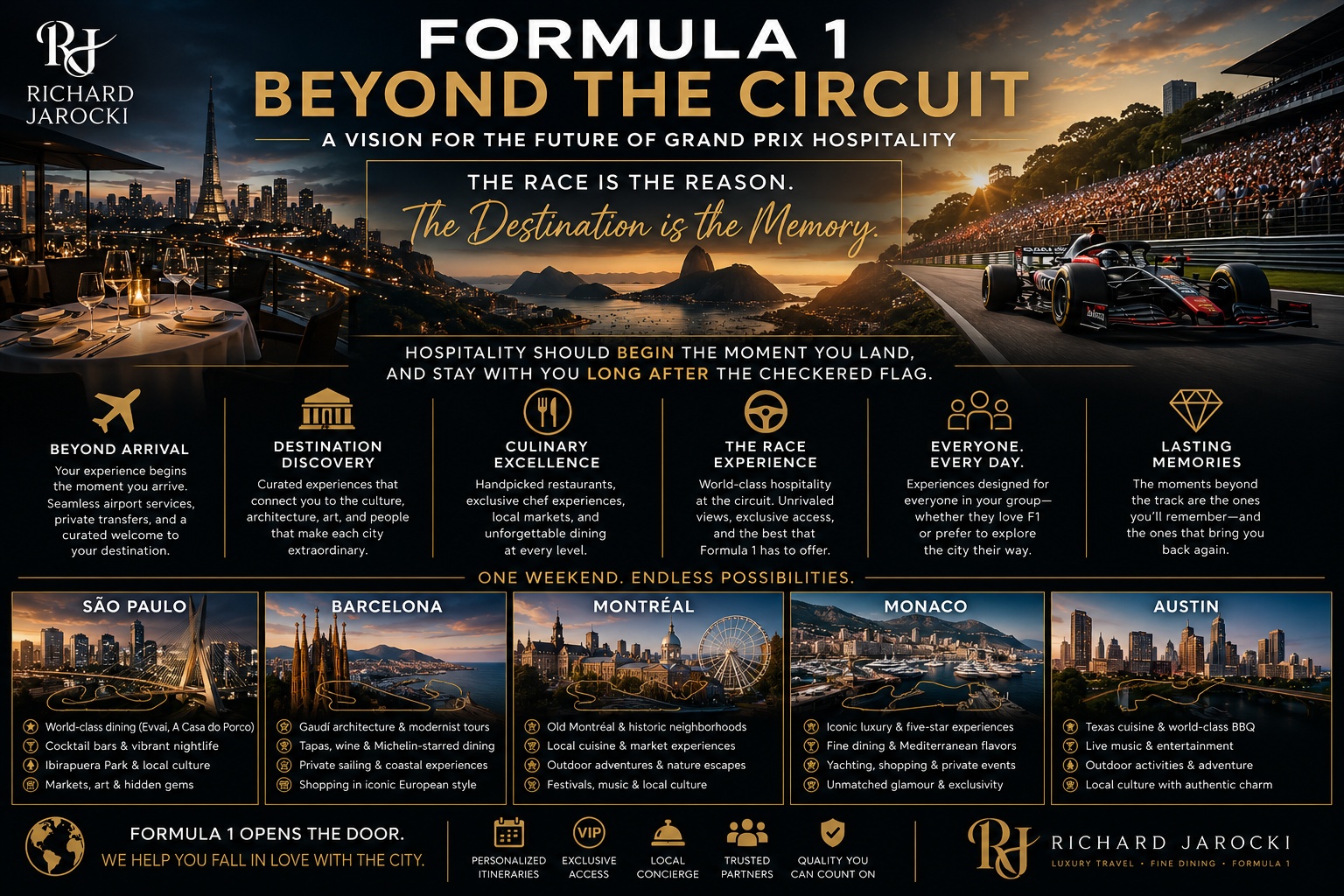
A Vision for the Future of Grand Prix Hospitality
The Opportunity
Over the past several years, I’ve traveled to Formula 1 destinations around the world—not simply to attend races, but to experience the cities that host them.
Long before I purchase a race ticket, I’m researching restaurants, cocktail bars, hotels, neighborhoods, architecture, museums, and local culture. Sometimes I know where I’ll have dinner months before I know where I’ll be sitting on race day.
Along the way, I realized something.
Formula 1 has become one of the world’s greatest reasons to travel.
But we’re still treating the destination as a backdrop rather than part of the experience.
Every Grand Prix introduces hundreds of thousands of people to cities they may never have otherwise visited. The racing is extraordinary, yet the opportunity to connect guests with the destination often begins and ends at the circuit gates.
I believe there’s an opportunity to expand what Formula 1 hospitality means—not by replacing what’s already exceptional, but by extending it beyond the track.
Formula 1 Isn’t Selling Three Days
This is where I think the article becomes more interesting.
People often describe Formula 1 as a weekend event.
I don’t think that’s true anymore.
When someone travels from New York to São Paulo, London to Singapore, or Sydney to Montréal, they’re not buying a three-day sporting event.
They’re planning an international vacation.
The race may be the reason they booked the flight, but it’s rarely the only reason they’re traveling.
For many guests, the Grand Prix is one chapter in a much larger story.
Hospitality should reflect that.
Hospitality Should Begin Before the First Practice Session
Today’s hospitality programs are exceptional once guests arrive at the circuit.
But what happens before Friday morning?
Imagine arriving in Barcelona.
Instead of simply receiving your race credentials, you receive a curated itinerary tailored to your interests.
Perhaps you’re passionate about architecture. Your first afternoon explores Gaudí’s masterpieces before dinner at one of Barcelona’s most celebrated restaurants.
Maybe food is your passion. Your itinerary introduces you to neighborhood tapas bars, a market tour, and one of the city’s Michelin-starred tasting menus.
Or perhaps you’re visiting with your family. While you’re at the circuit, your spouse and children spend the day on experiences designed specifically for them, all curated under the same standard of excellence associated with Formula 1.
Now hospitality isn’t confined to the paddock.
It’s woven into the entire journey.
One Trip. Different Experiences.
This, in my opinion, is where Formula 1 has its biggest opportunity.
Not everyone who travels to a Grand Prix is a Formula 1 fan.
Some are spouses.
Some are children.
Some are parents.
Some are corporate guests.
Some are clients invited by sponsors.
Some simply want to experience a new city.
Yet too often they’re treated as an afterthought.
Imagine asking one simple question during booking:
“Who is traveling with you?”
That single question changes everything.
One guest spends the afternoon inside the Paddock Club.
Their partner spends the afternoon exploring São Paulo’s art museums with a private guide before enjoying cocktails at one of Latin America’s best bars.
Their children participate in an FIA-inspired STEM program where they learn how aerodynamics, engineering, and sustainability shape modern motorsport through hands-on activities.
Everyone reconvenes for dinner.
Everyone has stories to tell.
Nobody spent the day waiting for someone else.
Every Grand Prix Should Feel Like Its Host City
One of Formula 1’s greatest strengths is its global calendar.
No two cities are alike.
So why should hospitality feel the same?
The experience in Japan should celebrate Japanese craftsmanship, precision, and cuisine.
Montréal should showcase Québec’s culinary scene, history, and neighborhoods.
São Paulo should introduce guests to one of the world’s most exciting food cities.
Melbourne should embrace its coffee culture, laneways, and coastal lifestyle.
Monaco should feel unmistakably Monaco.
The destination itself should shape the experience.
Because guests don’t simply remember where they watched the race.
They remember where they had the best meal of their lives.
They remember the bartender who introduced them to a local spirit.
They remember wandering neighborhoods they would never have discovered on their own.
Those memories become inseparable from the Grand Prix itself.
A New Standard: FIA-Endorsed Destination Experiences
This doesn’t require Formula 1 to become a tour operator.
Instead, it could become a trusted curator.
Working alongside tourism boards, Michelin Guide restaurants, museums, luxury hotels, local guides, and cultural institutions, every Grand Prix could offer an official collection of experiences carrying the same quality standards associated with the championship.
Guests would know these aren’t generic excursions.
They’re experiences chosen because they represent the very best of that city.
That distinction matters.
Technology Makes This Possible
Imagine the official Formula 1 app evolving beyond schedules and timing.
After purchasing your ticket, guests complete a short profile.
- Are you traveling alone?
- With family?
- With children?
- Are you interested in food?
- Architecture?
- Shopping?
- Wine?
- Photography?
- Wellness?
- Adventure?
Artificial intelligence could build a personalized itinerary around the race weekend, integrating official experiences, restaurant reservations, transportation, and local recommendations into one seamless journey.
Every guest leaves with an experience unique to them.
Why This Makes Business Sense
This isn’t simply about improving hospitality.
It’s about increasing value for everyone involved.
When visitors extend their stay from three nights to six, everyone benefits.
Hotels see higher occupancy.
Restaurants welcome more guests.
Museums and attractions gain additional visitors.
Local businesses generate more revenue.
Sponsors gain more opportunities to engage with guests beyond the circuit.
Host cities strengthen the economic case for investing in Formula 1.
Formula 1 itself becomes associated with world-class travel, not just world-class racing.
Hospitality becomes an economic engine rather than simply an event offering.
A Framework for Destination Hospitality
If I were designing hospitality for a Grand Prix, I’d build it around five principles.
1. Arrival
The guest experience begins at the airport—not at the circuit.
2. Discovery
Introduce visitors to the city’s neighborhoods, culture, history, and people.
3. Culinary
Use restaurants, markets, cafés, and bars to tell the story of the destination.
4. Circuit
Deliver the exceptional race-day experience Formula 1 already excels at.
5. Legacy
Leave guests wanting to return to the city, even when there isn’t a race.
When these five elements work together, a Grand Prix becomes more than a sporting event.
It becomes one of the world’s great travel experiences.
Beyond Hospitality
Ultimately, this isn’t just about hospitality.
It’s about strengthening the relationship between Formula 1 and the cities that welcome it.
The championship already inspires millions of people to travel.
The next evolution is ensuring they fall in love not only with the race, but with the destination itself.
Because the most memorable Grand Prix weekends don’t end when the checkered flag falls.
They continue every time someone remembers the café where they had breakfast, the neighborhood they wandered through, the restaurant they’ll spend years recommending to friends, or the city they can’t wait to return to.
Formula 1 has already become a global lifestyle brand.
I believe its next chapter is becoming the world’s greatest gateway to travel.
Leave a Reply