
Formula 1 Grandstand Seats: At a Glance
My priority: A clear view of the racing, a screen I can read, and a seat I’ll enjoy for the whole day.
Best viewing areas: Braking zones, corners and overtaking opportunities. A fast straight alone doesn’t always offer the most action.
Weather protection: Check whether your actual seat is covered and how the sun moves across the stand. Pack for rain even with a roof.
Screen visibility: Look for recent photos taken from your section. A nearby screen is useful only if you can see it clearly.
Comfort and access: Consider reserved versus unreserved seating, stairs, entry queues, toilets, food and the walk to your pickup point.
Ticket inclusions: Confirm which days are included and where you can go. Fan-zone access, track walks and hospitality vary by ticket and event.
My experience: Interlagos taught me the value of rain protection; Canada showed me how much shelter matters; Barcelona made me think harder about the sun.
Before booking: Check the current seating map, recent spectator photos, restrictions and transfer arrangements.
My rule: Buy for the experience you want, not just the name of the grandstand.
How to Choose Formula 1 Grandstand Seats: 10 Smart Lessons
I used to think choosing Formula 1 grandstand seats was mostly about finding a section with a good view of the track.
Then I started attending races.
My first Formula 1 trip was the Canadian Grand Prix, where wet weather made covered seating and access to an indoor hospitality dining area much more valuable than I understood when the weekend started.
At Interlagos, I got soaked and learned just how quickly São Paulo weather can change.
In Barcelona, I learned the opposite lesson when my grandstand seats spent race day directly in the sun.
All three were great Formula 1 experiences. I would happily go back to every one of them.
But they changed the way I look at Formula 1 tickets and a grandstand map before spending money.
Now I ask a lot more questions.
Is the grandstand covered?
Where will the sun be during the race?
Can I see a large screen?
How much of the circuit can I actually see?
Is this a part of the track where something is likely to happen, or will I mostly watch cars disappear past me at full speed?
How difficult is it going to be to reach the section?
Can I move around the circuit?
Can I leave and come back?
What food and drink options are available nearby?
And maybe the most important question: after sitting there for an entire Formula 1 weekend, would I pay for that seat again?
That is what this F1 grandstand guide is about.
I am not trying to tell you there is one perfect grandstand at every Formula 1 circuit. There is not.
What I can do is explain what I learned from attending races in Canada, Brazil and Spain, and how I now evaluate Formula 1 grandstand seats before I buy them.
1. A Great View Is Only the Beginning
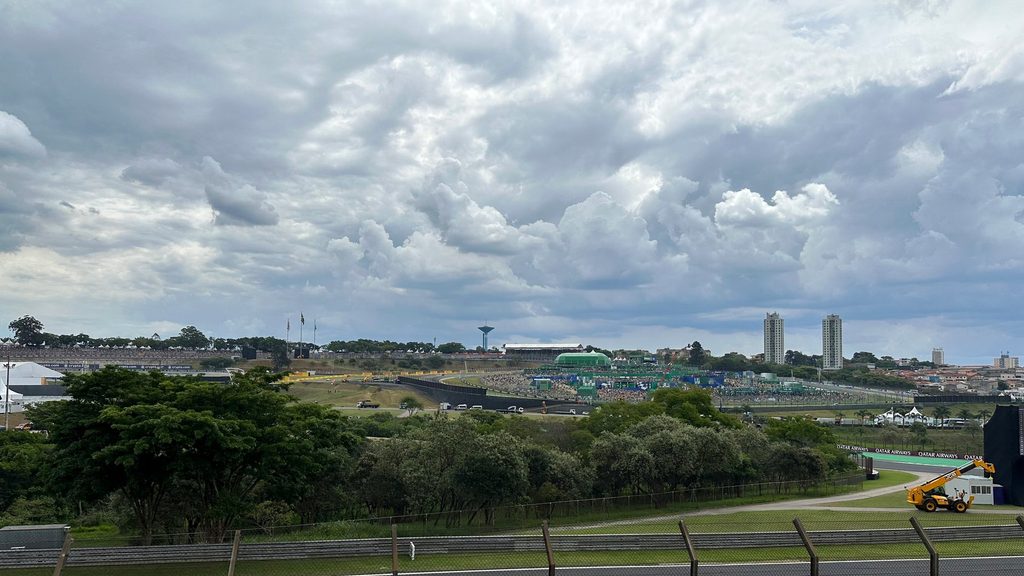
The first thing most of us look at is the circuit map.
That makes sense.
If I am paying for Grand Prix seating, I want to see something worthwhile.
But I have learned that the words “good view” can mean very different things.
A seat might give you a perfect look at one corner but almost nothing else.
Another grandstand might sit farther away from the action but allow you to see several parts of the circuit.
I increasingly prefer the second type.
I want to be able to follow cars for more than a few seconds.
Elevation matters too.
Being higher in a grandstand can sometimes open up an entirely different view of the circuit. You may be able to see over barriers, fencing and the people in front of you while also following cars through multiple corners.
That does not mean higher is always better.
If you are too far away, you can lose some of the feeling of speed and proximity that makes seeing Formula 1 in person so impressive.
The goal is balance.
When I look at Formula 1 grandstand seats now, I am asking what I can actually watch from that location, not simply whether the grandstand appears close to the track on a map.
2. At Interlagos, I Learned to Respect the Weather
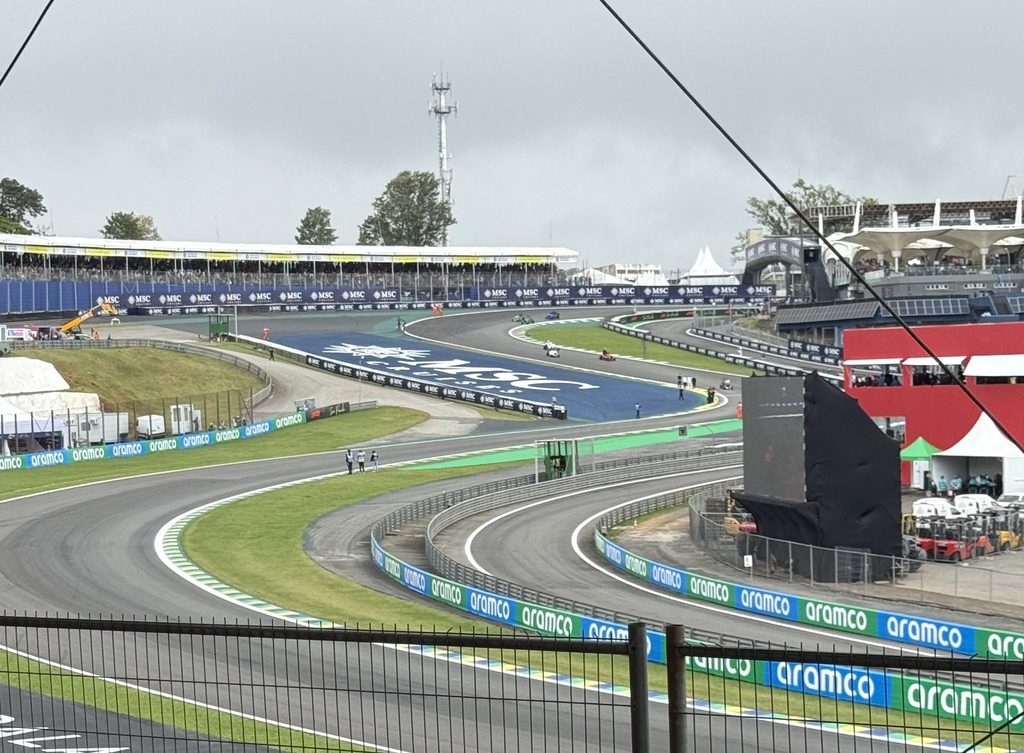
My first São Paulo Grand Prix taught me something very quickly:
A roof can be worth a lot.
São Paulo weather can be strange.
It does not rain every Grand Prix weekend, and I would never tell someone that rain is guaranteed.
But I have personally watched the weather go from looking completely fine to a serious downpour.
At Interlagos, I got soaked.
And I mean soaked.
Some of my favorite Formula 1 memories came out of that experience.
I was in Sector G, surrounded by fans, drinking beer and canned Jack and Coke, talking with people I had never met before and trying to find whatever shelter was available.
People made room for me when the rain came down.
That weekend became part of why I fell in love with the atmosphere at Interlagos.
But it also taught me something practical.
If I am choosing Interlagos grandstands again, I am looking very seriously at whether the section is covered.
Getting caught in the rain once can become a great story.
Spending an entire weekend wet because I ignored the possibility is something different.
That is the type of lesson you do not always get from looking at a circuit map.
Weather protection is now one of the first things I consider when comparing Formula 1 grandstand seats.
I wrote more about what Interlagos means to me in Why I Love Formula 1: Racing, Travel & Belonging.
3. Canada Taught Me That Shelter Can Change the Weekend
My first Formula 1 trip was the Canadian Grand Prix.
That weekend gave me an early lesson about weather and why experienced racegoers sometimes choose tickets very differently from first-time fans.
Montréal can be wet and unpredictable during Grand Prix weekend, and I learned that the hard way.
The difference was that I was traveling with people who had been there before.
They knew what to expect.
They had already secured covered ticketed seating along with access to a hospitality dining area.
The dining area did not have a track view, so this was not the same thing as sitting in a luxury suite overlooking the circuit.
But that was not really the point.
It gave us somewhere covered to get out of the weather, sit down, eat and reset during a long day at the track.
That experience taught me something I still think about now.
Formula 1 hospitality does not always have to be about the best view or the most exclusive access.
Sometimes the value is much simpler.
A dry place to sit.
A proper meal.
Somewhere to warm up.
Somewhere to get out of the rain.
And then you go back to your seat when the track action starts again.
I did not fully appreciate how valuable that was until the weather turned.
Now, when I compare Formula 1 grandstand seats, I also want to know whether the ticket gives me somewhere to escape bad conditions.
A covered grandstand helps.
Access to an indoor dining or hospitality area can help even more.
That Canadian Grand Prix experience taught me that the best Formula 1 tickets are not always just about what you can see from your seat.
Sometimes they are about how well the entire day works around it.
4. Barcelona Taught Me to Think About the Sun
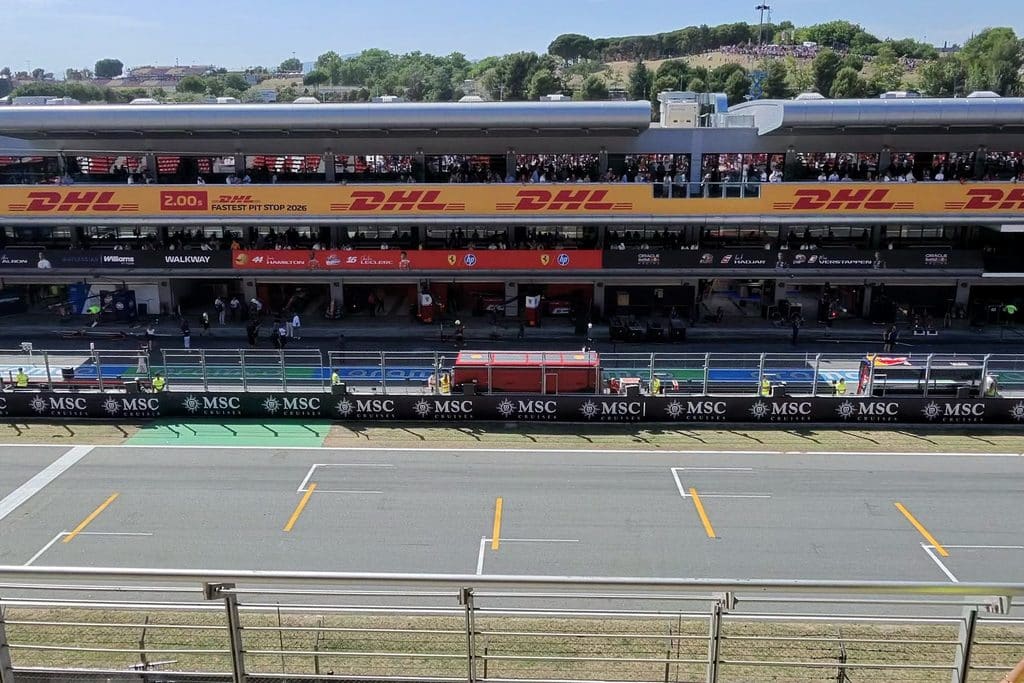
Circuit de Barcelona-Catalunya gave me the opposite lesson.
Instead of worrying about rain, I spent race day sitting directly in the sun.
That matters more than it sounds.
A Formula 1 race is not a two-hour event when you are attending in person.
You are at the circuit long before the race begins.
There may be support races, driver parades, track activity and plenty of time simply sitting in the grandstand.
Then the race starts.
If your seat is exposed to direct sun for most of that time, you feel it.
I still enjoyed the weekend.
The Barcelona Grand Prix grandstands gave me a good view, and I loved being at the circuit.
But now, when I look at Formula 1 grandstand seats, I also think about where the sun is going to be.
Is the grandstand covered?
Will part of it be shaded?
What direction does it face?
Will I be sitting in direct sunlight for hours?
Those questions are not as exciting as asking whether you can see an overtake.
They become much more important around hour four.
5. I Want a Screen I Can Actually See
This has become one of my biggest F1 seating tips.
Formula 1 is difficult to follow when you can only see one small part of the circuit.
At home, television gives you timing screens, replays, radio messages and cameras covering the entire track.
At the circuit, cars disappear from your view.
That is why I want a large screen somewhere I can comfortably see from my seat.
I do not want to spend the race trying to understand why everyone around me suddenly started cheering.
A good screen lets me follow the battle happening somewhere else on the circuit, see replays of incidents and understand what is actually happening strategically.
For me, a slightly less spectacular track view with a clear screen can be better than a supposedly premium view where I cannot follow the race.
For me, the best Formula 1 grandstand seats combine a worthwhile track view with a screen I can actually follow.
When researching Grand Prix tickets, I now look at photographs and videos taken from the actual grandstand.
I want to see the screen from approximately where I might sit.
Circuit maps do not always tell that story.
6. Not Every Fast Section Is a Great Place to Watch
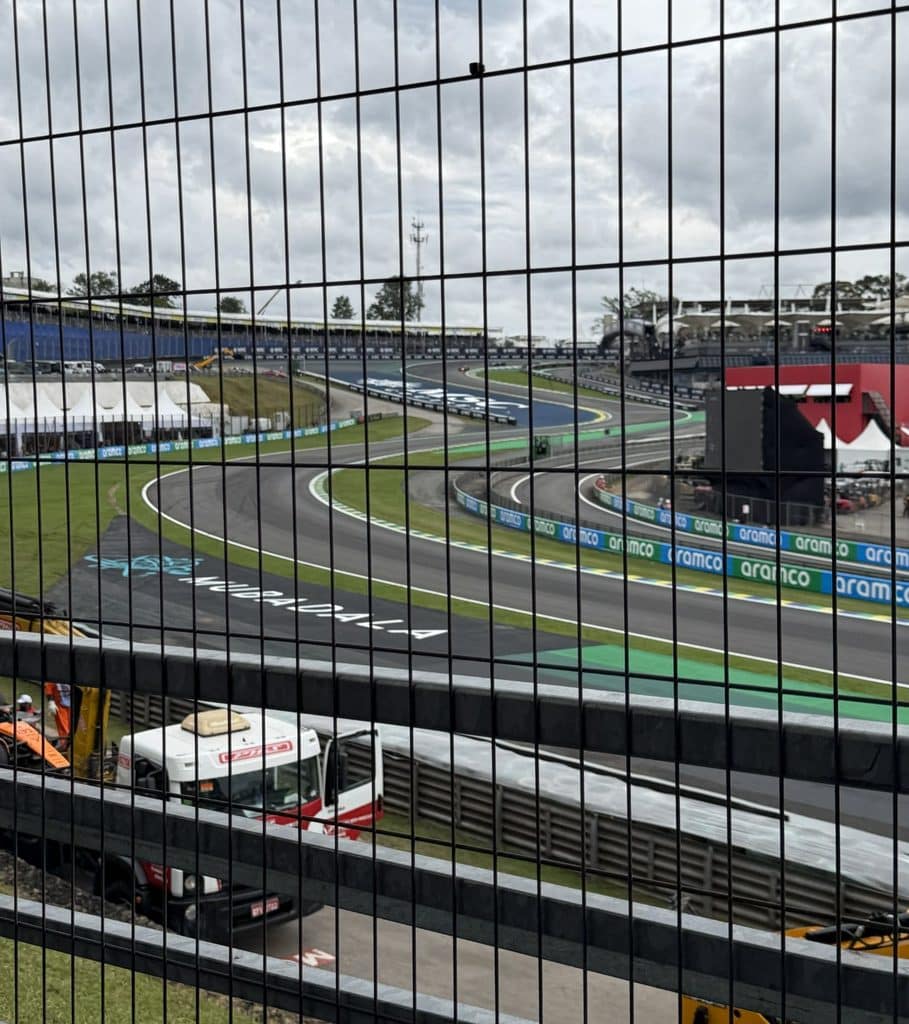
Seeing a Formula 1 car at full speed is incredible.
The speed does not fully translate through television.
But there is a difference between seeing that speed and watching a race develop.
If cars simply blast past your grandstand in a straight line, the first few laps can be spectacular.
After that, you may start wishing you could see more.
Braking zones tend to interest me more.
Corners where drivers can attack, defend, make mistakes or attempt an overtake give you a reason to keep watching that part of the track.
A technical sequence can also be interesting because you can see differences in how drivers approach the same corners.
That is why I look beyond the grandstand name.
I want to know what actually happens there.
A cheaper grandstand overlooking an interesting braking zone may give me a better weekend than a more expensive seat beside a section where very little happens.
That is another reason I do not assume the most expensive seats are automatically the best Formula 1 grandstands.
7. Access to the Grandstand Matters More Than I Expected
This is one of those things that becomes obvious after attending several races.
Getting to the circuit is only part of the journey.
You still have to get to your actual section.
At some tracks, that can involve a lot of walking.
In Barcelona, I walked more than twelve miles on each of my race days between getting to the circuit and moving around once I was there.
I do not mind walking.
I actually enjoy exploring a circuit.
But I still want to know what I am getting into.
How far is the entrance from the grandstand?
Are there steep hills?
How crowded does that route become after qualifying or the race?
Where are the bathrooms?
Where can I get food or a drink?
Is there somewhere nearby to get out of the sun or rain?
These are not glamorous questions.
They can make a major difference in how much you enjoy three days at a circuit.
A Formula 1 race weekend is already long.
I do not need to make it unnecessarily harder because I picked a grandstand without understanding where it actually is.
That is why researching Formula 1 grandstand seats has become about much more than the view.
8. How Much of the Circuit Can You Actually Explore?
Barcelona taught me to look at something else when choosing Formula 1 grandstand seats: how much freedom the ticket gives me once I am inside the circuit.
Barcelona was great for this.
I was able to walk around much of the circuit and experience the weekend from places beyond my own grandstand.
I still had my assigned seat, but I did not feel like I was confined to one small part of the track all day.
That made the entire weekend better.
I could walk, explore different areas, see the circuit from different perspectives and then return to my seat when I wanted to.
Interlagos has been much more restrictive in my experience.
Your ticket determines the sector you can access, and you generally remain within that section of the circuit.
I love Sector G and the atmosphere there, but the experience is different when you cannot simply decide to walk around the entire track and see what another section looks like.
That is something I would now research before buying Formula 1 tickets at a circuit I have never visited.
Can I move around the circuit, or does my ticket effectively keep me in one zone all weekend?
There was another part of Barcelona that I really appreciated:
I was able to leave the circuit and come back in.
That gave me more options during a long race day.
Outside the circuit, there was a grill serving chicken, pork, other meats and additional food, along with a full bar and sangria.
Being able to step outside, get something substantial to eat and have a drink, then return to the circuit made the day feel much less restrictive.
It was not hospitality.
It did not need to be.
It was simply a good place to sit down, eat some grilled food, have a sangria and take a break before going back inside.
Those details matter to me now.
When I compare Formula 1 grandstand seats, I am no longer looking only at what happens when I am physically sitting in the seat.
I want to know what the entire day looks like around it.
Can I explore?
Can I leave and return?
What food is available nearby?
Is there somewhere to sit away from the grandstand?
Can I get a proper meal rather than spending three days eating whatever happens to be closest to my section?
Barcelona gave me much more freedom in that respect.
Interlagos gives me an atmosphere I absolutely love, but the sector-based access means I have to think more carefully about which grandstand I choose because that section becomes a much larger part of my entire weekend.
The freedom that comes with Formula 1 grandstand seats can vary dramatically from one circuit to another.
That is another reason the cheapest or most expensive ticket does not automatically tell you which one is best.
9. Grandstands Are Not a Compromise for Me
I have done hospitality and paddock experiences.
I enjoy them.
The access can be incredible.
The food and drinks are generally better.
Having somewhere comfortable to sit, cool down and get away from the crowds has obvious value.
I would happily do those experiences again.
But lately, I have become much more selective about whether the upgrade makes sense.
If spending thousands more on hospitality means giving up several great dinners, a better hotel, extra days in the city or another trip altogether, I have to think about what I value more.
And I genuinely enjoy the grandstands.
There is something different about being surrounded by thousands of fans reacting to the race together.
Different teams.
Different drivers.
Different countries.
Same sport.
When an overtake happens, someone crashes, the weather suddenly changes or a favorite driver comes past, the reaction around you becomes part of the experience.
That is difficult to reproduce in a lounge.
I no longer look at Formula 1 grandstand seats as the option you choose when you do not buy hospitality.
Sometimes they are exactly where I want to be.
10. The Question I Ask Now: Would I Sit There Again?
This is the question I want to answer after every race I attend.
Not:
Was the grandstand expensive?
Not:
Was it considered one of the best sections?
Not:
Did someone on social media say it was the place to sit?
Would I spend my own money to sit there again?
That question forces me to consider the entire experience.
The track view.
The screen.
The weather protection.
The sun.
The crowd.
The walking.
The bathrooms and food nearby.
How easy it was to get in and out.
How much of the circuit I was allowed to explore.
Whether I could leave and return.
Whether there was somewhere to escape bad weather.
And whether the actual racing I could see justified the price.
Canada taught me how much I value covered F1 grandstands and somewhere indoors to reset during bad weather.
Interlagos taught me to take rain protection seriously and showed me how much the atmosphere in a grandstand can become part of the weekend.
Barcelona taught me to think about the sun, but it also showed me how much I value being able to explore a circuit and have options outside my assigned seat.
All three taught me that choosing Formula 1 grandstand seats is more complicated than looking at where a section sits on a circuit map.
That is the kind of information I want to keep adding to RJVIPGP after every race I attend.
How I Would Choose Formula 1 Grandstand Seats Today
If I were buying tickets for a new circuit tomorrow, I would start with the part of the track I want to see.
Then I would research the actual grandstand, not just the circuit map.
I would look for fan photos and videos from the seats.
I would check whether the section is covered.
I would find out where the sun is likely to be.
I would make sure there is a screen I can see.
I would look at how far the grandstand is from the entrance and transportation.
I would find out whether the ticket gives me access to other parts of the circuit or keeps me in one section.
I would check the food and drink situation.
I would find out whether there is somewhere indoors or covered to escape bad weather.
And if re-entry is allowed, I would want to know what options exist immediately outside the circuit too.
Choosing Formula 1 grandstand seats now means looking at the entire race-day experience, not just the seat number.
Then I would think about what I am getting for the money.
Sometimes the most expensive Formula 1 tickets will make sense.
Sometimes they will not.
The same philosophy applies to the rest of my Formula 1 travel.
The most expensive hotel is not automatically the best hotel for the trip.
The most famous restaurant is not automatically the dinner I will enjoy most.
And the most expensive grandstand is not automatically the seat I would choose again.
If you are planning your first Grand Prix, spend a little more time researching your seat than you think you need to.
You are going to spend a lot of hours in it.
Make sure it is somewhere you actually want to be.
For more on how I build the rest of a race trip around the circuit, read Formula 1 Luxury Travel: 7 Reasons Every Grand Prix Is More Than Just a Race.
Completely Unnecessary. AbsolutelyMore Formula 1 Travel Tips
My São Paulo Grand Prix Travel Guide
What to Look for in an F1 Luxury Vacation Package
Formula 1 Luxury Travel: 7 Reasons I Keep Coming Back
Completely Unnecessary. Absolutely Worth It.
Leave a Reply