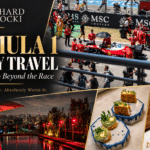
How I plan a Formula 1 weekend usually comes down to two things I refuse to treat as afterthoughts: the race and dinner. Getting both right takes a little more thought than putting a reservation underneath the race on a calendar.
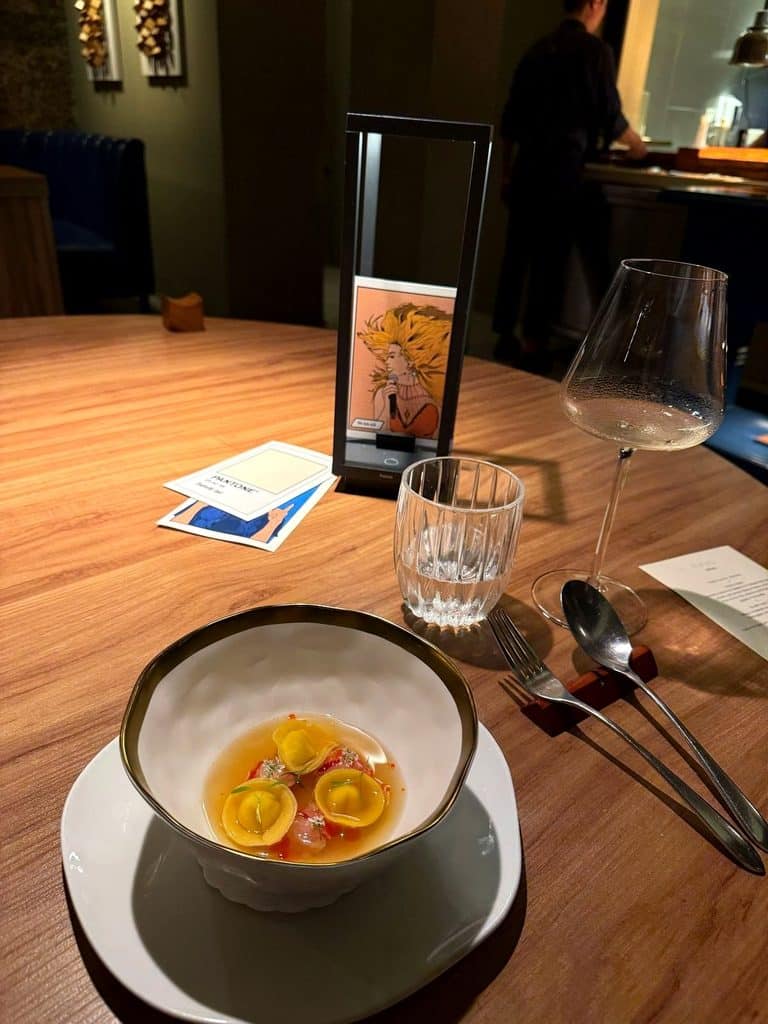
This year, I am planning to reserve Tan Tan for race night. My understanding is that 7:30 is the latest reservation time they offer, so that is the time I am working toward—not a confirmed booking yet. But what happens if the circuit gives me a reason to stay longer?
Do you leave for the restaurant you have been looking forward to, or stay and accept that dinner might not happen?
That is the part of Formula 1 travel I find interesting. You can research the transport, choose the hotel carefully, and allow time to get ready. You still have to decide what matters when two experiences compete for the same evening. Sometimes a simple race trip gets out of control for a very good reason.
The race anchors the weekend. Everything else has to fit around the time it really takes to enjoy it.
The Plan Is Dinner at 7:30. The Moment May Never Happen Again.
Imagine this: Kimi Antonelli wins the world championship in Brazil. This is a hypothetical, not a prediction or a claim about the championship standings. You are there, the atmosphere changes, and you have the chance to stay for the celebrations. If officials permit spectators onto the track, you might be able to be part of that too.
Meanwhile, the Tan Tan reservation I am planning would be for 7:30. A restaurant booking and a championship celebration do not necessarily fit into the same evening, however much I want them to.
Now the decision is much bigger than whether the car gets back quickly enough. You are choosing between a meal you deliberately built into the trip and a moment you could not have booked at any price. Leaving might mean missing something extraordinary. Staying might mean giving up a restaurant you cannot simply visit tomorrow.
I do not think there is a neat answer that works for every race, every restaurant, or every person. That is why I want to ask the question before the weekend, rather than pretend the itinerary can guarantee both.
What am I actually giving up?
A dinner I can reasonably rebook is different from the one available table at a restaurant I have wanted to visit for years. Equally, lingering after an ordinary afternoon is different from being there when a driver wins a world championship. I would want to be honest about the specific experience on each side, not reduce it to “race versus food.”
Is dinner prepaid? Is there a cancellation fee, or someone waiting for me? A choice that feels right can still carry a real loss.
Stay in touch, rather than assume the table will wait
If I am running late, my plan is to stay in touch with Tan Tan, explain what is happening, and hope they can accommodate me. That would be a favor, not something I am entitled to. Before booking, I will check the actual arrival and cancellation terms; sending a message does not extend any grace period. I would still need to respect their booking terms and accept it if the table could no longer be held.
Spectators were permitted onto the track at Interlagos in 2025. That makes the possibility feel real to me, but it does not guarantee access this year. I would follow the event’s instructions and only enter if officials permit it.
What I would actually tell the restaurant
I would keep the message practical: I have a reservation, I am delayed leaving the circuit, and I want to know whether arriving later is still possible. If I have a realistic estimate, I can share it. If traffic is not moving, I would rather say that than promise an arrival time I cannot support.
Then I need to listen to the answer. They may have another seating, a full bar, or a kitchen that cannot accommodate the change. Keeping them informed is basic consideration; it is not a way to negotiate an unlimited hold on a table.
If they can still take me, I would confirm what we have agreed and keep them updated if that changes. If they cannot, I can thank them, deal with any applicable booking terms, and make another plan. The restaurant should not have to guess whether I am coming.
I am not making two dinner reservations just in case
If Tan Tan cannot accommodate me, I will have to figure it out. That might mean trying somewhere else and waiting for a table. It might mean changing the kind of dinner I had in mind altogether. A walk-in alternative is a possibility, not a guaranteed backup.
What I do not want to do is make a second reservation while keeping the first one, just so I have options. That ties up two tables when I only intend to use one. I would rather accept some uncertainty than make my evening easier at the expense of a restaurant or another diner.
The question is which choice I would regret more afterward. Not which one makes the original itinerary look successful. I can leave room for the answer to change when the moment actually arrives.
How I Plan a Formula 1 Weekend: Decide What Cannot Move
Before booking, I want to identify where that kind of choice could appear. What would I be genuinely disappointed to miss, and which two experiences might compete?
On a Grand Prix trip, the race is an obvious answer. But the restaurant that made me excited about the city might be another. I want to see whether those two priorities can coexist before I add the rest. If they cannot, I want to know that I am taking a risk. A famous cocktail bar, a neighborhood walk, and an interesting lunch can all be worthwhile without every one of them becoming a fixed commitment.
I would start by checking the official weekend schedule for the event I am attending, then looking at restaurant availability across the whole stay. I do not want to choose a dinner night simply because it is the first slot the booking page offers. I want to know what that slot would ask of the rest of the day.
I have written separately about choosing Formula 1 grandstand seats. Here, I am assuming the circuit experience matters enough to protect. I do not want the dinner plan quietly making that decision for me without acknowledging the tradeoff.
The Best Meal Deserves More Than the Only Empty Slot
My first instinct is often to add the restaurant. The more useful second question is whether I will actually enjoy it on that particular night.
A long tasting menu asks something of you. You want an appetite, some energy, and enough attention to notice what is happening. When a meal matters to me, I would rather give it a clear evening than arrive with half my attention still caught in the journey back from the track.
That is why I would consider a non-track evening for the hardest-to-get or most anticipated reservation. Depending on the trip, that could mean arriving earlier or staying longer. It only makes sense if the extra time and expense work; adding another hotel night to justify a dinner is exactly the kind of logic that explains this website.
Barcelona is a good example of why I care. Mont Bar was my favorite meal of that trip, even with some serious competition. I also went to Disfrutar. Those experiences deserve their own attention, rather than becoming accomplishments to tick off between race sessions.
In São Paulo, Evvai is my favorite restaurant in the world. That does not mean every night should be an Evvai-sized commitment. It means I want to protect the night that is. A more flexible dinner on another evening can help make the important one better.
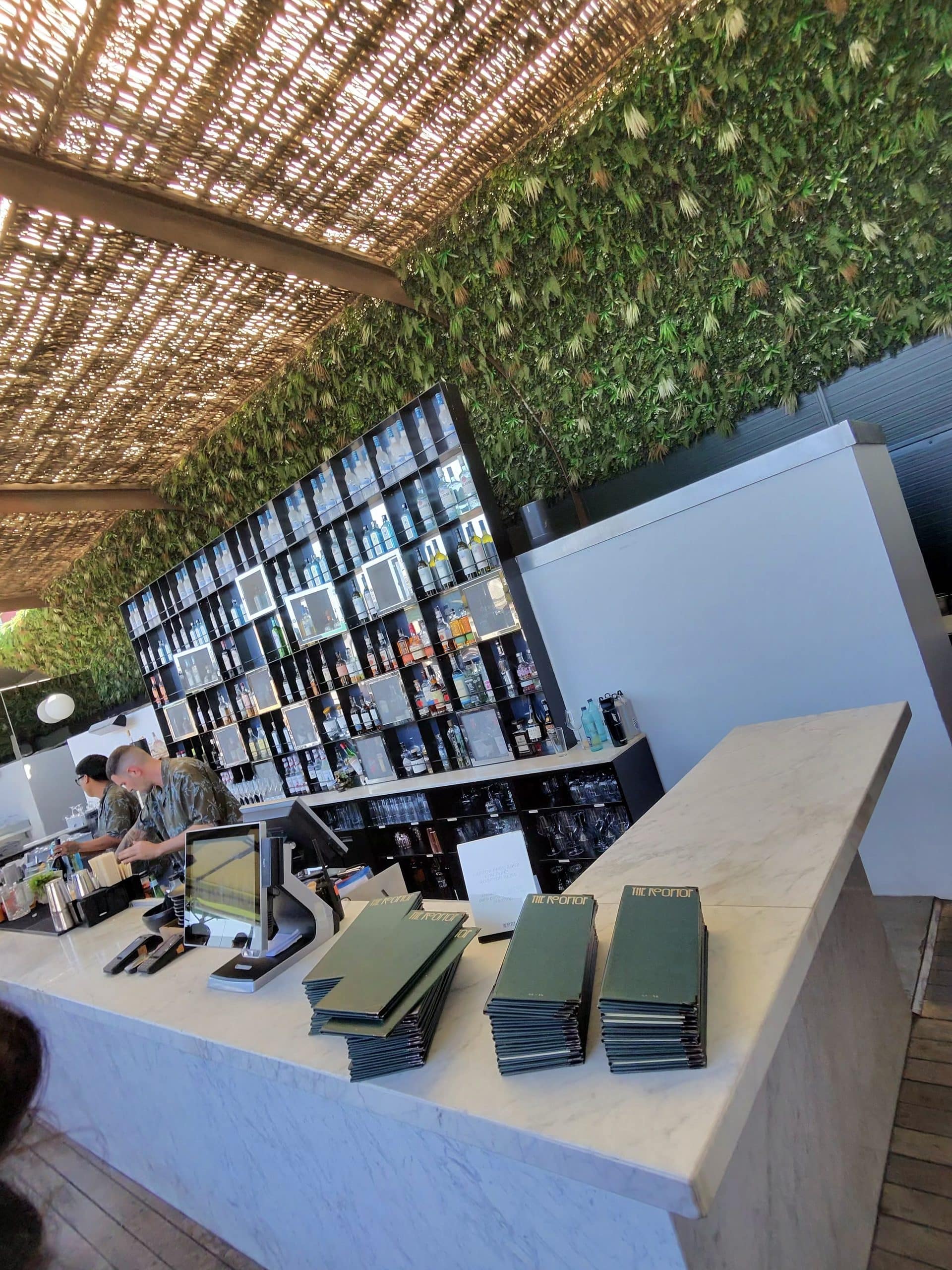
Mont Bar: a meal I want time to enjoy, rather than another appointment to reach.
Evvai gives me a reason to leave a proper evening for dinner in São Paulo.
I am not saying a good restaurant cannot work after the race. I am saying that “available” and “a good fit for the day” are different questions. If the reservation only works when everything else runs perfectly, I would look for another night. If there is no other night, I need to decide whether the possibility of missing dinner is worth accepting.
Work Backward From Dinner, Without Planning Backward From Wishful Thinking
Once I have a possible reservation, I would work backward: restaurant arrival, travel from the hotel, time to get ready, the return from the circuit, and getting out of the venue in the first place. Every part belongs in the plan.
My own preference is about an hour at the hotel to get ready after the track. I want a shower, clean clothes, and enough time to feel like I am starting the evening rather than continuing the afternoon. That hour is easy to leave out when the calendar only shows the race and dinner.
The drive back is another piece that deserves honesty. A normal map estimate can be useful for understanding distance, but I would not treat it as a promise for the end of a Grand Prix. Walking out, reaching the pickup point, finding the driver, and joining the traffic all sit between the grandstand and the hotel.
Then there is the second journey, from the hotel to the restaurant. Staying somewhere that suits the city part of the trip can make that easier. I stayed at Sir Victor in Barcelona, and the hotel was part of the broader experience, not simply somewhere to sleep between track days.
A hotel belongs in the evening plan too, including time to get ready before going out.
The test is straightforward: after allowing for the parts I know I want, is there still a comfortable margin? If the only way to make the reservation is to erase the hotel reset or assume a frictionless departure, I need to recognize the risk. With a plan like Tan Tan, that means accepting I may need to call, wait, or find something else—not pretending a second reservation solves it.
São Paulo Made Me Take the Journey Back Seriously
After the 2025 São Paulo Grand Prix, traffic was at a standstill. That experience belongs in my planning much more than a hopeful estimate of how quickly the trip ought to take.
For that journey, I prefer the comfort of a prearranged Rhino ride and air conditioning over squeezing onto a packed subway. That is my preference, not a claim that a car is always faster or that everyone should make the same choice. Being comfortable while waiting and avoiding the wait are two different things.
I recommend Rhino based on my experience with its armored cars and professional drivers. I have also had good experiences with Uber Black in São Paulo. The important point for this post is that choosing a service I like does not give me permission to make an unrealistic dinner reservation.
I would check the pickup arrangements for the specific event, confirm where I need to meet the driver, and keep the restaurant plan realistic even after arranging the car. The detailed city and circuit advice belongs in my São Paulo Grand Prix travel guide; the lesson here is about what I book afterward.
Interlagos: leaving the circuit is part of the day, not an instant jump back into the city.
A restaurant cannot control the circuit exit, and the driver cannot make my preferred reservation time more sensible. That part is on me.
What a Realistic Race Day Would Look Like
I find a sequence more useful than a pretend-perfect timetable. This is a planning example, not a record of a particular day or a promise about how long an event will take.
Before the circuit: Keep the morning simple
I would leave room for breakfast and the journey without adding a destination brunch or a sightseeing stop that introduces another deadline. There will be plenty happening at the track. The morning does not need to prove that I am making the most of every minute.
At the circuit: Be there for the experience
I want to enjoy the racing without mentally leaving early for dinner. The time commitment includes getting in and out, not just the sessions themselves. I would also keep an eye on what I need for the conditions, rather than assume that feeling fine when I leave the hotel means I will feel the same later.
After the circuit: Get back, then reset
The departure comes first. Then the ride, the hotel, and time to get ready. This is the stretch I would leave deliberately loose. A delay here should use some margin, not immediately put a special dinner at risk.
For dinner: Choose an evening that can stand on its own
If the timing genuinely supports a reservation, great. Otherwise, I would choose a less demanding plan with realistic availability, checking hours and booking requirements rather than assuming somewhere will take me. Casual does not have to mean disappointing, and a shorter dinner does not have to be a consolation prize.
After dinner: Let the extra stop stay extra
A cocktail can be a great finish. It does not need to become compulsory. I love a good bar, but adding a second reservation simply because there is space on the screen can turn a satisfying day into a very long one.
What I Would Move—and What I Might Have to Give Up
When a plan feels crowded, removing an extra bar or a cross-town detour is easy compared with the 7:30 decision. Those smaller choices are still worth making. They leave more energy for the things I care about and fewer unnecessary deadlines.
But I do not want to pretend every conflict can be fixed by becoming more organized. Sometimes the restaurant has one opening. Sometimes the circuit gives you a reason to stay. Sometimes you have done the planning properly and still have to choose.
That is where checking booking terms, discussing the plan with anyone joining me, and knowing my alternatives helps. It does not make the decision for me. It makes the consequences clearer.
I would rather make a conscious choice and accept the cost than spend the whole evening resenting whichever experience I chose. There may be another visit. There may not be another version of that particular race day.
The Better Choice Depends on Why I Wanted Both Experiences
Before deciding to leave the circuit, I would ask what staying adds. Am I waiting around because I cannot quite bring myself to leave, or is something happening that makes the extra time meaningful? Those are different reasons, and I do not want the fear of missing out to make every decision.
I would ask the same question about dinner. Is this a meal I genuinely care about, or am I attached to the reservation because it took effort to get? Researching and booking something can make it feel more important than it will actually be. The point is to enjoy the evening, not protect the work I put into the calendar.
That still leaves room for choosing dinner. Leaving the circuit does not mean I care less about Formula 1. Staying does not mean I suddenly care less about restaurants. It means that on this particular day, with these particular choices, one experience mattered more.
If I am sharing the evening with someone, their expectations matter too. I would want that conversation before we reach the point of choosing. An itinerary is easier to change when everyone understands what was firm, what was hopeful, and what might depend on the race.
Leave Something of the City Unscheduled
I like researching trips. I like finding the place that makes the planning feel worthwhile. But I also want time to walk, look around, and follow an interesting street without checking whether I am now behind.
My Barcelona travel guide covers more of the city beyond the circuit. A race weekend can lead into that wider trip, but it needs some room to happen. Booking every lunch and evening in advance would leave very little space for the discoveries I enjoy most.
There should still be time to see the city that brought the whole trip together.
That is the balance I want from Formula 1 travel: enough planning to protect the race and the meals that matter, with enough freedom to enjoy the place around them. The reward for doing the work beforehand should be less clock-watching once I am there.
The weekend can still get a little out of control. If it does, I want to know the difference between a bad plan and a moment worth changing a good plan for.
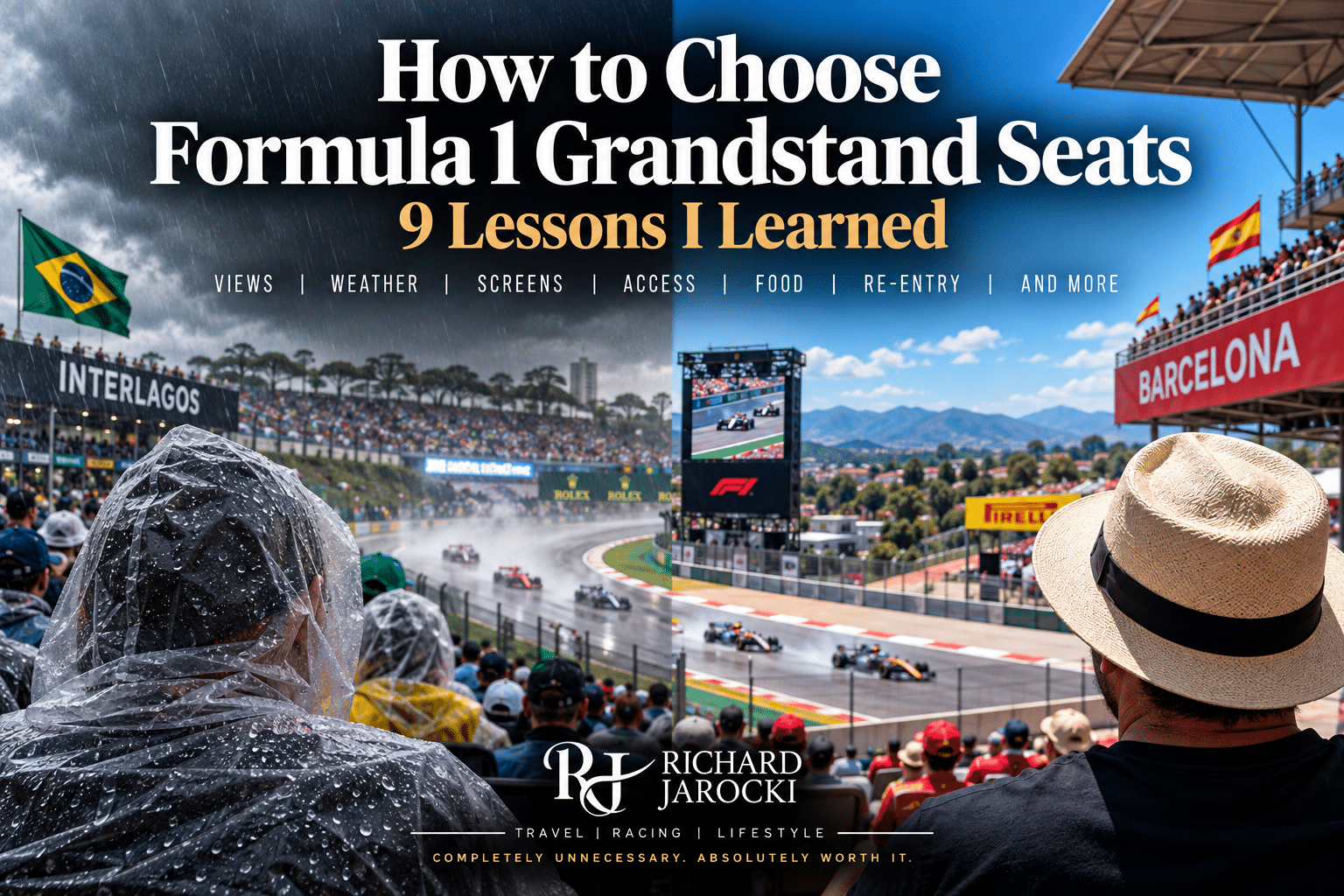
I used to think choosing Formula 1 grandstand seats was mostly about finding a section with a good view of the track. Then I started attending races.
My first Formula 1 trip was the Canadian Grand Prix, where wet weather made covered seating and access to an indoor hospitality dining area much more valuable than I understood when the weekend started. At Interlagos, I got soaked and learned how quickly São Paulo weather can change. In Barcelona, I learned the opposite lesson when my seats spent race day directly in the sun.
All three were great Formula 1 experiences. I would happily go back to every one of them. But they changed the questions I ask before spending money: Can I see the racing and a screen? Will I be comfortable for hours? How difficult is the walk? What happens when I want food, shelter or a ride back to the hotel?
Most importantly, after spending an entire Formula 1 weekend there, would I pay for that seat again?
This guide is based on what I learned in Canada, Brazil and Spain. There is no single perfect grandstand at every circuit. The right choice depends on what you want to watch, how you like to spend the day and what you want to do with the rest of the trip.
1. A Great View Is Only the Beginning
The first thing most of us look at is the circuit map. That makes sense. If I am paying for Grand Prix seating, I want to see something worthwhile. But I have learned that the words “good view” can mean very different things. A seat might give you a perfect look at one corner but almost nothing else. Another grandstand might sit farther away from the action but allow you to see several parts of the circuit. I increasingly prefer the second type.
I want to be able to follow cars for more than a few seconds. Elevation matters too. Being higher in a grandstand can sometimes open up an entirely different view of the circuit. You may be able to see over barriers, fencing and the people in front of you while also following cars through multiple corners. That does not mean higher is always better. If you are too far away, you can lose some of the feeling of speed and proximity that makes seeing Formula 1 in person so impressive.
The goal is balance. When I look at Formula 1 grandstand seats now, I am asking what I can actually watch from that location, not simply whether the grandstand appears close to the track on a map.
2. At Interlagos, I Learned to Respect the Weather
My first São Paulo Grand Prix taught me something very quickly: A roof can be worth a lot. São Paulo weather can be strange. It does not rain every Grand Prix weekend, and I would never tell someone that rain is guaranteed. But I have personally watched the weather go from looking completely fine to a serious downpour. At Interlagos, I got soaked. And I mean soaked. Some of my favorite Formula 1 memories came out of that experience.
I was in Sector G, surrounded by fans, drinking beer and canned Jack and Coke, talking with people I had never met before and trying to find whatever shelter was available. People made room for me when the rain came down. That weekend became part of why I fell in love with the atmosphere at Interlagos. But it also taught me something practical. If I am choosing Interlagos grandstands again, I am looking very seriously at whether the section is covered.
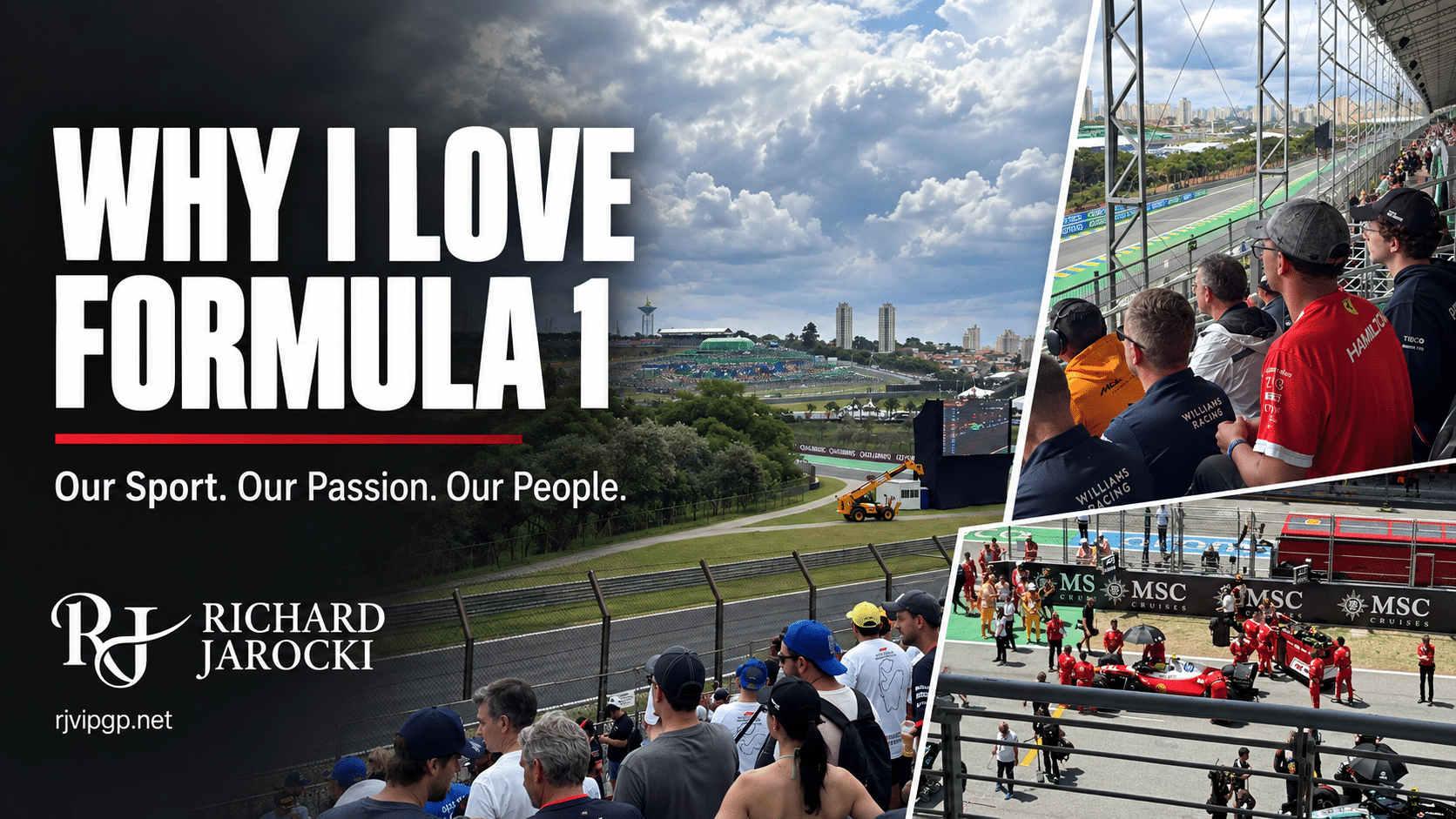
Getting caught in the rain once can become a great story. Spending an entire weekend wet because I ignored the possibility is something different. That is the type of lesson you do not always get from looking at a circuit map. Weather protection is now one of the first things I consider when comparing Formula 1 grandstand seats. I wrote more about what Interlagos means to me in Why I Love Formula 1: Racing, Travel & Belonging.
What changed between my Interlagos visits
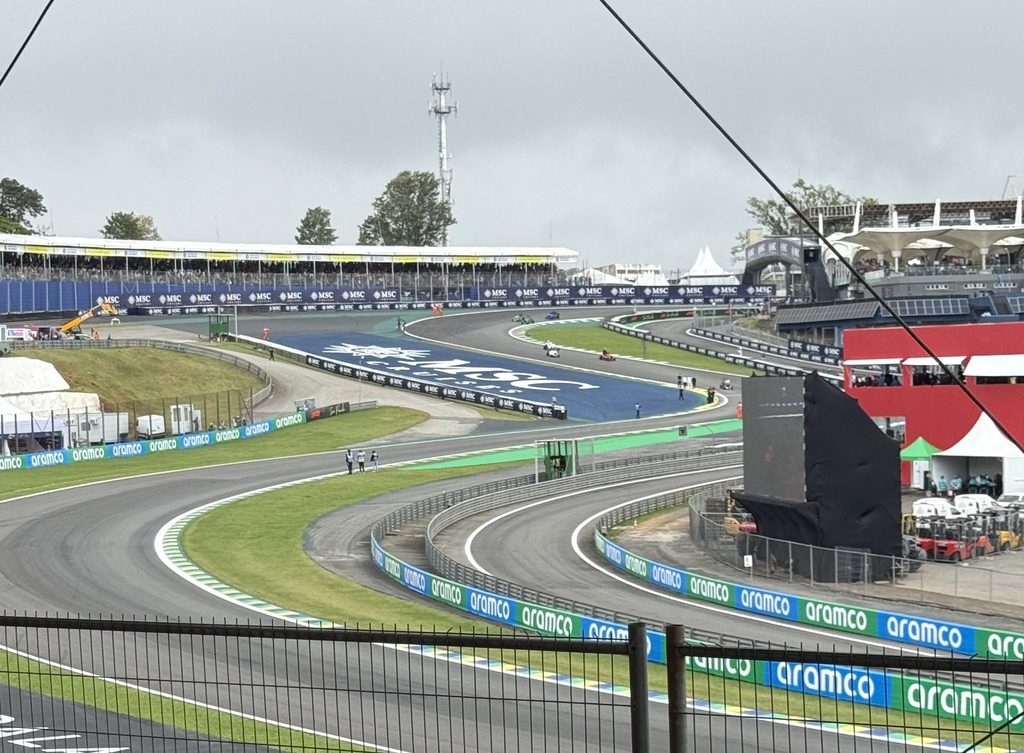
In 2024, Sector G meant uncovered cement seating and the kind of rain that makes you rethink your packing. In 2025, I sat in Sector N: covered metal stadium seating, a view toward the Senna S and back straight, and a nearby television screen. Those are descriptions of my visits, not a guarantee that every row or future ticket offers the same sightline or weather protection.
I still value the energy in G. N helped me appreciate what a different seat and a roof can do for the same race weekend. For my upcoming 2026 visit, I have chosen R, but I have not experienced that section yet. I will judge it after I have actually sat there.
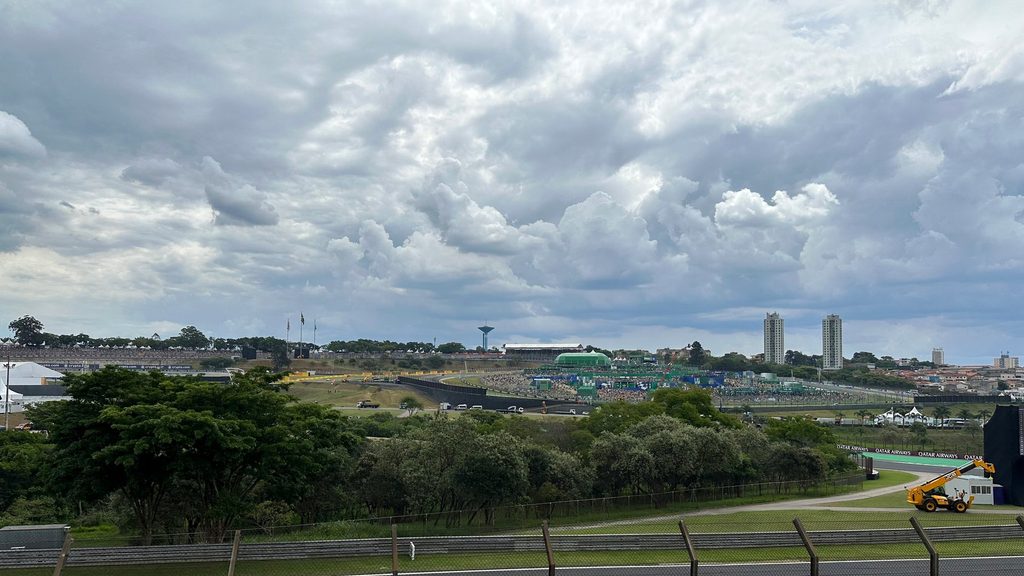
The view across Interlagos during my 2024 São Paulo Grand Prix weekend.
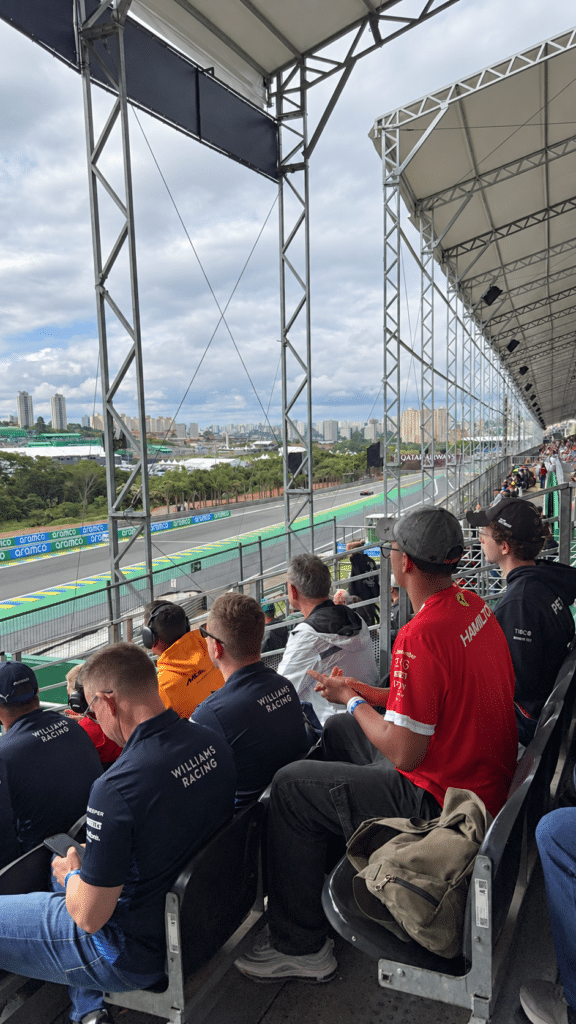
A spectator’s view toward the Senna S at Interlagos.
3. Canada Taught Me That Shelter Can Change the Weekend
My first Formula 1 trip was the Canadian Grand Prix. That weekend gave me an early lesson about weather and why experienced racegoers sometimes choose tickets very differently from first-time fans. Montréal can be wet and unpredictable during Grand Prix weekend, and I learned that the hard way. The difference was that I was traveling with people who had been there before. They knew what to expect. They had already secured covered ticketed seating along with access to a hospitality dining area.
The dining area did not have a track view, so this was not the same thing as sitting in a luxury suite overlooking the circuit. But that was not really the point. It gave us somewhere covered to get out of the weather, sit down, eat and reset during a long day at the track. That experience taught me something I still think about now. Formula 1 hospitality does not always have to be about the best view or the most exclusive access. Sometimes the value is much simpler.
A dry place to sit. A proper meal. Somewhere to warm up. Somewhere to get out of the rain. And then you go back to your seat when the track action starts again. I did not fully appreciate how valuable that was until the weather turned. Now, when I compare Formula 1 grandstand seats, I also want to know whether the ticket gives me somewhere to escape bad conditions. A covered grandstand helps. Access to an indoor dining or hospitality area can help even more.
That Canadian Grand Prix experience taught me that the best Formula 1 tickets are not always just about what you can see from your seat. Sometimes they are about how well the entire day works around it.
4. Barcelona Taught Me to Think About the Sun
Circuit de Barcelona-Catalunya gave me the opposite lesson. Instead of worrying about rain, I spent race day sitting directly in the sun. That matters more than it sounds. A Formula 1 race is not a two-hour event when you are attending in person. You are at the circuit long before the race begins. There may be support races, driver parades, track activity and plenty of time simply sitting in the grandstand. Then the race starts.
If your seat is exposed to direct sun for most of that time, you feel it. I still enjoyed the weekend. The Barcelona Grand Prix grandstands gave me a good view, and I loved being at the circuit. But now, when I look at Formula 1 grandstand seats, I also think about where the sun is going to be. Is the grandstand covered? Will part of it be shaded? What direction does it face? Will I be sitting in direct sunlight for hours?
Those questions are not as exciting as asking whether you can see an overtake. They become much more important around hour four.
5. I Want a Screen I Can Actually See
This has become one of my biggest F1 seating tips. Formula 1 is difficult to follow when you can only see one small part of the circuit. At home, television gives you timing screens, replays, radio messages and cameras covering the entire track. At the circuit, cars disappear from your view. That is why I want a large screen somewhere I can comfortably see from my seat. I do not want to spend the race trying to understand why everyone around me suddenly started cheering.
A good screen lets me follow the battle happening somewhere else on the circuit, see replays of incidents and understand what is actually happening strategically. For me, a slightly less spectacular track view with a clear screen can be better than a supposedly premium view where I cannot follow the race. For me, the best Formula 1 grandstand seats combine a worthwhile track view with a screen I can actually follow. When researching Grand Prix tickets, I now look at photographs and videos taken from the actual grandstand.
I want to see the screen from approximately where I might sit. Circuit maps do not always tell that story.
6. Not Every Fast Section Is a Great Place to Watch
Seeing a Formula 1 car at full speed is incredible. The speed does not fully translate through television. But there is a difference between seeing that speed and watching a race develop. If cars simply blast past your grandstand in a straight line, the first few laps can be spectacular. After that, you may start wishing you could see more. Braking zones tend to interest me more.
Corners where drivers can attack, defend, make mistakes or attempt an overtake give you a reason to keep watching that part of the track. A technical sequence can also be interesting because you can see differences in how drivers approach the same corners. That is why I look beyond the grandstand name. I want to know what actually happens there. A cheaper grandstand overlooking an interesting braking zone may give me a better weekend than a more expensive seat beside a section where very little happens.
That is another reason I do not assume the most expensive seats are automatically the best Formula 1 grandstands.
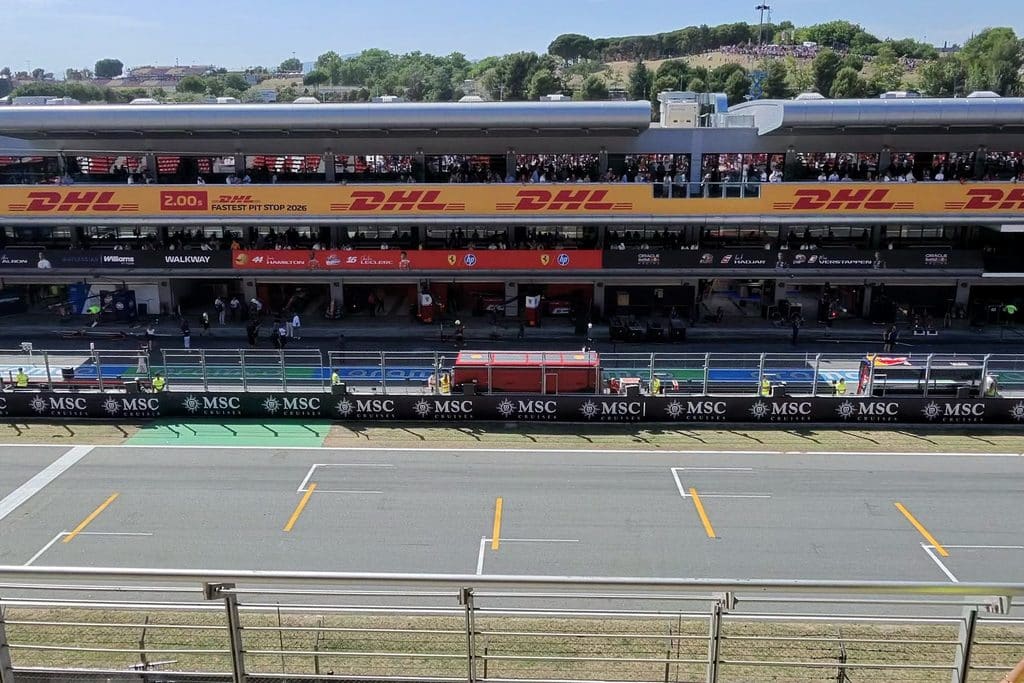
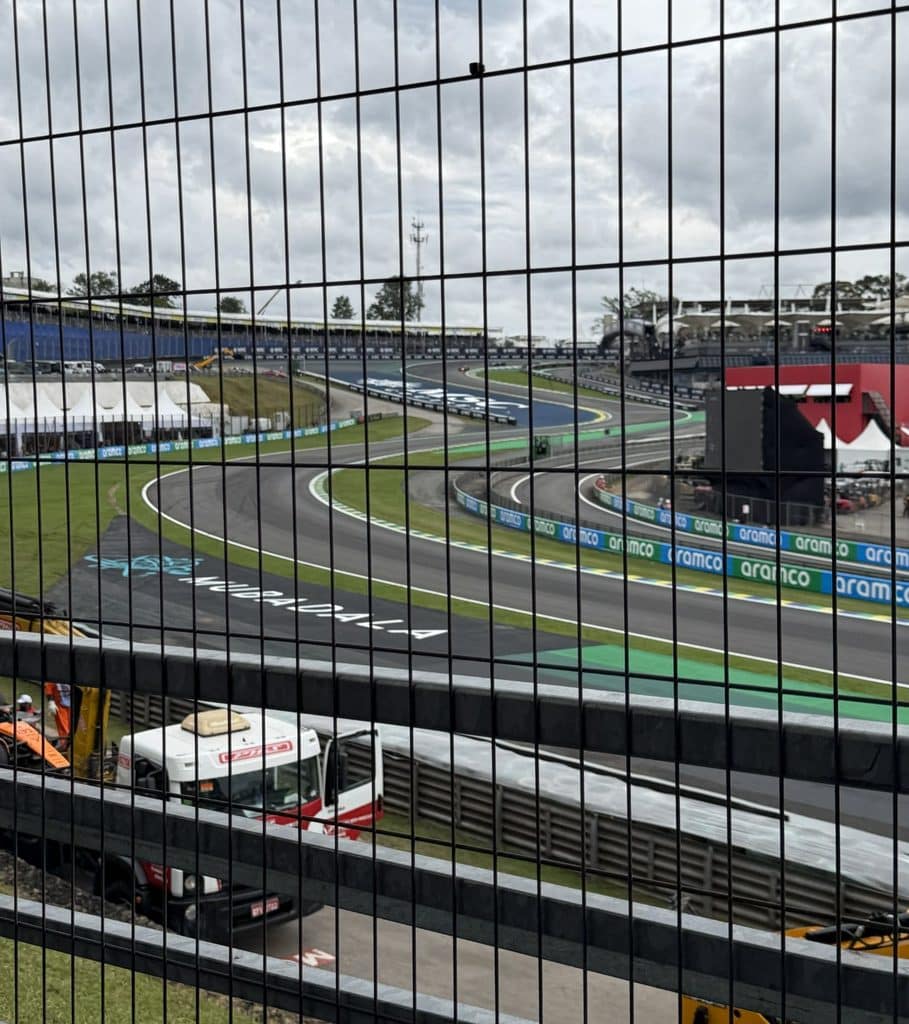
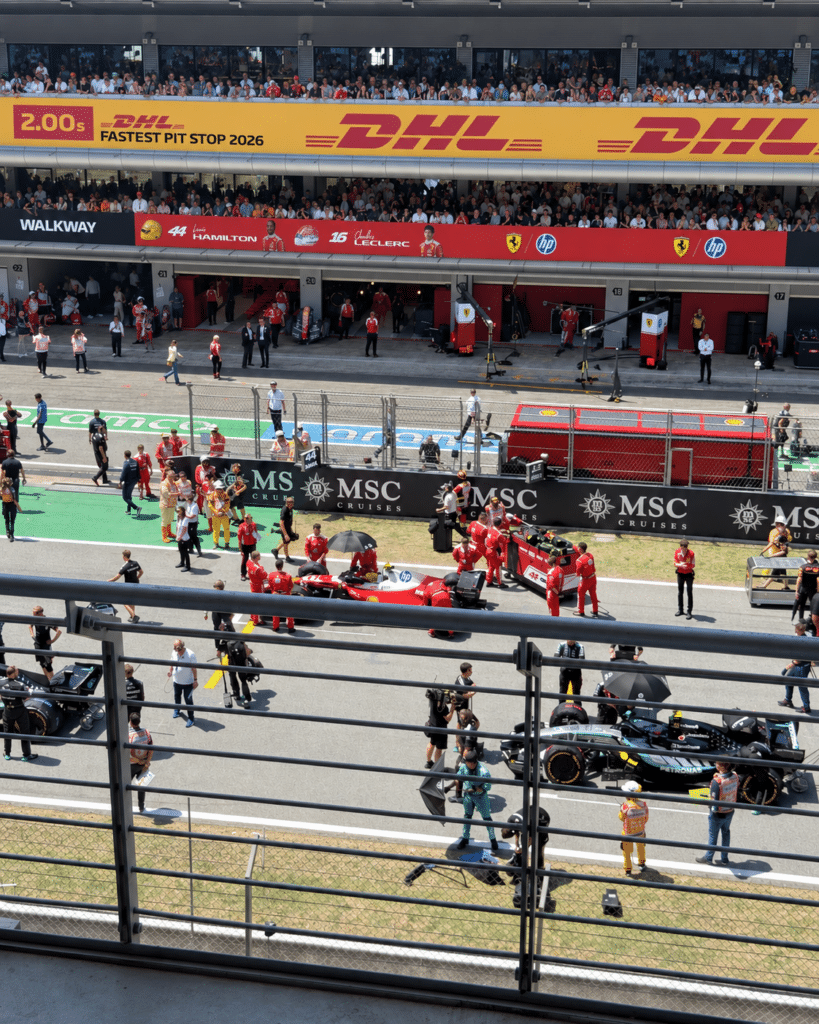
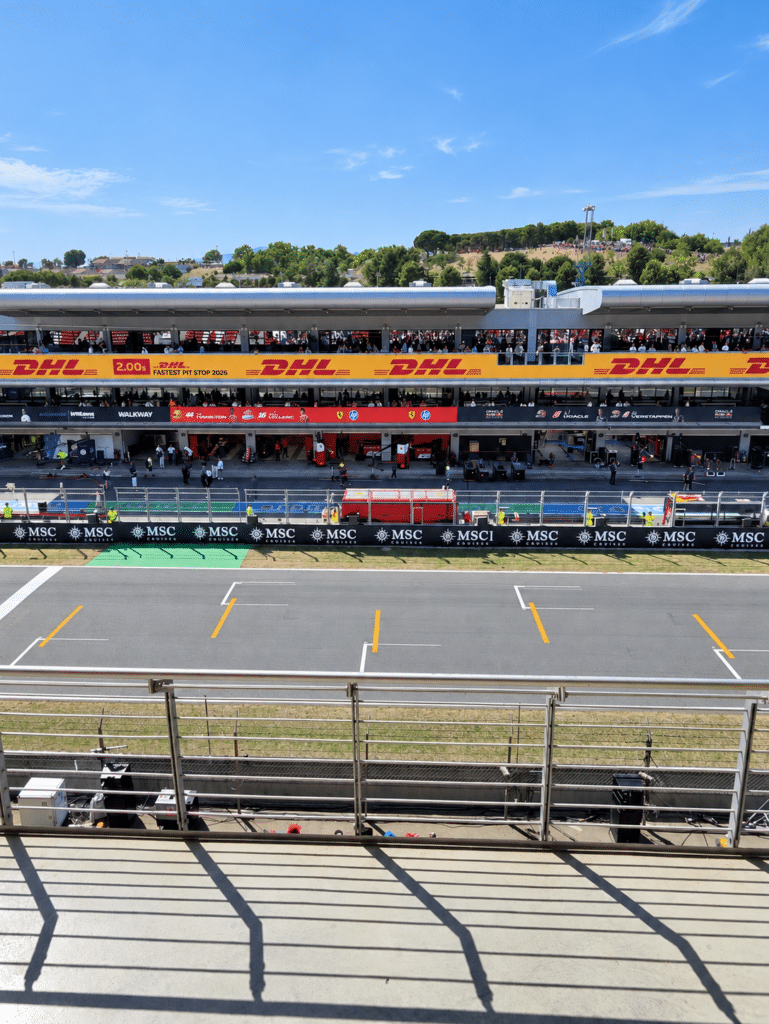
The Barcelona circuit main straight, pit building and garages viewed across the safety fence from a grandstand.
The safety fence is part of the view from the stands.
7. Access to the Grandstand Matters More Than I Expected
This is one of those things that becomes obvious after attending several races. Getting to the circuit is only part of the journey. You still have to get to your actual section. At some tracks, that can involve a lot of walking. In Barcelona, I walked more than twelve miles on each of my race days between getting to the circuit and moving around once I was there. I do not mind walking. I actually enjoy exploring a circuit. But I still want to know what I am getting into.
How far is the entrance from the grandstand? Are there steep hills? How crowded does that route become after qualifying or the race? Where are the bathrooms? Where can I get food or a drink? Is there somewhere nearby to get out of the sun or rain? These are not glamorous questions. They can make a major difference in how much you enjoy three days at a circuit. A Formula 1 race weekend is already long.
I do not need to make it unnecessarily harder because I picked a grandstand without understanding where it actually is. That is why researching Formula 1 grandstand seats has become about much more than the view.
Queues and the ride home belong in the decision
At Interlagos in 2024, I waited roughly 20 minutes when I arrived around 10 a.m. on Saturday. With my Sector N entry in 2025, arriving around 9:30–10 a.m. on Friday and Saturday meant only a few people ahead of me; Sunday’s line also moved quickly. N had its own entry and separate concessions and facilities. That was my experience on those days, not a forecast for your queue.
Leaving deserves just as much thought. São Paulo traffic was bumper-to-bumper after the race in 2025. I personally prefer a professional driver and air-conditioning to a crowded train, but a car does not make the traffic disappear. I want to understand the walk to the pickup point, where a driver can actually meet me and how much flexibility I need before dinner.
The seat matters. So does the ride home.
8. How Much of the Circuit Can You Actually Explore?
Barcelona taught me to look at something else when choosing Formula 1 grandstand seats: how much freedom the ticket gives me once I am inside the circuit. Barcelona was great for this. I was able to walk around much of the circuit and experience the weekend from places beyond my own grandstand. I still had my assigned seat, but I did not feel like I was confined to one small part of the track all day. That made the entire weekend better.
I could walk, explore different areas, see the circuit from different perspectives and then return to my seat when I wanted to. Interlagos has been much more restrictive in my experience. Your ticket determines the sector you can access, and you generally remain within that section of the circuit. I love Sector G and the atmosphere there, but the experience is different when you cannot simply decide to walk around the entire track and see what another section looks like.
That is something I would now research before buying Formula 1 tickets at a circuit I have never visited. Can I move around the circuit, or does my ticket effectively keep me in one zone all weekend? There was another part of Barcelona that I really appreciated: I was able to leave the circuit and come back in. That gave me more options during a long race day. Outside the circuit, there was a grill serving chicken, pork, other meats and additional food, along with a full bar and sangria.
Being able to step outside, get something substantial to eat and have a drink, then return to the circuit made the day feel much less restrictive. It was not hospitality. It did not need to be. It was simply a good place to sit down, eat some grilled food, have a sangria and take a break before going back inside. Those details matter to me now. When I compare Formula 1 grandstand seats, I am no longer looking only at what happens when I am physically sitting in the seat.
I want to know what the entire day looks like around it. Can I explore? Can I leave and return? What food is available nearby? Is there somewhere to sit away from the grandstand? Can I get a proper meal rather than spending three days eating whatever happens to be closest to my section? Barcelona gave me much more freedom in that respect.
Interlagos gives me an atmosphere I absolutely love, but the sector-based access means I have to think more carefully about which grandstand I choose because that section becomes a much larger part of my entire weekend. The freedom that comes with Formula 1 grandstand seats can vary dramatically from one circuit to another. That is another reason the cheapest or most expensive ticket does not automatically tell you which one is best.
Check the rule for your actual ticket: My Barcelona re-entry and freedom to explore describe what I experienced on that visit. Do not assume that another event, package or year has the same policy. Confirm permitted areas, any scan-out procedure and same-day re-entry with the circuit before leaving. Start with the official Circuit de Barcelona-Catalunya website and the terms supplied with your booking.
9. Grandstands Are Not a Compromise for Me
I have done hospitality and paddock experiences. I enjoy them. The access can be incredible. The food and drinks are generally better. Having somewhere comfortable to sit, cool down and get away from the crowds has obvious value. I would happily do those experiences again. But lately, I have become much more selective about whether the upgrade makes sense.
If spending thousands more on hospitality means giving up several great dinners, a better hotel, extra days in the city or another trip altogether, I have to think about what I value more. And I genuinely enjoy the grandstands. There is something different about being surrounded by thousands of fans reacting to the race together. Different teams. Different drivers. Different countries. Same sport. When an overtake happens, someone crashes, the weather suddenly changes or a favorite driver comes past, the reaction around you becomes part of the experience.
That is difficult to reproduce in a lounge. I no longer look at Formula 1 grandstand seats as the option you choose when you do not buy hospitality. Sometimes they are exactly where I want to be.
Separate the grandstand ticket from the extras
My 2025 São Paulo F1 Experiences Thursday event is a good example. There was food and drink at trucks and stands, a lap of the circuit on a truck and a trophy-photo opportunity. Kym Illman took my trophy photo, which was a highlight for me as a fan of his work. I enjoyed that evening, but I do not need to repeat every extra every year.
Those were my 2025 inclusions. A standard grandstand ticket should not be assumed to include them, and neither should a differently named package. When comparing official F1 Experiences São Paulo packages, read the exact days, seating, activities, food and drink, and transfer details for the option you are buying. A pit-lane walk, track tour, paddock tour and hospitality access are different things.
10. The Question I Ask Now: Would I Sit There Again?
The question I want to answer after every race is straightforward: would I spend my own money to sit there again? A grandstand’s price, reputation or popularity on social media cannot answer that for me.
I think about the track view, the screen, weather protection, the crowd, walking, bathrooms and food. I think about how easy it was to get in and out, where I was allowed to explore and whether there was somewhere to escape bad weather. Then I ask whether the racing I could see justified the price.
Canada taught me how much I value covered seating and somewhere indoors to reset. Interlagos taught me to take rain seriously and showed me how much the crowd can become part of the weekend. Barcelona taught me to think about the sun, but also how much I enjoy exploring a circuit and having options outside my assigned seat.
All three made choosing Formula 1 grandstand seats more complicated than looking at a circuit map, and much more personal. That is the kind of useful detail I want to keep adding to RJVIPGP after every race I attend.
How I Would Choose Formula 1 Grandstand Seats Today
If I were buying tickets for a new circuit tomorrow, I would start with the part of the track I want to see. Then I would research the actual grandstand rather than relying on a map or a premium-sounding name.
Look at the real view. Find recent spectator photographs and videos from the section and, where possible, the row. Notice fencing, support posts, distance and how long the cars stay in sight.
Find the screen. Check its angle and readability from your likely seat. Nearby is not always the same as usable.
Plan for the conditions. Research the direction of the sun, roof coverage and rain exposure. Comfortable shoes and appropriate layers matter over a long weekend.
Understand the seat. Confirm reserved or unreserved allocation, the seating surface, stairs and any accessibility arrangements you need directly with the organizer.
Map the whole day. Locate your entrance, food, bathrooms, shelter, transport stop and pickup area. Ask whether your ticket permits other sectors or same-day re-entry.
Read the inclusions. Check the exact dates and what is separately ticketed. Do not assume Thursday activities, a track walk, hospitality or transfers come with a grandstand seat.
Compare the total trip. Decide what an upgrade would add and what else that money could pay for: a hotel you prefer, several dinners, more days in the city or another trip.
The most expensive Formula 1 tickets will sometimes make sense for me, and sometimes they will not. The same applies to hotels and restaurants. A famous name or a higher price does not automatically make something the right choice for the trip.
If you are planning your first Grand Prix, spend a little more time researching the seat than you think you need to. You will spend a lot of hours in it. Make sure it is somewhere you actually want to be.
Plan the Rest of Your Formula 1 Trip
A good race seat is one part of a weekend I want to enjoy. The hotel, transport and time for the city’s restaurants matter too. These guides explain how I put those pieces together.
Have a grandstand you would book again, or one you would avoid next time? Send me a message on Instagram. I am always interested in what made the difference: the racing, the crowd, the shelter or something nobody mentioned before you arrived.
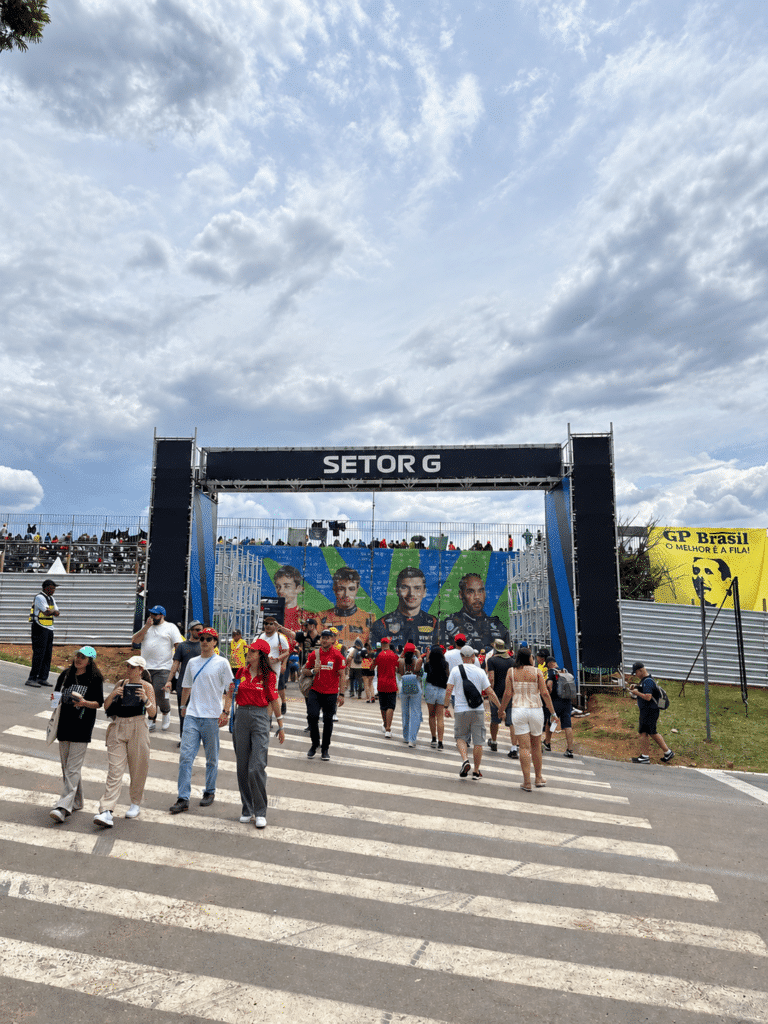
Sector G. Where my love for Formula 1 and São Paulo really began.
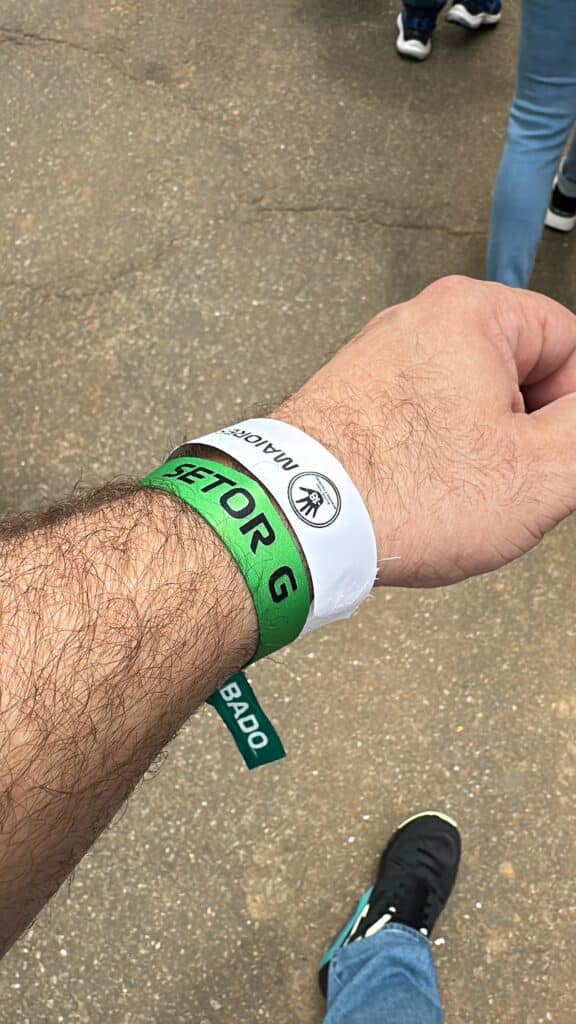
Setor G. A wristband from the weekend that changed how I saw Formula 1—and São Paulo.
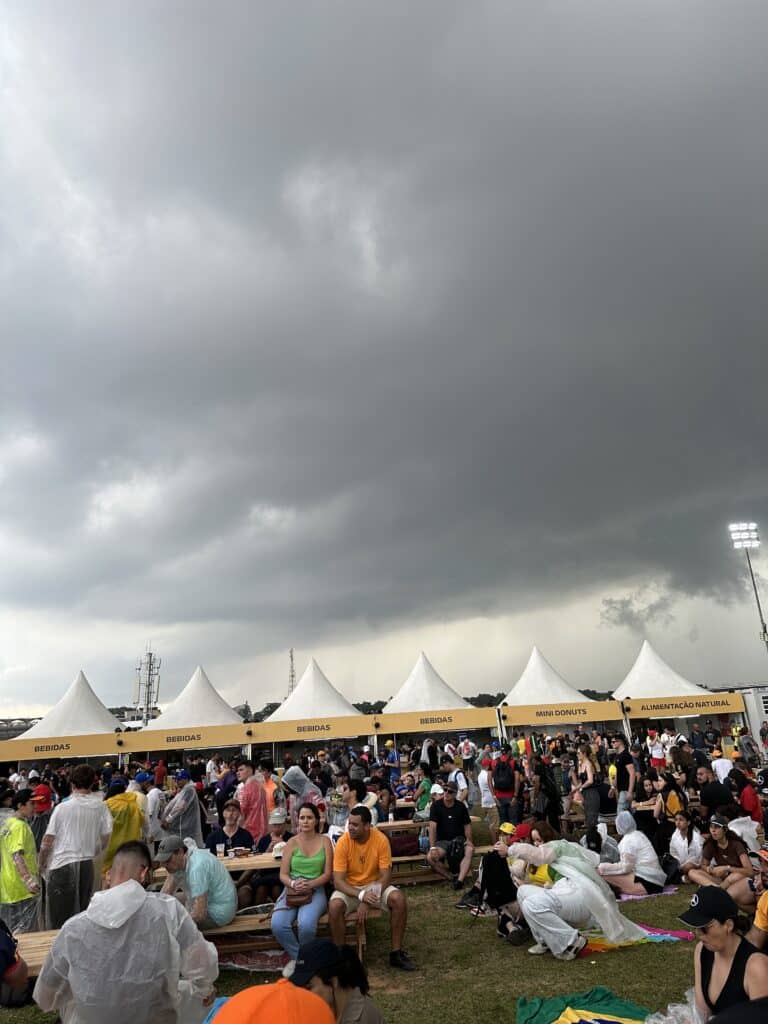
A plastic poncho, a sky like this, and strangers who made me feel like family. This is where I fell in love with F1 and Brazil.
My São Paulo Grand Prix Experience Started in Sector G
My first real Formula 1 experience was in Sector G at Interlagos, getting poured on for hours in a plastic poncho.
I was drinking beer and canned Jack and Coke with people I had never met. First, we were trying to hide from the rain. Later, we were dancing together in muddy fields.
Half the people around me didn’t speak the same language I did. Somehow, we still found ways to connect.
What I remember most is how they made room for me. When we were sheltering under a tent or gazebo, people shifted over and squeezed together so I could get underneath with them. They didn’t know me, but they welcomed me like family.
The F1 fan experience became personal for me right there: people I had never met making room for me like I belonged
That weekend made me fall in love with Formula 1. It also made me fall in love with Brazil.
I appreciate comfortable seats, air conditioning, and a beautiful hospitality space. But when I think about why this sport means so much to me, I still think about that plastic poncho, the mud, and the strangers who made me feel I belonged.
Growing up in the United States with American parents, Formula 1 wasn’t something I heard much about at home. It wasn’t part of my world.
I had Arab and Italian friends growing up, and later Brazilian, Portuguese, Spanish, and South American friends. Some of their family members watched Formula 1 and talked about it. Looking back, I realize the sport was around me. I just wasn’t paying attention.
That changed when I went to work at a Ferrari dealership.
The training manuals and modules taught me about Ferrari’s history and heritage, including its connection to racing. Understanding the brand meant learning why all of this mattered so much to people.
Attending events was part of my job. I also attended races personally, outside my capacity as an employee. What began as something I needed to understand gradually became something I wanted to spend my own time learning about.
Now I get the questions. Friends call me about the current race, upcoming events, and things happening in Formula 1. I went from barely noticing the sport to being the person people associate with it.
The history pulled me in, too. The races, the parties, the personalities, the circuits, and the heritage behind the teams.
I hated history in school. Now I’ll voluntarily spend a night reading about it.
Apparently, I needed race cars involved.
Before working at Ferrari, I never really understood why someone would name their son Enzo.
Now I do.
I used to hate history. Now I stop for the cars, the stories and everything that came before.
The Formula 1 Community is Why I Keep Coming Back: You Don’t Have to Support the Same Driver to Belong
It doesn’t matter who you support. It matters that you love F1.
I’ve attended races in the United States, Canada, Brazil, and Spain. One thing that keeps standing out is how people treat each other.
I have never personally seen a fight at a race over which team someone supports. You hear about rivalries turning ugly in football, soccer, baseball, and basketball. My experience at Formula 1 has been people supporting different teams and still enjoying the weekend together.
I’m describing what I’ve experienced. It’s a big part of why I keep going back.
It doesn’t matter who you support. Being an F1 fan is enough.
Sometimes a conversation starts with, “Did you see Senna back in the day?” Suddenly, someone is sharing a race they’ll never forget, and you’re telling them about yours.
For me, a race is one of the few places where I meet people from across the world simply by sitting beside them or waiting in line. For someone who doesn’t always find it easy to strike up a conversation, that matters.
The connection is already there.
In the grandstands, you might have someone on one side whose net worth has more zeros than you can imagine, and someone on the other who saved for months and made real sacrifices to attend.
You might never know which is which.
For those three days, they’re discussing the same drivers, debating the same decisions, and jumping out of their seats for the same overtake. People whose lives might rarely intersect outside the circuit can spend an entire weekend bonding.
A person’s budget doesn’t tell you how much they love the sport.
Why I Love Formula 1: The People Are Part of the Experience
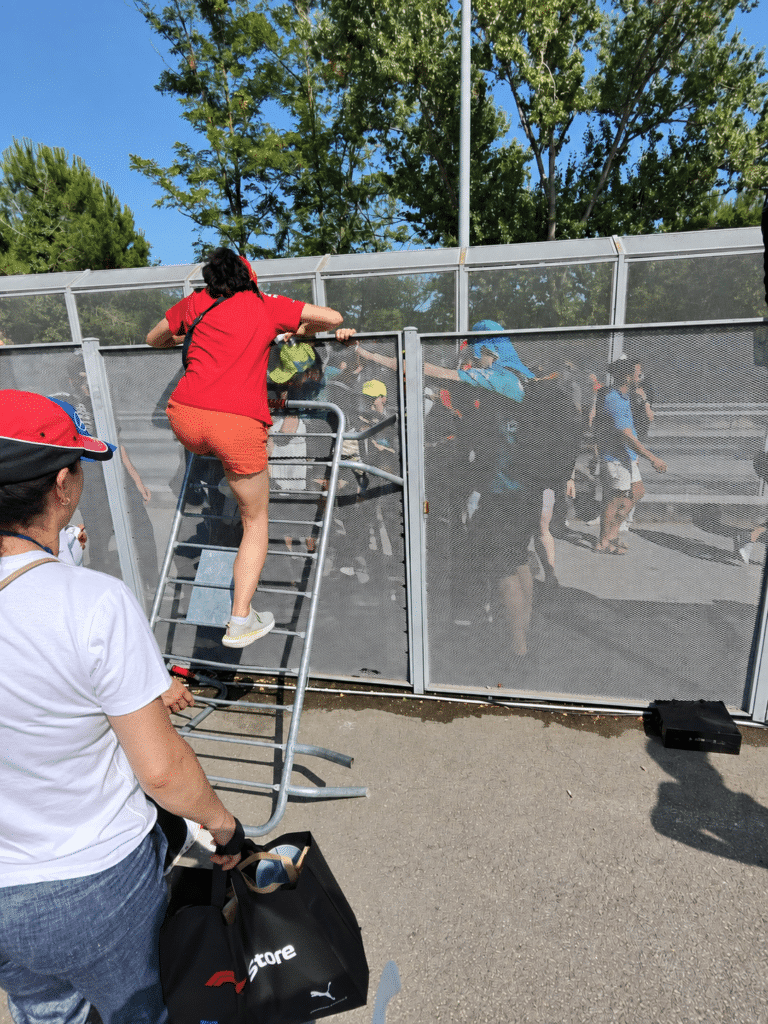
Barcelona, strangers helped each other through a chaotic exit. That part of the weekend stayed with me too.
In Spain, we got caught in the congestion of people trying to get onto the track while we were trying to leave. We ended up using a divider as a makeshift ladder to get over a fence.
It was chaotic. What stayed with me was how everyone helped each other get out.
In São Paulo, when I joined the crowd going onto the track, people around me made sure the little kids didn’t get crushed in the rush. Even in all that excitement, they were looking out for the children around them.
And the connections don’t end at the circuit.
On a flight back to Brazil, I made friends with a man about ten years older than me. He has three daughters and takes each of them individually to races. We talked for most of the flight.
That stayed with me. Each daughter gets her own trip with her dad, her own time with him, and memories they can share.
There we were, two people on a plane who found enough common ground through Formula 1to spend hours talking.
I feel that same connection at watch parties and car shows. We talk about the cars, the drivers, and the racing. People who might otherwise walk past each other suddenly have a reason to stop and talk.
Sometimes All It Takes Is a Pair of Ferrari Shoes
I don’t have to be at a circuit for Formula 1 to connect me with someone.
I own Ferrari, Red Bull, Mercedes, and McLaren gear, and I wear it a lot. I wear Ferrari Puma shoes to work every day.
People notice. A shirt, a logo, or a pair of shoes can start a conversation with someone I’ve never met.
It even helped me get invited to an invitation-only omakase experience. The person involved in arranging access had seen my Instagram and wanted to talk about Formula 1. That shared interest helped open the door.
That’s my world coming together: racing, food, and meeting people through something we both enjoy.
It doesn’t matter whether we support the same team. We already have something to talk about.
Even My NASCAR Customers Understand
I work at a Ford dealership in a very blue-collar area. A lot of my customers are big NASCAR and IndyCar fans. They love American cars and American racing, and they’re proud of it.
When I tell them I love Formula 1, they respect it. Would they rather get me watching more of the racing they follow? Absolutely.
But it gives us something to talk about. We can appreciate each other’s enthusiasm without having to choose the same favorite.
I understand their attachment to American racing. For me, the international side of Formula 1 is a huge part of the attraction.
I want to experience the world. I want to sit next to someone from another country, hear their story, and share a race weekend with them.
Formula 1 gives me a reason to do that.
One Driver, an Entire Team
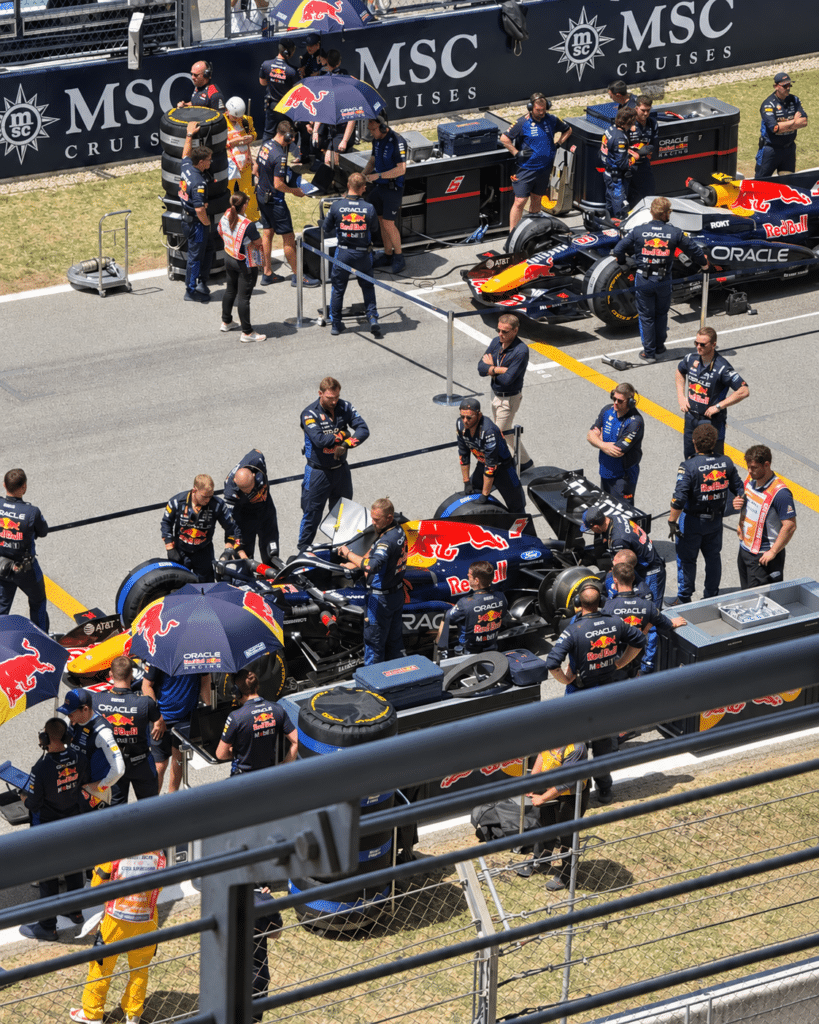
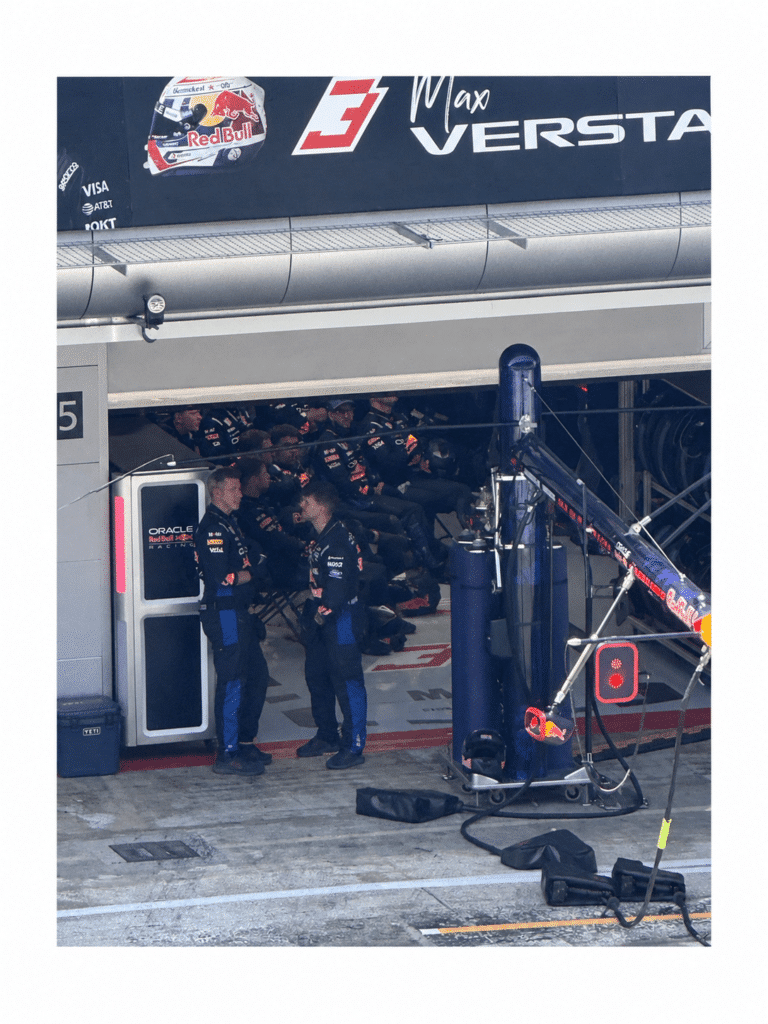
The driver gets the spotlight. Look at how many people it takes to get that car ready.
A fast car is only one piece of the picture. This is a team sport.
What makes the racing exciting to me is how many people have to get things right.
The driver is an athlete competing against some of the best in the world, with someone in their ear helping them make decisions. Behind that driver are the mechanics, engineers, strategists, pit crew, and people back at the factory.
Then there’s everything happening with the car.
Tire temperature. Tire wear. Reliability. Setup. When to pit. When to push. When to hold something back.
The driver has to deliver while processing all of that. The team has to provide the equipment, information, and opportunities to make it possible.
Other sports depend on teamwork, too. What fascinates me about Formula 1 is how closely the human performance and engineering depend on each other.
One incorrectly secured wheel or one miscalculation can undo a weekend’s work.
A fast car can help win a race. A great driver can produce an extraordinary result. Winning a world championship takes a team delivering again and again across a season.
That’s why I have trouble with dismissing a driver’s success by saying, “They just have the best car.” Building, preparing, and extracting performance from that car is part of the competition.
The achievement belongs to more people than the person holding the trophy.
There is a whole team behind every lap.
Why I Relate to Max
I’m a Ferrari fan. Lewis Hamilton and Charles Leclerc are my drivers. But I’ve also become a huge Max Verstappen fan.
I can be a no-nonsense person in business and in life. That’s part of what I relate to in the way Max comes across. He’s direct, fiercely competitive, and sometimes an asshole about it. I can appreciate that personality.
Obviously, I don’t know him personally. But he strikes me as someone I could spend a night bullshitting with over drinks—gin and tonics, or preferably tequila for me.
Then he could beat my drunk ass on a simulator over and over again.
I’d love a chance at something like Max versus 100 in karts, too. The aggressive New York–New Jersey driver in me would want to give him a fight for position. Realistically, I suspect he’d be disappearing into the distance while I was still figuring out the first corner.
But that’s part of being a fan: imagining what it would be like to share the thing you love with someone who does it at a level you can barely comprehend.
I support Ferrari, and I still stop to watch what’s happening at Red Bull. Also a Red Bull and Max Fan…. Simply Lovely
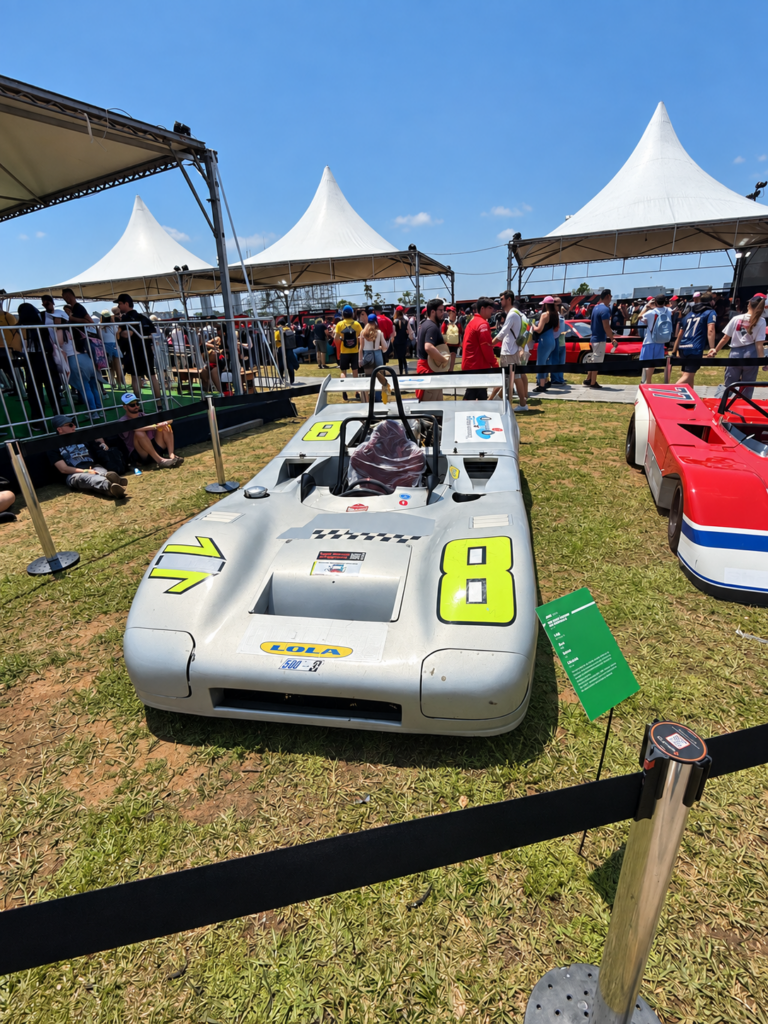
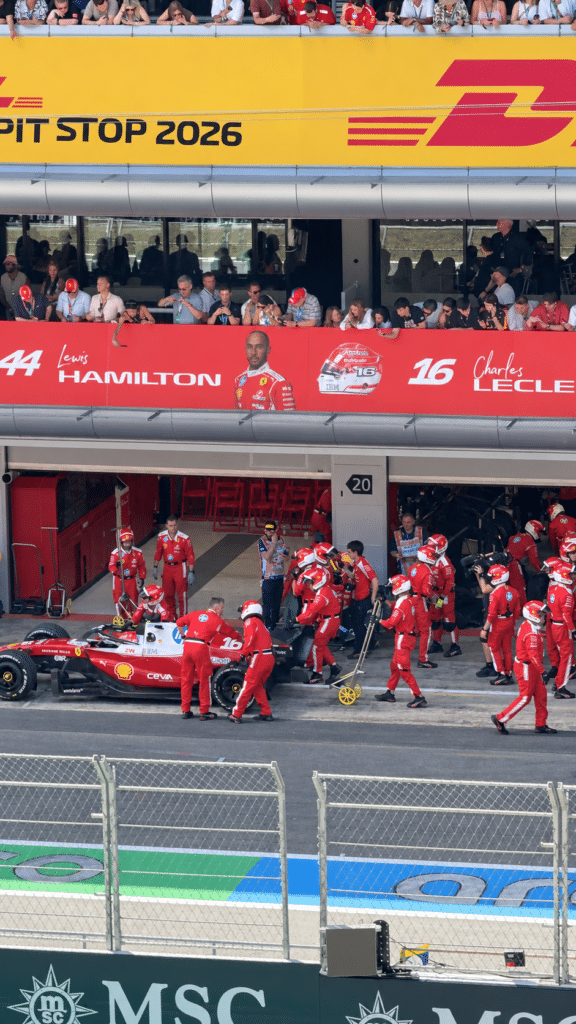
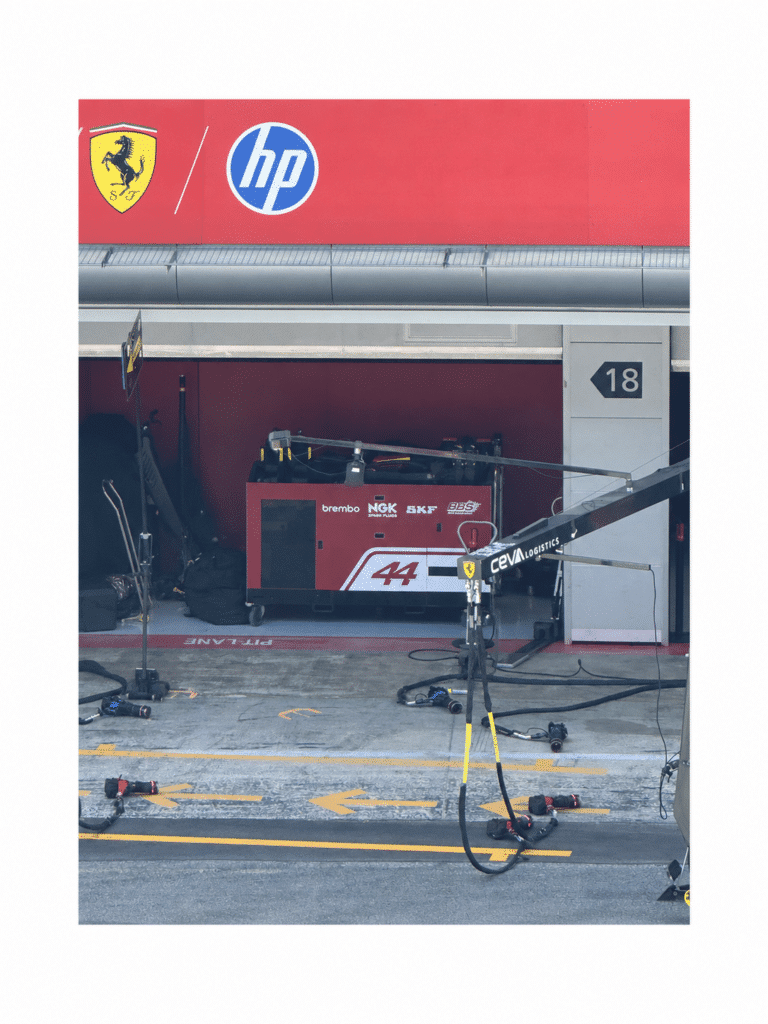
Number 44 in Ferrari red. A garage I couldn’t walk past without looking.
I Was There for Both Comebacks
I was at Interlagos in 2024 when Max won from 17th on the grid.
I was there again in 2025 when he started from the pit lane and finished third.
Two different races. Two extraordinary recovery drives. I got to witness both in person. Formula 1’s São Paulo recap
Those are the races I’ll tell my grandnephews about. I’ll be able to say, “I was there.”
And now I’m going back in 2026.
I don’t know what this year’s race will bring. That’s part of the excitement. But I know how much it means to return to the place where I fell in love with the sport and the country.
Why I Love Formula 1: You Can Be Moved by Someone Else’s Win
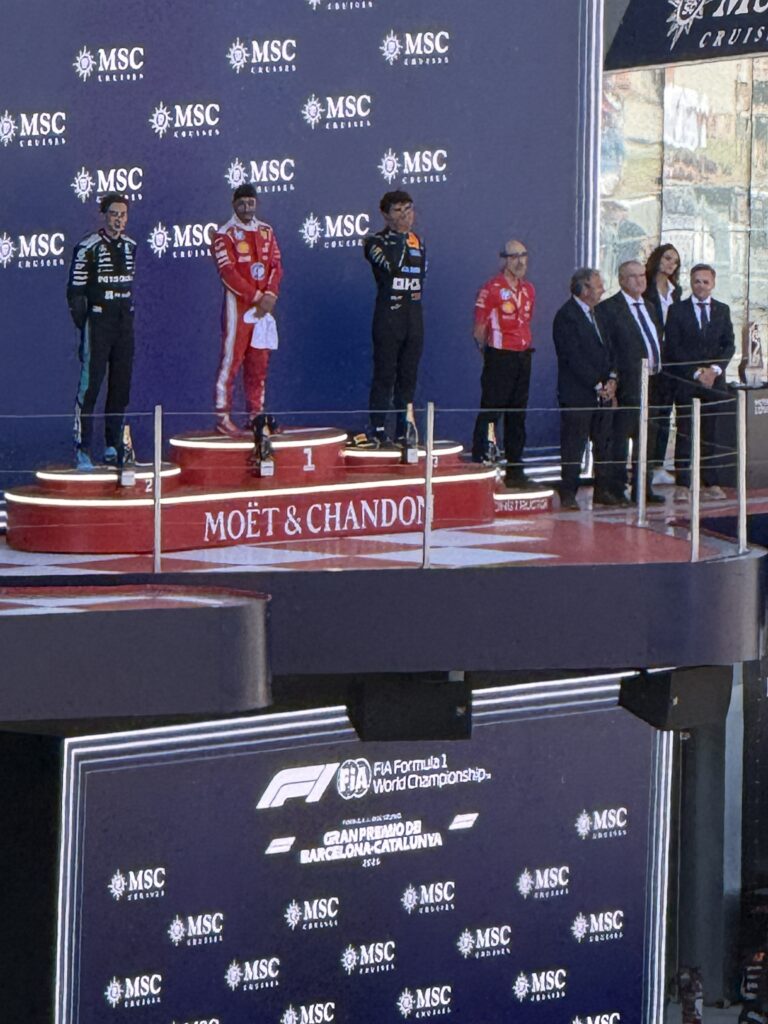
Lewis Hamilton, George Russell and Lando Norris on the podium at the 2026 Barcelona Grand Prix. Seeing Hamilton up there in Ferrari red is a moment I’ll carry with me.
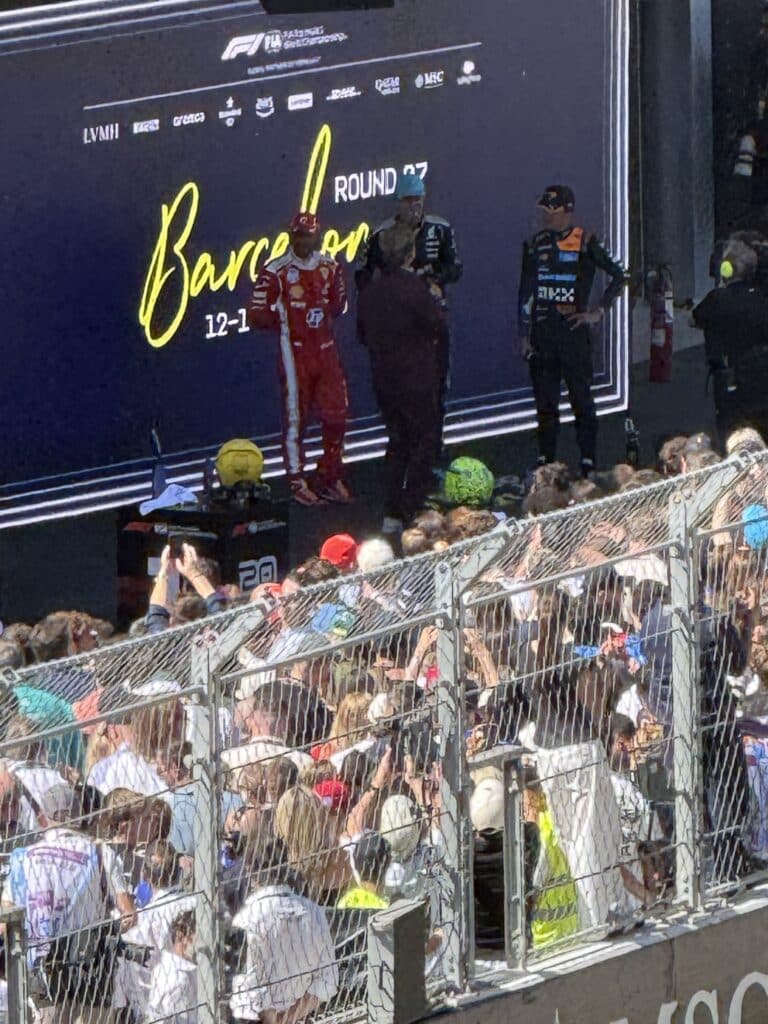
Lewis Hamilton, George Russell and Lando Norris sharing the stage at the 2026 Barcelona Grand Prix. Three teams, three talented drivers, and a sport I love.
In Barcelona in June 2026, I teared up watching Lewis win his first Grand Prix in Ferrari red. I was there for a moment I’ll always associate with that trip. FIA’s Barcelona race report
Then Kimi Antonelli won at Monza from 19th on the grid, becoming the first Italian to win there in 60 years, since Ludovico Scarfiotti in 1966. He was just 20 years old. Formula 1’s Monza report, Reuters
Would I have preferred Ferrari to win? Of course. It hurt a little that this Italian victory at Monza wasn’t in a red car. I would have loved a Max win, too.
But Kimi’s moment still touched me.
I respect Mercedes and McLaren. Kimi, George Russell, Lando Norris, and Oscar Piastri are talented drivers. Recognizing the strength of their cars doesn’t stop me from appreciating what they contribute.
I’ve also personally watched Max and Lewis go over to congratulate a winner after a long race. When you’ve spent all that time fighting for a result, acknowledging the person who beat you means something.
There are rivalries, tempers, and disagreements. Of course there are. But I’ve seen respect alongside them.
I can want my drivers to win and still feel something when someone else achieves an extraordinary result.
Learning About the Greats
The more history I read, the more I appreciate the different qualities that make a great driver.
Michael Schumacher is a perfect example of what I mean about teamwork. Seven world championships tell you about his results. His relationship with Ferrari tells you about his leadership.
He spent time at the factory, worked closely with engineers, encouraged the people around him, and set an example through his preparation. Alongside the team’s leadership and technical staff, he helped build an extraordinary period of Ferrari success. Schumacher’s career
Ayrton Senna brings another dimension: intensity, commitment, and skill in difficult conditions. His second-place drive in the rain at Monaco in 1984, racing for the small Toleman team, showed his ability before he became a three-time world champion.
What stands out to me in his approach is the belief in his abilities and the relentless desire to improve. That’s my interpretation of what I’m learning about him: someone who took his talent seriously and kept asking how much further he could go. Senna’s career and approach
Niki Lauda returned to racing just six weeks after his near-fatal accident in 1976 and went on to win two more championships. Later, he helped bring Lewis Hamilton to Mercedes. His influence continued long after he stopped driving. Lauda’s life and career
Jackie Stewart won three world championships and used his position to fight for a safer sport. Looking after the people who race alongside you, and those who will come after you, is a legacy worth respecting. Stewart’s contribution
And remarkable comeback drives didn’t begin with the drivers I follow today. John Watson won from 22nd at Long Beach in 1983. Rubens Barrichello took his first F1 victory for Ferrari from 18th in Germany in 2000. Kimi Räikkönen won from 17th in Japan in 2005, taking the lead on the final lap. Formula 1’s historic comeback victories
I’m still learning these stories. That’s part of the enjoyment. Every one gives me another reason to appreciate what I’m watching now.
Why I Love Formula 1: I Found Athletes Whose Minds Interest Me
I never really idolized athletes growing up.
The people who caught my attention were people like Warren Buffett, Steve Jobs, and Bill Gates. I was interested in how they thought, what they built, and how they made decisions.
Formula 1 gave me athletes whose minds interested me as much as their physical abilities.
A driver has to process what the car is doing and explain it clearly enough for engineers to act on it, while competing at extraordinary speed. That combination of concentration, judgment, and communication fascinates me.
Then you learn about their lives outside the cockpit.
Charles Leclerc plays piano and composes music. He released Dreamers, a collaboration with pianist Sofiane Pamart. That’s another side of someone I already enjoy watching race. Charles’s music
Nico Rosberg turned down a place to study aeronautical engineering at Imperial College London to pursue racing. He also achieved the highest score recorded at the time on Williams’s engineering aptitude test. Rosberg’s background
You don’t need a university degree to be intelligent. What interests me is how many different abilities these people bring to their lives and their work.
What They Give Back Matters
These drivers live extraordinary lives. There’s money, luxury, travel, and access most people will never experience. I enjoy that side of Formula 1, too.
I also respect what they choose to give back.
Senna’s legacy includes his concern for opportunities for children in Brazil. The Instituto Ayrton Senna carries that forward through work supporting public education, educators, and young people’s development. His name continues to mean something beyond the races he won. Instituto Ayrton Senna
That’s something I admire about Lewis Hamilton, too. I can get emotional watching Lewis win in Ferrari red and also respect what he’s building outside racing.
Through Mission 44, the charity he founded, he supports efforts to help young people overcome barriers in education and employment. His own experiences helped shape that mission: creating opportunities for people who might otherwise be overlooked. Mission 44
Max has supported Wings for Life, which funds spinal cord injury research, including through charity memorabilia auctions. A helmet auction is one documented example of turning the demand for something connected to him into support for that work. Wings for Life
Sebastian Vettel has worked to expand opportunities for women in karting through Race 4 Women. Helping people find a way into the sport is a contribution I appreciate. Vettel’s work
Lando Norris, the reigning world champion, announced LN4 Fusion and a funded young-driver development programme in September 2026. The programme is intended to provide financial support, coaching, and guidance. Running a team is a business, but helping young talent overcome financial barriers is still worth recognizing. Reuters’ report
Lando has also spoken openly about his own mental-health struggles through Mind. That work predates his championship. I respect someone who lets people see that success and self-doubt can exist in the same person. Lando’s words for Mind
We don’t see every private act of generosity. I won’t pretend to know everything these drivers do away from the cameras. The work we can see gives me plenty to admire.
And the next generation is already developing. Kimi Räikkönen’s 11-year-old son, Robin, has signed with Red Bull’s driver development programme, with his involvement officially beginning in 2027. He’s still a kid in karting, with his own path ahead of him, but the possibility of watching another Räikkönen work toward Formula 1 is exciting. Formula 1’s announcement
Someday, my grandnephews might be telling me about the drivers they follow. I’ll have my own stories to share.
Ferrari Opened the Door. The Whole Sport’s Heritage Keeps Me Interested.
The more I learn, the more I appreciate the history beyond Ferrari.
Lotus deserves a place in that conversation. Colin Chapman’s team combined talented drivers with engineering ideas that changed the sport. Seven Constructors’ Championships demonstrate its success; its pioneering ground-effect work shows its influence. Drivers including Jim Clark, Graham Hill, Emerson Fittipaldi, and Mario Andretti became world champions in Lotus cars. Lotus’s heritage, Its engineering influence
McLaren began with Bruce McLaren establishing his own team in 1963. Decades later, people are still working, racing, and winning under his name. McLaren’s heritage
Some of today’s teams also have histories you wouldn’t guess from the name on the garage.
The modern Mercedes operation’s ownership lineage runs through Tyrrell, BAR, Honda, and Brawn GP. Brawn competed for one season in 2009 and won both championships before becoming Mercedes.
Today’s Aston Martin operation traces its roots through Jordan, Midland, Spyker, Force India, and Racing Point.
And here’s a connection I particularly appreciate working at a Ford dealership: Red Bull’s operation began as Ford-backed Stewart Grand Prix before becoming Jaguar Racing under Ford’s ownership. Red Bull took over and began racing under its own name in 2005. Formula 1’s team histories
Learning those connections changes how I look at the grid. Behind a team can be decades of ambition, difficult seasons, new owners, breakthroughs, and people determined to keep racing.
The same happens when I read about a circuit. Knowing what happened there gives the place meaning before I even arrive.
When Ferrari’s Cars Became a Gesture of Respect
Sometimes a team’s most memorable gesture has nothing to do with winning.
At Monza in September 2001, just five days after the attacks in the United States, Ferrari removed its sponsor logos and painted the noses of its cars black. Michael Schumacher and Rubens Barrichello raced those cars as a tribute to the victims. The story of Ferrari’s tribute
An Italian team, at its home Grand Prix, made a visible gesture of mourning for people across the Atlantic.
That means something to me.
In a sport surrounded by advertising, prestige, and celebration, those cars expressed grief and respect. It’s another part of the history that helps me understand why people form such deep attachments to these teams.
I Love Hospitality. I’m Beginning to Prefer the Grandstands: Why I Love the Grandstand Experience
I’ve paid for paddock access and hospitality. I enjoy those experiences.
I like air conditioning. I like comfortable seats. Put me at a hot circuit for an entire weekend and I will absolutely appreciate somewhere cool to sit down.
I’ve also found that even the higher-end hospitality crowd, which can sometimes feel stuffy in other settings, loosens up around Formula 1. There’s a race to discuss, a driver to cheer for, or a strategy decision everyone has an opinion on.
That shared interest makes conversation easier.
But I’m beginning to prefer the grandstands.
I love being around the other fans. The conversations, the camaraderie, the shared excitement. I also get to experience something of the country through the people who call it home.
I can’t always afford tickets costing $10,000, $20,000, or $30,000. And the more races I attend, the more I realize that the grandstands give me something I actively want.
You don’t need a hospitality package to feel part of Formula 1. I’ve experienced that in Sector G at Interlagos and seen it among the fans watching from the grass in Barcelona.
There are different ways to experience a race at different budgets. Travel still takes planning, and affordability varies from person to person. But the most expensive ticket doesn’t buy you more passion.
I’ve experienced F1 travel on different budgets, and the most expensive ticket hasn’t always given me the best memories.
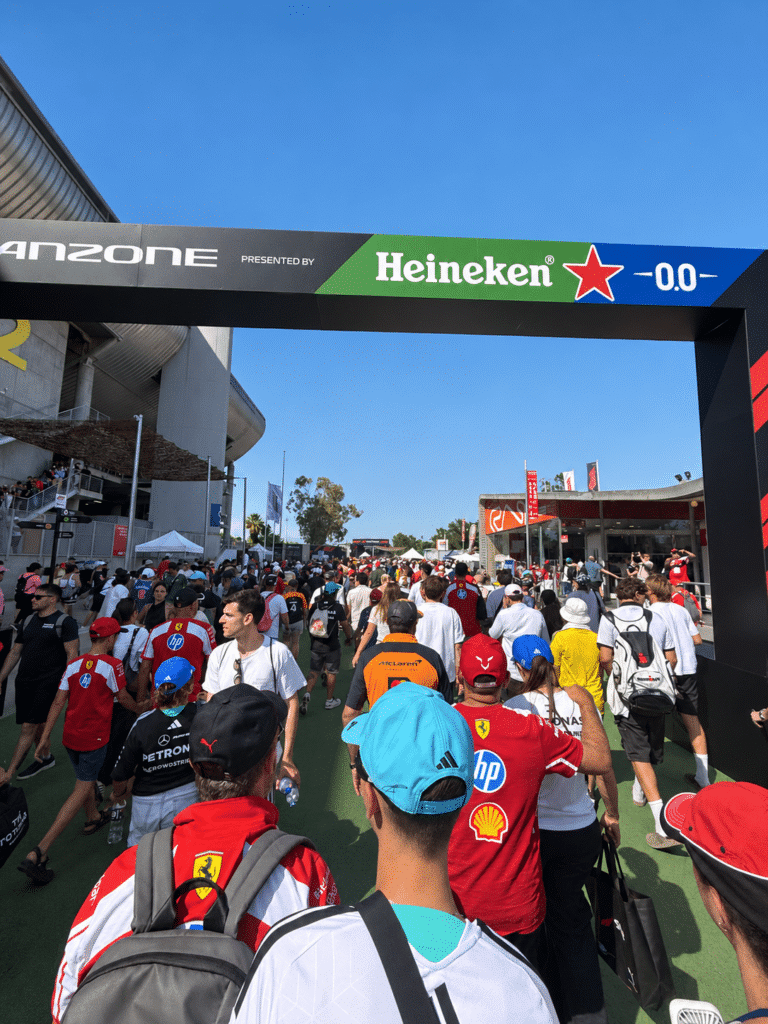
Even between sessions, I could spend hours taking this place in.
Half the experience is everything—and everyone—you find between sessions.
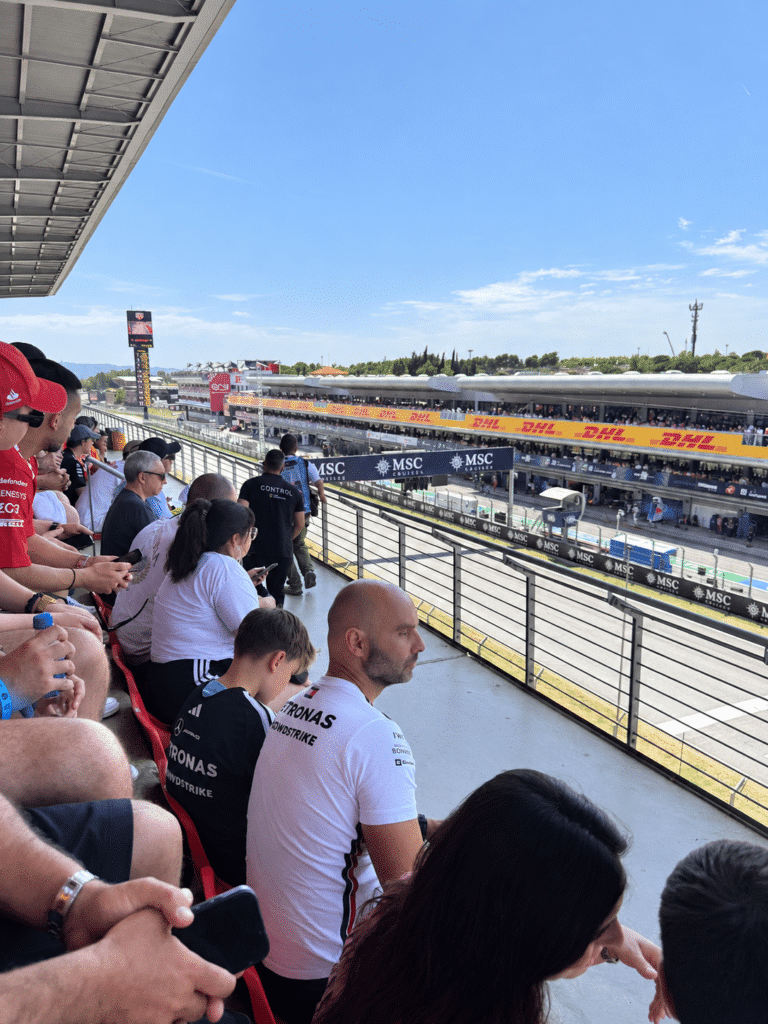
These were the seats I loved: a view of the track and a whole weekend of people to meet.
The people I went to Barcelona with were counting rows, working out where we should sit next time to get more shade.
I understood what they were doing. But my reaction was: fuck that, I loved our seats.
We were in the second row of the grandstand’s second level. There was only one row of people in front of us. I wanted a view of the track, a screen if possible, and a fun trip wrapped around the race.
I’ll sweat in the Spanish summer sun for that.
And I made the most of being there. I walked more than 12 miles on each of those days. There was roughly a two-mile walk to the circuit, and I spent hours walking around once I was inside.
When the cars weren’t running, I was exploring. Looking around the circuit, checking out different areas, and taking in the people and atmosphere.
I loved that part just as much.
What I particularly enjoyed in Barcelona was how much of the spectator grounds I could explore with my ticket. Compared with my experience in São Paulo, I had much more freedom to wander. That didn’t mean access to the paddock or every restricted area, but it gave me a lot to discover beyond my own seat.
For me, a race weekend includes all of that. I want to watch the racing, walk around, meet people, and experience the place.
The circuit, the crowd, the city. This is the view I keep coming back for.
Turning My Passion into Grand Prix Travel Planning: I Tried to Build a São Paulo Group Trip. It Didn’t Happen.
I’ve tried to turn this passion into something I can share with other people.
I put together a high-end São Paulo trip built around Formula 1. I wanted to bring a group there and show them the city, the food, the culture, and the people who made me fall in love with it.
I failed at that attempt, and I’m not going to pretend otherwise. But I’m not stopping. I still offer that trip and help planning it.
Along the way, I’ve been able to plan trips for people to Montreal, Texas, São Paulo, Barcelona, Monza, and a few other circuits. Even without bringing a whole group to Brazil, I’ve helped people experience the sport and the destinations around it.
Now I’m reworking and rebranding what I offer. My goal is eventually to help people travel to every race, with options across a much wider range of budgets.
Give me a $2,000 budget or a $200,000 budget, and I want to explore what’s possible. Those are very different trips. The race, departure point, flights, and number of travelers will determine what works.
I won’t promise every race fits every budget. I want to find the opportunities.
I know what a beautiful hotel and a hospitality suite can add to a weekend. I also know what it feels like to stand in Sector G in a plastic poncho and have the experience change your life.
I want to help other people find their version of that.
Spain Was Amazing. I Also Spent Way Too Much.
My personal goal is to return to São Paulo for the race every year and visit at least one other circuit.
Family, finances, and schedules will have a say. I won’t always be able to do everything I want. But I’ll do what I can.
This year, I had an amazing nine days in Spain. I ate at incredible restaurants, explored some great places, and experienced a race weekend I’ll never forget.
I also spent way too much money. If I put the total here, plenty of people would think I’d lost my mind.
The race tickets were less than €1,000. I spent more than that at the track on helmets and souvenirs alone.
That’s worth admitting in a conversation about Formula 1 travel. The race ticket wasn’t what sent my spending through the roof. My choices did.
The restaurants, shopping, and extras were things I wanted. They weren’t requirements for enjoying the race.
I spent enough that I nearly had to miss Brazil.
At one point, I was prepared to go to São Paulo and watch the race on television. I wanted my feet on the ground in a city I love, feeling the energy of race weekend, even if I couldn’t get to the circuit.
But I worked my ass off and made it happen. I’m going.
Live the Fuck Out of Life as You Can
If I want more race weekends, I can make different spending decisions—or find ways to make more money.
Honestly, I prefer the second option.
That’s how I’ve approached most of my life. I’ve worked my ass off, sometimes way too much. Now I want that work to fund something I love. Hopefully, I can build a way to earn a living through that passion, too.
Over the last five years, Formula 1, travel, and food have changed what I want.
I’m less interested in accumulating possessions, buying a bigger house, or owning more land. I want time in places I haven’t been. Meals I’ll remember. Race weekends with people I haven’t met yet.
You can’t take any of this with you. But while you’re here?
Live the fuck out of life as you can.
“As you can” matters. I have family responsibilities, bills, a job, and limits like everyone else. Some years will allow more than others. I want to make the most of the opportunities I do have, while working toward more.
Learning about Senna’s commitment and seeing Hamilton use his success to create opportunities makes me think about what I want to do with my own life.
I’m not comparing planning someone’s vacation to changing access to education. But I understand the desire to take something that matters to you and make it useful to someone else.
For me, that can start with helping someone experience a race, discover a country, or feel confident taking a trip they’ve been putting off.
And it starts with allowing myself to live, too.
Sometimes that means a beautiful hotel and an incredible dinner. Sometimes it means sweating in a grandstand, walking miles around a circuit, or dancing in the mud with people whose language I don’t speak.
I’ve felt completely alive doing all of those things.
I’m 44. My goal is to spend three to five weeks a year traveling internationally and grow that over time. Local exploring is something I can do on weekends. I want more opportunities to experience other countries and continents.
If I had work I could do from anywhere, I’d love to follow the calendar and attend every race. I’d even stay in hostels to make it happen.
Private room and private bathroom, of course. Let’s not get carried away.
I still prefer a nice hotel.
Eventually, I’d love a life where home is a small base: somewhere to keep my seasonal clothes, recharge for a weekend or a week, and prepare for the next trip.
I may have to keep working for the rest of my life. I hope I can make that work something I love, something that brings me closer to the experiences I want.
I don’t want to keep postponing them until some perfect future when I finally have enough money or enough free time.
Something Worth Carrying Forever
I don’t have any tattoos.
I could never think of something I wanted on my body forever. I don’t have children. I could definitely see myself getting a tattoo of the pets who have meant so much to me, but until now, I haven’t taken that step.
Now I want to start marking the places and experiences that have become part of my life.
Flags of countries I’ve visited. The outlines of circuits where I’ve attended races. Something I can look at and remember being there.
Maybe a 44, for Lewis Hamilton and the age when I really began to understand the man I’ve become. Maybe a 3, for Max and the relentless competitive mentality I relate to. Maybe Senna’s helmet or Schumacher’s.
I’m still deciding what those tattoos will look like. But for the first time, I have things I want to carry that way.
One Senna quote that speaks to me is:
“I have no idols. I admire work, dedication and competence.”
That wording appears in McLaren’s tribute to him. It puts into words something I’ve been trying to explain about the people I admire: the work, the ability, and the commitment behind their achievements. McLaren’s Senna tribute
His insistence on giving something your full effort resonates with me, too. I believe in my abilities. I also believe I can improve, and I intend to keep finding out how much further I can go.
About ten years ago, I took a step back in my career to build my property management and cleaning company.
That business has been doing well, and it no longer needs me to be as involved in the day-to-day work. That gives me a choice about where I put my time and energy next.
I could pursue the same kinds of positions I held before. I know what it takes to build a successful operation because I’ve done it.
Instead, I’m choosing to build my Formula 1, travel, and food blog into a career because I truly love it.
The results may take longer. The money may be less immediate. But I want to put my experience, intelligence, and drive into something I’m excited to keep building—something that brings together racing, travel, food, hospitality, and helping other people experience the world.
There will still be hard work. I’m comfortable with that. What’s different is how much I want to do this work and where I hope it will take me.
That’s why “Live the fuck out of life as you can” means so much to me. I’ve spent years building businesses and a career. Now I want to use what I’ve learned to build a life around the things I love.
A flag or a circuit outline would remind me of somewhere I actually went. People I met. A weekend I made happen. A moment when I felt fully present.
For years, I couldn’t think of anything I wanted on my body forever.
Now I’m building a life full of things I don’t want to forget.
Sometimes I wish I’d discovered this passion in my teens. Maybe I would have made different career decisions. Maybe my life would have taken a completely different direction.
But working at Ferrari helped bring me here. So did the people I met, the jobs I held, and the trips I eventually took.
The life I’ve lived made me the person who appreciates all of this today.
I wish I’d found it earlier. I don’t regret the life that led me to it.
Now I want to keep going for as long as I can. Another race. Another country. Another continent.
Maybe another planet.
Hopefully Elon gets Formula 1 to Mars before I die. It doesn’t even have to be cars. I’ll watch them race space shuttles.
Just give me a grandstand and some people who love it as much as I do.
And until then, I’ll keep trying to get back to São Paulo—to the place where strangers made room for me under a tent and helped turn an interest into a passion.
Our sport. Our passion. Our people.
Ponchos on. Nobody was done enjoying the weekend. Our sport. Our passion. Our people.
Follow my Instagram A Vision for the Future of Grand Prix Hospitality The Opportunity Over the past several years, I’ve traveled to Formula 1 destinations around the world—not simply to attend races, but to experience the cities that host them. Long before I purchase a race ticket, I’m researching restaurants, cocktail bars, hotels, neighborhoods, architecture, […]
How the 2024 São Paulo Grand Prix Made Me Fall in Love with Travel My São Paulo travel story For more than twenty years, my life revolved around one thing: the automotive business. Long hours. Endless weekends. Sales goals. Deliveries. Finance paperwork. It was a career I genuinely loved, but it didn’t leave much room […]
Formula 1 Luxury Travel at a Glance The race is the reason I book. The city is why I want to return. For me, the best Grand Prix trips combine the atmosphere at the circuit with memorable meals, a hotel that suits the weekend and enough time to explore. My firsthand perspective: São Paulo and […]
Cookie Consent
We use cookies to improve your experience on our site. By using our site, you consent to cookies.
Essential cookies enable basic functions and are necessary for the proper function of the website.
Name
Description
Duration
trustedsite_visit
-
trustedsite_tm_float_seen
-
Cookie Preferences
This cookie is used to store the user's cookie consent preferences.
30 days
These cookies are needed for adding comments on this website.
Name
Description
Duration
comment_author_email
Used to track the user across multiple sessions.
Session
comment_author_url
Used to track the user across multiple sessions.
Session
comment_author
Used to track the user across multiple sessions.
Session
Google Tag Manager simplifies the management of marketing tags on your website without code changes.
Name
Description
Duration
cookiePreferences
Registers cookie preferences of a user
2 years
td
Registers statistical data on users' behaviour on the website. Used for internal analytics by the website operator.
session
These cookies are used for managing login functionality on this website.
Name
Description
Duration
wordpress_logged_in
Used to store logged-in users.
Persistent
wordpress_sec
Used to track the user across multiple sessions.
15 days
wordpress_test_cookie
Used to determine if cookies are enabled.
Session
Statistics cookies collect information anonymously. This information helps us understand how visitors use our website.
GoDaddy's visitor traffic tracking, added automatically to sites hosted with GoDaddy and to sites built with GoDaddy Website Builder. It records page views, clicks, and page timing, and sends them to GoDaddy to measure traffic and site performance.
Holds the number of pages viewed in the current visit and the time of the last interaction, so GoDaddy's traffic tracking can tell when a visit has ended.
20 minutes
_tccl_visitor
Stores a randomly generated visitor ID so GoDaddy's traffic tracking recognizes a returning visitor across sessions.
1 year
_tccl_visit
Stores a randomly generated ID for the current visit so page views and clicks can be grouped into one session.
30 minutes
Google Analytics is a powerful tool that tracks and analyzes website traffic for informed marketing decisions.
Used to monitor number of Google Analytics server requests when using Google Tag Manager
1 minute
_gid
ID used to identify users for 24 hours after last activity
24 hours
_ga_
ID used to identify users
2 years
_gali
Used by Google Analytics to determine which links on a page are being clicked
30 seconds
_ga
ID used to identify users
2 years
__utmx
Used to determine whether a user is included in an A / B or Multivariate test.
18 months
__utmc
Used only with old Urchin versions of Google Analytics and not with GA.js. Was used to distinguish between new sessions and visits at the end of a session.
End of session (browser)
__utmv
Contains custom information set by the web developer via the _setCustomVar method in Google Analytics. This cookie is updated every time new data is sent to the Google Analytics server.
2 years after last activity
__utmz
Contains information about the traffic source or campaign that directed user to the website. The cookie is set when the GA.js javascript is loaded and updated when data is sent to the Google Anaytics server
6 months after last activity
__utmb
Used to distinguish new sessions and visits. This cookie is set when the GA.js javascript library is loaded and there is no existing __utmb cookie. The cookie is updated every time data is sent to the Google Analytics server.
30 minutes after last activity
__utmt
Used to monitor number of Google Analytics server requests
10 minutes
__utma
ID used to identify users and sessions
2 years after last activity
_gac_
Contains information related to marketing campaigns of the user. These are shared with Google AdWords / Google Ads when the Google Ads and Google Analytics accounts are linked together.