
Tag: Formula One

  • Formula 1 Beyond the Circuit

    Formula 1 Beyond the Circuit

    Follow my Instagram

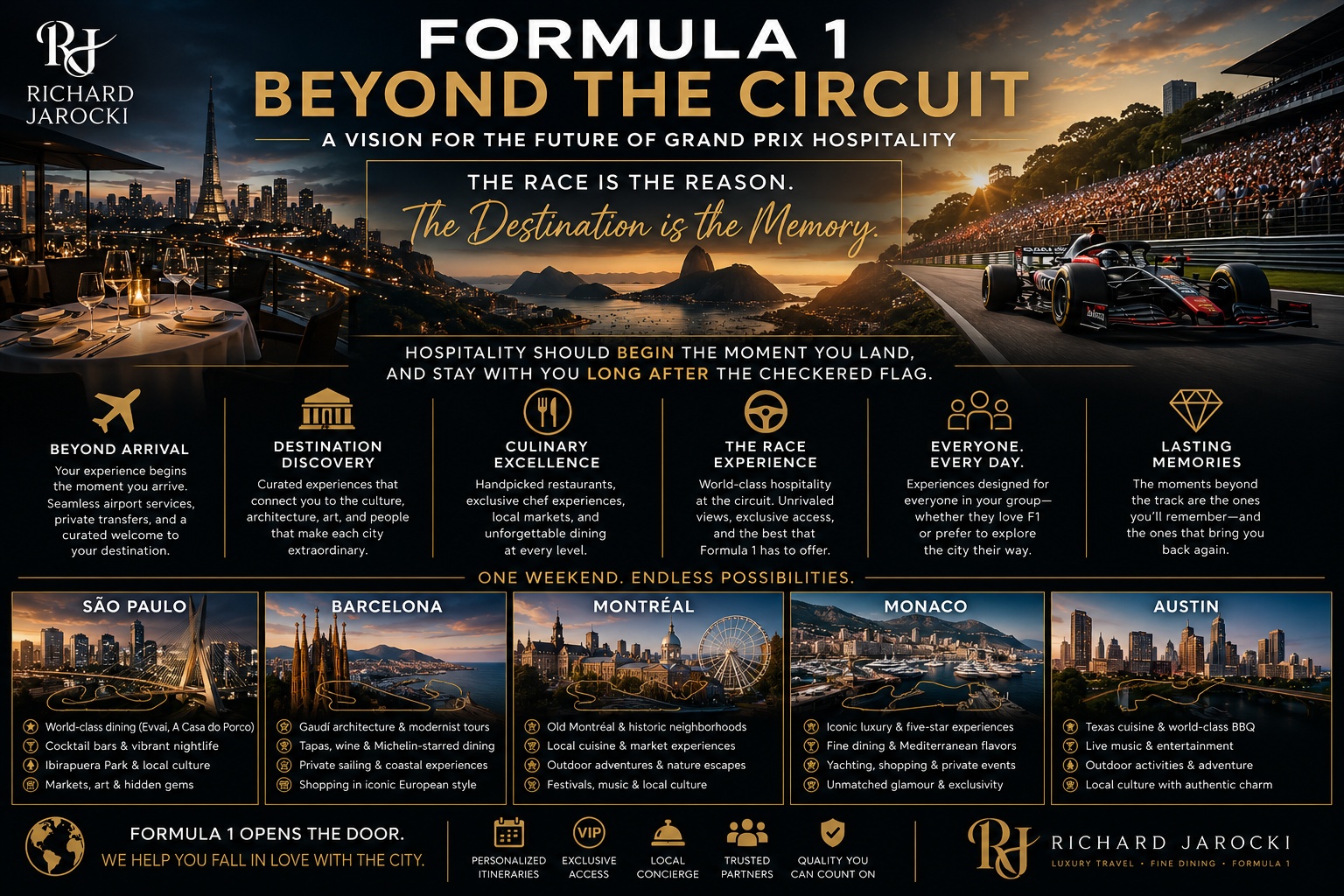
    Infographic illustrating a vision for the future of Formula 1 hospitality, featuring Grand Prix destinations, luxury travel, fine dining, and experiences beyond the race circuit by Richard Jarocki.

    A Vision for the Future of Grand Prix Hospitality

    The Opportunity

    Over the past several years, I’ve traveled to Formula 1 destinations around the world—not simply to attend races, but to experience the cities that host them.

    Long before I purchase a race ticket, I’m researching restaurants, cocktail bars, hotels, neighborhoods, architecture, museums, and local culture. Sometimes I know where I’ll have dinner months before I know where I’ll be sitting on race day.

    Along the way, I realized something.

    Formula 1 has become one of the world’s greatest reasons to travel.

    But we’re still treating the destination as a backdrop rather than part of the experience.

    Every Grand Prix introduces hundreds of thousands of people to cities they may never have otherwise visited. The racing is extraordinary, yet the opportunity to connect guests with the destination often begins and ends at the circuit gates.

    I believe there’s an opportunity to expand what Formula 1 hospitality means—not by replacing what’s already exceptional, but by extending it beyond the track.


    Formula 1 Isn’t Selling Three Days

    This is where I think the article becomes more interesting.

    People often describe Formula 1 as a weekend event.

    I don’t think that’s true anymore.

    When someone travels from New York to São Paulo, London to Singapore, or Sydney to Montréal, they’re not buying a three-day sporting event.

    They’re planning an international vacation.

    The race may be the reason they booked the flight, but it’s rarely the only reason they’re traveling.

    For many guests, the Grand Prix is one chapter in a much larger story.

    Hospitality should reflect that.


    Hospitality Should Begin Before the First Practice Session

    Today’s hospitality programs are exceptional once guests arrive at the circuit.

    But what happens before Friday morning?

    Imagine arriving in Barcelona.

    Instead of simply receiving your race credentials, you receive a curated itinerary tailored to your interests.

    Perhaps you’re passionate about architecture. Your first afternoon explores Gaudí’s masterpieces before dinner at one of Barcelona’s most celebrated restaurants.

    Maybe food is your passion. Your itinerary introduces you to neighborhood tapas bars, a market tour, and one of the city’s Michelin-starred tasting menus.

    Or perhaps you’re visiting with your family. While you’re at the circuit, your spouse and children spend the day on experiences designed specifically for them, all curated under the same standard of excellence associated with Formula 1.

    Now hospitality isn’t confined to the paddock.

    It’s woven into the entire journey.


    One Trip. Different Experiences.

    This, in my opinion, is where Formula 1 has its biggest opportunity.

    Not everyone who travels to a Grand Prix is a Formula 1 fan.

    Some are spouses.

    Some are children.

    Some are parents.

    Some are corporate guests.

    Some are clients invited by sponsors.

    Some simply want to experience a new city.

    Yet too often they’re treated as an afterthought.

    Imagine asking one simple question during booking:

    “Who is traveling with you?”

    That single question changes everything.

    One guest spends the afternoon inside the Paddock Club.

    Their partner spends the afternoon exploring São Paulo’s art museums with a private guide before enjoying cocktails at one of Latin America’s best bars.

    Their children participate in an FIA-inspired STEM program where they learn how aerodynamics, engineering, and sustainability shape modern motorsport through hands-on activities.

    Everyone reconvenes for dinner.

    Everyone has stories to tell.

    Nobody spent the day waiting for someone else.


    Every Grand Prix Should Feel Like Its Host City

    One of Formula 1’s greatest strengths is its global calendar.

    No two cities are alike.

    So why should hospitality feel the same?

    The experience in Japan should celebrate Japanese craftsmanship, precision, and cuisine.

    Montréal should showcase Québec’s culinary scene, history, and neighborhoods.

    São Paulo should introduce guests to one of the world’s most exciting food cities.

    Melbourne should embrace its coffee culture, laneways, and coastal lifestyle.

    Monaco should feel unmistakably Monaco.

    The destination itself should shape the experience.

    Because guests don’t simply remember where they watched the race.

    They remember where they had the best meal of their lives.

    They remember the bartender who introduced them to a local spirit.

    They remember wandering neighborhoods they would never have discovered on their own.

    Those memories become inseparable from the Grand Prix itself.


    A New Standard: FIA-Endorsed Destination Experiences

    This doesn’t require Formula 1 to become a tour operator.

    Instead, it could become a trusted curator.

    Working alongside tourism boards, Michelin Guide restaurants, museums, luxury hotels, local guides, and cultural institutions, every Grand Prix could offer an official collection of experiences carrying the same quality standards associated with the championship.

    Guests would know these aren’t generic excursions.

    They’re experiences chosen because they represent the very best of that city.

    That distinction matters.


    Technology Makes This Possible

    Imagine the official Formula 1 app evolving beyond schedules and timing.

    After purchasing your ticket, guests complete a short profile.

    • Are you traveling alone?
    • With family?
    • With children?
    • Are you interested in food?
    • Architecture?
    • Shopping?
    • Wine?
    • Photography?
    • Wellness?
    • Adventure?

    Artificial intelligence could build a personalized itinerary around the race weekend, integrating official experiences, restaurant reservations, transportation, and local recommendations into one seamless journey.

    Every guest leaves with an experience unique to them.


    Why This Makes Business Sense

    This isn’t simply about improving hospitality.

    It’s about increasing value for everyone involved.

    When visitors extend their stay from three nights to six, everyone benefits.

    Hotels see higher occupancy.

    Restaurants welcome more guests.

    Museums and attractions gain additional visitors.

    Local businesses generate more revenue.

    Sponsors gain more opportunities to engage with guests beyond the circuit.

    Host cities strengthen the economic case for investing in Formula 1.

    Formula 1 itself becomes associated with world-class travel, not just world-class racing.

    Hospitality becomes an economic engine rather than simply an event offering.


    A Framework for Destination Hospitality

    If I were designing hospitality for a Grand Prix, I’d build it around five principles.

    1. Arrival

    The guest experience begins at the airport—not at the circuit.

    2. Discovery

    Introduce visitors to the city’s neighborhoods, culture, history, and people.

    3. Culinary

    Use restaurants, markets, cafés, and bars to tell the story of the destination.

    4. Circuit

    Deliver the exceptional race-day experience Formula 1 already excels at.

    5. Legacy

    Leave guests wanting to return to the city, even when there isn’t a race.

    When these five elements work together, a Grand Prix becomes more than a sporting event.

    It becomes one of the world’s great travel experiences.


    Beyond Hospitality

    Ultimately, this isn’t just about hospitality.

    It’s about strengthening the relationship between Formula 1 and the cities that welcome it.

    The championship already inspires millions of people to travel.

    The next evolution is ensuring they fall in love not only with the race, but with the destination itself.

    Because the most memorable Grand Prix weekends don’t end when the checkered flag falls.

    They continue every time someone remembers the café where they had breakfast, the neighborhood they wandered through, the restaurant they’ll spend years recommending to friends, or the city they can’t wait to return to.

    Formula 1 has already become a global lifestyle brand.

    I believe its next chapter is becoming the world’s greatest gateway to travel.

  • History of the Autodromo Jose Carlos Pace Race Track

    Rising up brazil flags. Crowd of people holding brazilian flags, back view.

    The Autodromo Jose Carlos Pace is a legendary motorsport site with a rich history that captivates racing enthusiasts and casual fans. Known for its challenging layout and vibrant atmosphere, this iconic race track in São Paulo, Brazil, has served as a backdrop for some of the most thrilling moments in Formula One history. As anticipation builds for the upcoming 2025 Grand Prix, it’s essential to explore the origins and evolution of this remarkable venue, showcasing its significance in the racing community.

    This blog post will explore the fascinating history of Autodromo Jose Carlos Pace and detail key milestones that have shaped its legacy.

    The Origins of the Autodromo Jose Carlos Pace

    Since its inception, the Autodromo Jose Carlos Pace, better known as Interlagos, has become a symbol of motorsport excitement. Located in São Paulo, Brazil, the race track first opened in 1940. It originally operated as a public road circuit but underwent significant improvements in the 1950s, solidifying its reputation as a premier racing venue. Named after Brazilian driver José Carlos Pace, who tragically lost his life in a plane crash in 1977, the track honors his legacy and passion for the sport. Its unique configuration, nestled in a natural valley, provides an exhilarating challenge for drivers and an unforgettable experience for fans.

    From its early days, the Autodromo Jose Carlos Pace evolved into a beloved host for various motorsport events. In 1973, the circuit officially joined the Formula One calendar, gaining international acclaim for its passionate crowds and vibrant atmosphere. Over the years, the track has witnessed thrilling races and produced iconic moments, becoming a staple in motorsport. As the site prepares to welcome the 2025 Grand Prix, the enduring spirit of Interlagos continues to capture the hearts of racing enthusiasts, promising a rich legacy that enhances its status as one of the greatest tracks in history.

    Key Milestones in the History of the Race Track

    The Autodromo Jose Carlos Pace, located in São Paulo, Brazil, has witnessed numerous key milestones since its opening in 1970. Originally constructed to host Formula One races, the circuit was named after the Brazilian driver José Carlos Pace, who tragically lost his life in a plane crash in 1977. The track’s inaugural race occurred during the 1972 Brazilian Grand Prix, marking the beginning of its reputation as a challenging and exciting venue for motorsport enthusiasts. Over the years, this legendary site has undergone several modifications to enhance safety and improve the overall racing experience, with notable changes made to its layout and infrastructure.

    In 1990, the track hosted a memorable race that showcased the fierce competition among several world-class drivers. As Formula One gained popularity in the 1990s, the Autodromo became a staple on the racing calendar, with its vibrant atmosphere attracting fans from around the globe. The venue faced its share of challenges, including environmental concerns and financial difficulties, which prompted renovations in the early 2000s. These upgrades modernized the facilities and solidified the circuit’s status as one of the premier racing venues in the world. Today, the track continues to captivate audiences, and preparations for the highly anticipated 2025 Grand Prix highlight its enduring legacy and significance in motorsport.

    The Road to the 2025 Grand Prix

    As the 2025 Grand Prix approaches, excitement builds around the Autodromo Jose Carlos Pace, known for its challenging layout and vibrant atmosphere. The track, featuring a blend of fast straights and technical corners, demands skill and precision from drivers, making it a thrilling experience for both participants and fans. The venue’s rich history adds to the anticipation, as it has hosted legendary races and iconic drivers, all of which contribute to its status as a must-visit destination in motorsport.

    Preparations for the 2025 Grand Prix are underway, with facility enhancements and increased spectator experience focus. Organizers aim to elevate the overall atmosphere by integrating modern amenities while preserving the track’s historic charm. Attendees can expect engaging fan zones, food and entertainment options, and closer racing access that deepens their connection to the sport. As we gear up for this epic event, the Autodromo Jose Carlos Pace continues to be a beloved landmark in the heart of São Paulo, setting the stage for another unforgettable chapter in its storied narrative.

    Join Us for Unforgettable Moments at the 2025 Grand Prix

    Discover unforgettable moments in the world of motorsport at the 2025 São Paulo Grand Prix. Picture yourself in exclusive VIP suites overlooking the track, sipping premium champagne as the roaring engines and high-speed action unfold before you. Our curated packages offer the best views of the race and private access to hospitality lounges, gourmet dining, and meet-and-greet opportunities with racing legends.

    Rising up brazil flags. Crowd of people holding brazilian flags, back view.
  • F1 2025 Pre-Season Testing Day One: Key Insights and Takeaways

    The 2025 Formula 1 pre-season testing has kicked off with a flurry of activity, and day one is already offering a glimpse into what the new season might hold. Motorsport experts and fans alike are buzzing with excitement as teams fine-tune their machines ahead of the championship battles. In this post, we compile and analyze insights from leading sources to give you a comprehensive recap of day one.

    Key Takeaways from Day One Testing

    Nine Things We Learned – Insights from The Race

    The Race detailed nine pivotal takeaways from the opening session. Their analysis highlights:

    • Performance Trends: Early indicators of car performance, with certain teams showcasing improved aerodynamic efficiency.
    • Setup Innovations: How teams are experimenting with new setups that could play a crucial role once the season starts.
    • Reliability Issues: Initial testing also revealed areas where teams need to focus on reliability as they push the limits of the 2025 regulations.

    Bahrain’s Day One – What Formula1.com Has to Say

    According to Formula1.com, Bahrain’s testing session provided valuable data on:

    • Thermal Management: How teams are tackling the challenges of managing tire temperatures in Bahrain’s climate.
    • Driver Feedback: Early comments from drivers that could hint at mid-season development paths.
    • Competitive Parity: The session underscored that while some teams appear ahead in certain areas, the field remains closely contested.

    Five Essential Observations from DMarge

    DMarge distilled the testing action into five key observations:

    • Aerodynamic Shifts: Notable changes in aerodynamic packages, suggesting teams are adapting to new technical regulations.
    • Power Unit Performance: A closer look at the performance of hybrid power units, with some teams finding a better balance between power and efficiency.
    • Data-Driven Adjustments: How engineers are leveraging simulation data to make rapid in-field adjustments.

    Detailed Analysis by Total Motorsport

    For those wanting a deeper dive, Total Motorsport provided a comprehensive review of the session’s technical and strategic insights:

    • Chassis and Handling: Observations on chassis stiffness and handling characteristics that may set the stage for future developments.
    • Team Strategies: An analysis of how different teams are approaching testing with a focus on long-run performance versus qualifying pace.

    Live Updates from BBC Sport

    Finally, BBC Sport’s live coverage kept fans updated in real time, capturing the dynamic environment of day one:

    • On-Track Developments: Continuous updates on lap times, weather conditions, and any unexpected technical issues.
    • Fan Engagement: Real-time commentary that brought the excitement of the track directly to fans worldwide.

    What Does This Mean for the 2025 Season?

    Building Momentum:
    The early data from testing suggests that teams are on the right track in adapting to the new 2025 regulations. With innovative setups and engine improvements already in play, the groundwork is being laid for an intensely competitive season.

    Areas of Focus:
    While performance gains are evident, reliability remains a crucial area. Teams that balance raw speed with durable engineering will likely emerge as the season progresses.

    Competitive Edge:
    The close performance margins seen during testing indicate that the title fight could be as unpredictable as ever. With every team making strategic tweaks, fans can expect fierce battles on race day.

    Final Thoughts

    Day one of F1 2025 pre-season testing has set the stage for what promises to be an exhilarating season. From aerodynamic innovations and power unit adjustments to real-time live updates, the insights gathered across multiple expert sources provide a solid foundation for predicting how the season might unfold. Whether you’re a dedicated fan or a casual observer, these early signals point to a season full of strategic battles and breakthrough performances.

    For ongoing updates and detailed analysis, be sure to follow the live coverage on BBC Sport and revisit expert insights from The RaceFormula1.comDMarge, and Total Motorsport.

    Stay tuned for more insights as the 2025 F1 season approaches!

  • How Brands Are Betting Big on Formula 1 in 2025

    The Business of Formula 1: How Brands Are Betting Big in 2025

    Formula 1 is no longer just a motorsport—it’s a global luxury platform, a lifestyle brand, and one of the fastest-growing marketing stages in the world. With a 24-race calendar, Netflix-fueled fandom, and elite audiences across continents, brands are investing in F1 not just to sell, but to belong. From fashion to fintech, champagne to crypto, 2025 is proving that Formula 1 is where business meets spectacle.

    Here’s how—and why—brands are betting big on Formula 1 this season.

    📈 1. The F1 Audience Is Premium—and Expanding Fast

    F1’s audience growth since the launch of Drive to Survive is staggering. According to Liberty Media, global viewership passed 1.5 billion cumulative viewers in 2024, with massive growth in the U.S., India, and Southeast Asia. But what really excites marketers? The demographics.

    • Over 60% of F1 fans are under 35
    • 38% are in the top income bracket for their region
    • F1 fans spend more on travel, fashion, and experiences than fans of any other sport

    In short: it’s a global, mobile, high-income audience that craves both access and aspiration. That’s brand gold.

    🤝 2. Sponsorships Are Getting Smarter and More Strategic

    Gone are the days when a brand slapped its logo on a car and called it a day. In 2025, F1 partnerships are multi-platform activations that span race weekends, social media, in-person events, and product collabs.

    Notable Brand Moves in 2025:

    • Gucci x Ferrari: A limited-edition capsule collection unveiled at the Italian GP
    • Mastercard x McLaren: Real-time race-day benefits for premium cardholders
    • Heineken Silver Paddock Lounge: Immersive pop-up hospitality at select GPs
    • Amazon Web Services (AWS): Powering F1 data streams and in-race strategy visualizations

    Even teams are rethinking structure. Red Bull and Mercedes now have dedicated brand integration teams, ensuring sponsors aren’t just visible—they’re embedded into the fan journey.

    👔 3. F1 Is a Networking Goldmine for Executives and Investors

    The Paddock Club isn’t just about champagne and photo ops. It’s one of the most powerful business networking environments in the world. Executives, venture capitalists, athletes, and celebrities mingle trackside in exclusive lounges, closing deals and forging partnerships.

    Luxury brands are leveraging these settings to:

    • Host private dinners for clients and partners
    • Launch exclusive product drops during race weekends
    • Create VIP hospitality programs for top-tier customers

    For founders and dealmakers, being present at a Grand Prix is less about the race and more about the room you’re in.

    👟 4. Fashion and Lifestyle Brands Are All In

    From grandstand looks to grid walk style, F1 is now a fashion runway. The days of polos and caps are evolving into streetwear drops, designer collabs, and influencer-driven styling.

    F1-Style Moves in 2025:

    • Rhude x Lewis Hamilton: A track-to-streetwear collab worn by celebs and drivers
    • Tommy Hilfiger x Mercedes-AMG: Mixing archival racing heritage with modern street fashion
    • Puma’s multi-driver lifestyle lines: Inspired by Leclerc, Piastri, and Tsunoda
    • Alpine x Palace: A capsule line blending skate culture with motorsport edge

    Luxury brands know that F1 isn’t just about cars—it’s about culture. And aligning with F1 puts them in front of a fashion-conscious, social-savvy audience worldwide.

    🏙️ 5. Cities Are Marketing F1 as a Lifestyle Event

    Hosting a Grand Prix isn’t just a sporting decision—it’s a citywide marketing campaign. Governments and tourism boards now pitch F1 weekends as luxury lifestyle festivals designed to attract high-net-worth travelers.

    In 2025, São Paulo, Las Vegas, and Singapore are leading the way. These cities promote:

    • Luxury hotel packages tied to GP weekends
    • Restaurant and nightlife collabs with F1 teams and sponsors
    • Race-themed activations in fashion districts and cultural venues

    This creates a halo effect where every local brand benefits from the F1 energy.

    🧠 6. Tech, Data, and Crypto Brands See Long-Term Value

    Formula 1 is a data-driven sport—and tech brands see it as the perfect demo space.

    2025 Highlights:

    • Oracle x Red Bull: Using machine learning to power in-race decisions
    • Salesforce x Ferrari: Enhancing fan engagement through CRM and AI
    • Coinbase and Crypto.com: Still pushing hard with activations, NFTs, and wallet-linked experiences

    The tech integration is real, and it gives brands real-time case studies to show off their products in high-pressure, high-profile environments.

    🍾 7. Hospitality Is the New Luxury Branding Battleground

    Hospitality at a Formula 1 race is no longer just a perk—it’s the brand. Curated experiences are the ultimate flex for companies wanting to impress clients, reward loyalty, or build buzz.

    In 2025, we’re seeing:

    • Private paddock dinners hosted by luxury watchmakers
    • Multi-day hospitality packages tied to new product launches
    • Boutique event series run by independent curators like Richard Jarocki, who blend F1 access with Michelin-star dining, fine spirits, and nightlife

    For brands, it’s about turning F1 into a multi-sensory ecosystem where their audience lives, eats, celebrates, and connects.

    🧭 Final Thoughts: F1 Is the Ultimate Brand Playground

    Formula 1 has transformed into more than just a sport. It’s a global luxury stage, a content engine, a cultural phenomenon, and a powerful commercial ecosystem. From fashion houses and fintech startups to watchmakers and whiskey brands, everyone wants in—not just for the exposure, but for the experience.

    And for luxury consumers and high-level networkers, an F1 race is the new boardroom, runway, and VIP lounge—all rolled into one.

    Want to experience the business and lifestyle side of Formula 1 in person?
    Apply for Richard Jarocki’s exclusive São Paulo Grand Prix experience—where motorsport, luxury, and insider access converge.

    👉 www.richardjarocki.com/apply-to-attend